
Subwoofers are speakers specially designed to bring out low frequencies and are a fundamental part of any audio system. Their ability to add information to what we hear makes them responsible for taking high-quality sound one step further.
Like any other speaker, its proper functioning depends on each element in the sound chain being correctly set, so sometimes difficulties may arise when playing sounds. It is important to solve these difficulties when they arise to maintain the integrity of your equipment and prevent new problems from arising.
Knowing how your subwoofer works and reacts to external factors is a useful way to interpret any faults they may have. In this article, we will discuss the difficulties affecting a subwoofer and the possible solutions to these problems.
Is it Normal For a Subwoofer to Get Warm? And How To Keep It Cool
It is only normal for a subwoofer to get warm when it has a malfunction. This can result from constant clipping or a gain higher than the speaker can handle. It is important to solve this inconvenience since otherwise, the speaker can get burned or damaged.
Although this is a problem that you should not worry about, since it occurs with some frequency, it is important to solve it to avoid causing damage in the long term. When the gain of the signal received by your subwoofer is above the decibels that the speaker can handle, it begins to generate a distorted sound. This distortion causes the subwoofer to move discontinuously, causing heat buildup.
If this excess temperature persists for a long time, it can damage the coil, making the speaker unusable. This mostly happens when a subwoofer is set to levels approaching maximum volume. Most subwoofers perform best when the gain knob is set to 50% power or just above that setting. If your device is exceeding those percentages and at the same time generating distortion, consider starting to use it below those levels.
It would help if you kept in mind that each subwoofer has a limit, and sometimes to get more power, you will need to replace your subwoofer with one with more capacity. Otherwise, you will make the device work overloaded, giving rise to this type of problem and eventual damage.
Controlling both the gain and EQ levels on the low frequencies and not exceeding the limits of your subwoofer will help you control those temperature problems. Another good way to cool down the subwoofer is to play music or sounds below the tuning frequency of the enclosure. While many of these sounds are virtually inaudible to the human ear, they can cause your subwoofer’s speaker to vibrate appropriately and dissipate built-up heat.
What Causes a Subwoofer to Fail?
Some frequent failures, in addition to the distorted signal in a subwoofer, are problems originating in the power supply, failures in the speaker due to having received a blow, and impedance incompatibilities. Any of these faults can affect the operation of the subwoofer.
The power supply of a subwoofer, especially those active in which it is incorporated, usually suffers from overheating problems that can cause the breakage of any of its internal components. In the worst case, they can also give rise to the source shorting out and burning out, thus making it unusable.
These types of power supply issues sometimes reflect on subwoofer performance through sudden blackouts, loss of power and volume, or even no sound at all due to a blown speaker coil. If your device suffers any of these failures, you should take your subwoofer to a specialized service.
Bumps are also something to avoid to keep your subwoofer in good shape. The materials with which the speaker is made are prepared to withstand the vibration that the sound generates, but they can be fragile when hit. A strong impact can loosen or even break the subwoofer cone or membrane, causing the sound to be heard totally distorted or extremely low. Try locating the subwoofer in places where it will not block the way or can fall to the floor.
Impedance is another factor to keep in mind, especially when connecting a passive subwoofer to external amplification. The most common impedance values for in-home use subwoofers are 4, 6, and 8 ohms. Therefore, before connecting your subwoofer, you must check that the amplifier supports the speaker’s impedance.
The lower impedance, the higher the power output. If the amplifier you are using does not have the same impedance, this can generate interference that leads to spikes and plateaus in the voltage. Although this will not be noticeable at the sound level, it can be detrimental in the long run. Ensure the impedance levels match to avoid damage to the speaker winding.
How to Prolong The Durability of my Subwoofer?
One of the best ways to prolong the life of your subwoofer is to use it within reasonable volume levels and by disconnecting it from the power supply completely when not in use. This way, the wear of the device will be much less in the long term than if you keep it connected.
The more power the subwoofer handles, the higher the temperature it will generate, which will be reflected in more pronounced wear. Due to this, staying within levels in which the device starts to work overloaded is recommended. A good way to tell that this is happening is when you notice some clipping in the sound.
Many subwoofers include a switch on the back that toggles from “always on” to “standby”, which allows the device to turn off when it is not receiving an audio signal. If your subwoofer does not have this kind of switch, it is recommended that you press the “turn off” button at the end of its use. Otherwise, the source will continue working and generating temperature unnecessarily.
The environment is a factor that can damage this type of device in the long term. Make sure that the place where your subwoofer occupies is not exposed to high levels of humidity, nearby heat sources, or direct sunlight. In the same way, maintaining regular cleaning and removing dust and dirt will prevent the device from accumulating moisture and prolong the well-being of the device.
How Do I Correctly Position my Subwoofer?
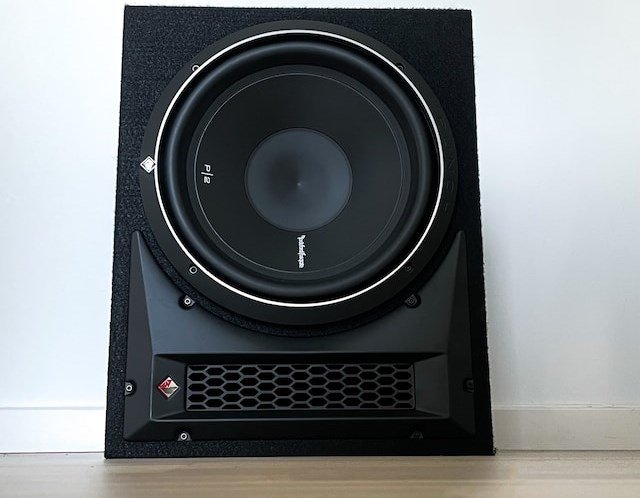
Subwoofers tend to spread their sound omnidirectionally, so you should avoid placing them too close to walls so that the sound spreads evenly. On the other hand, low frequencies tend to generate more reflections when they are placed too close to corners.
The more the subwoofer is placed towards the middle of the room, the better the bass waves will spread throughout the room. Placing it toward one of the corners is usually comfortable, but it won’t necessarily make it sound better. It is always better to place it on the ground, without lifting it or pointing it up.
Some subwoofers usually include an option to go from 360º to 180º sound through a switch. With this tool, you can make the subwoofer only send sound forwards, which can be useful if you are too close to a wall as it reduces reflections. As in many cases where we have to deal with acoustics, there is a lot of trial and error to find the best option.
Calibration is key for the subwoofer to offer its best performance. For this, you must adjust the parameters until you find the best possible setting for your device’s place. The size of the room, the furniture in it, and the consistency of the walls all influence the way sound behaves.
That is why it is important to customize the calibration to the characteristics of each place. Some subwoofers have the option of automatic calibration. However, being guided by your judgment when perceiving the sound is highly recommended.
What is The Difference Between a Subwoofer And a Woofer?
A woofer is a speaker designed to reproduce low and medium-frequency sounds. It can bring power and clarity to an audio system. On the other hand, a subwoofer operates in a similar way with the difference that it focuses on a specific lower frequency range.
The first clear difference between a woofer and a subwoofer is the frequency range of each speaker. While the woofer works between 40 Hz and 2 kHz, covering both low and medium frequencies, the subwoofer’s capacity is centered between 20 Hz and 200 Hz, focusing on a much shorter range without covering medium frequencies.
This difference in the frequency range is responsible for defining the character of each device. A woofer can define low and medium frequencies through its sound, thus achieving a more powerful and spacious sound. This makes it a marked improvement in any audio system to which it is added.
The subwoofer, on the other hand, brings more dimension and character to the sound, focusing on sounds that can make things vibrate. This is because the low frequencies have a more perceptible sound pressure level at a lower volume, which means that through a subwoofer complemented by the speakers in charge of reproducing the medium and high frequencies, the sound becomes heavy and deep either.
A woofer and a subwoofer can work together and can be very useful when it comes to setting rooms, especially large and medium-sized ones. The main thing is that the EQ of the sound system and their location are conducive so that the frequencies complement each other and do not cancel each other out.
Conclusion
Subwoofers are devices that can greatly improve the playback capability of your audio system. Used correctly, they can offer many benefits for a reasonable investment of money.
Several factors can cause high temperatures in subwoofers. It is important to keep in mind what the main causes are to solve it more quickly and avoid possible damage. Following the detailed instructions in the manufacturer’s manual and not exposing your subwoofer to risks will extend its useful life.
Excessive power and prolonged use are the main causes of temperature and general wear on subwoofer components. Keeping these issues in mind and trying to control them, you will avoid most of the problems that may arise. I hope this article is very helpful to you. Thanks for your time!

The Integraudio Editorial Team consists of experienced music producers, audio engineers, and plugin enthusiasts dedicated to providing in-depth reviews and guides for music production software.