
What Is Modern Hip-Hop?
Modern Hip-Hop really does cover a lot of ground. In this tutorial we will be focusing on a style similar to that of Kendrick Lamar, Tyler The Creator and Denzel Curry.
This has a much more live feel to it, and more organic sounds blended with electronic sounds. It has a real character to it.
The biggest part of what makes Modern Hip-Hop what it is is not having everything sound synthetic and perfectly in time. It’s about the groove, the sonic textures, and the live feel. It’s really a blend between a live band performing and programming beats. For me, personally, to get a more live feeling, I am going to record live guitar and bass, purely as those are my main instruments. But I encourage you to record any instrument you can play.
Another key aspect of this style is where the influences are coming from. Here it’s a broad range, but you can hear influences from:
- Jazz
- Gospel
- Funk
- Psychedelic Rock
- Neo Soul
The chords used are very much inspired by the Jazz influence. Rather than using simple minor or major triads, you’ll often hear more ‘Jazzy’ chords, such as 7ths, 9ths, 11ths, and more. Don’t worry if you don’t know what I am talking about, I’ll get more in depth about how these chords are formed and used. For now, I just want to acknowledge that there is a bit more complexity in terms of the chords and harmonies used in Modern Hip-Hop.
I’ll be using Ableton Live 12, but you can use any digital audio workstation that you prefer.
Producing A Modern Hip-Hop Song
Often when writing in this sub-genre, you don’t write each section independently. What I mean by this is that each element is influencing the other. So you may start with drums, for example, and get a beat going. Then maybe you write some chords on a keyboard to play over the beat, but you feel that the keys are dictating a different rhythm, so you rewrite the drums to fit. And so on with each element.
To represent this process truly in writing isn’t really possible. Instead as I go through each section I will talk about how each part interconnects with each other. I just wanted to mention this before starting so that you know how important it is to consider every element when writing. Let’s start with chopping up our sample.
Samples
For samples, this can be the part where people producing Modern Hip-Hop get a bit overwhelmed. There’s so much choice out there and finding the right sample to use in a song is a skill in itself. I had a long look through some samples on Splice, specifically searching for chord and melody samples. I stumbled across this one below.
I love the way this sounds, and as I was listening to it I was mentally picking out the parts I wanted to use in the beat. There’s a couple of ways you can go about chopping samples. You can manually chop up the audio clip and place it where you want, and pitch it how you want. Or you can load it into a sampling instrument in your DAW, one which has the ability to slice up the sample and play it back on different keys. I’ll be using both techniques to show you each way.
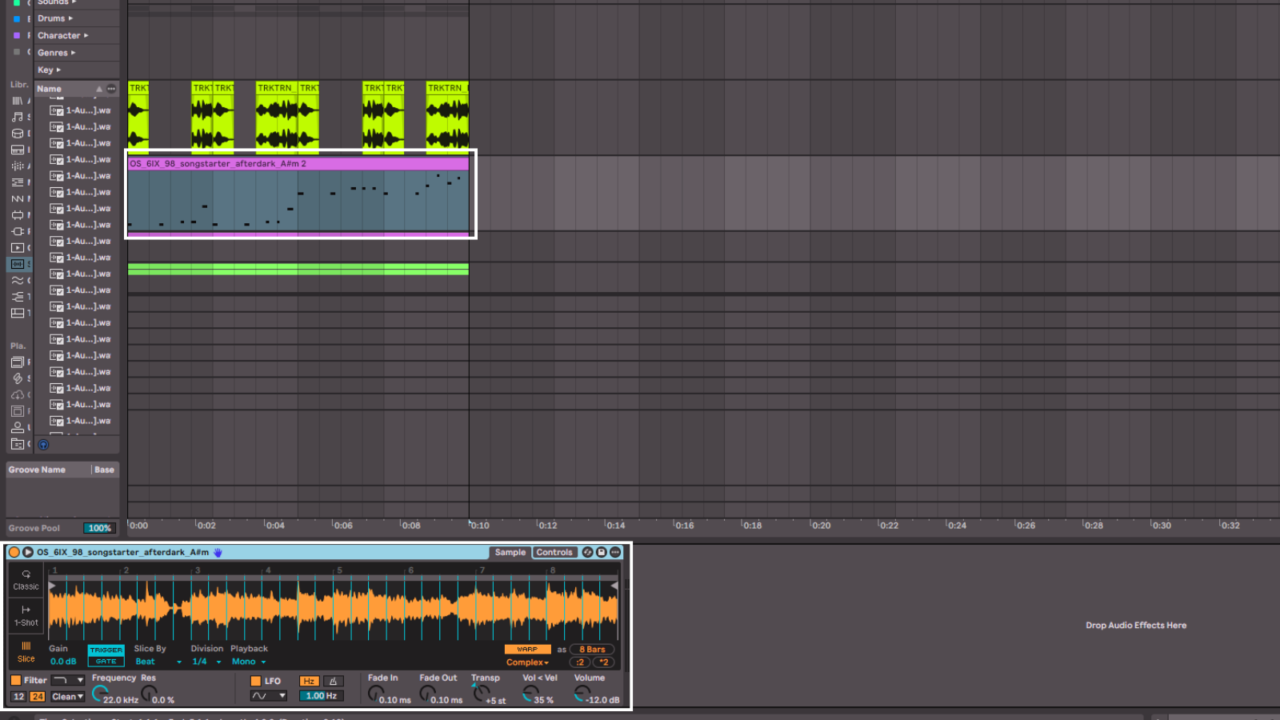
First, let’s start with using a sampler. I’ll be using Simpler, which is a stock plugin in Ableton Live. By choosing the slice option, selecting “Slice By: Beat”, and choosing the division (the space between splice cuts), I can then play the sample out on a MIDI device. I personally enjoy playing sample chops using a MIDI device with drum pads, as it feels more like a traditional sampler, so I am using the Novation Launchpad Mini here.
I transposed the sample up by 5 semitones, just as I liked the way it felt there. After playing around with the chops, I ended up with this:
This is what the whole track is being based off of. The rhythm of the chops will dictate the drums, and of course the chords in the sample will dictate what chords and bass notes will be used.
The other sample I found was a vocal sample of someone shouting. This is intended to be more of a background element, I just liked the energy it brought. So I chopped it up by listening through and cutting out the parts I wanted. Then I used those parts to arrange some kind of rhythm that complimented the sample chops above.
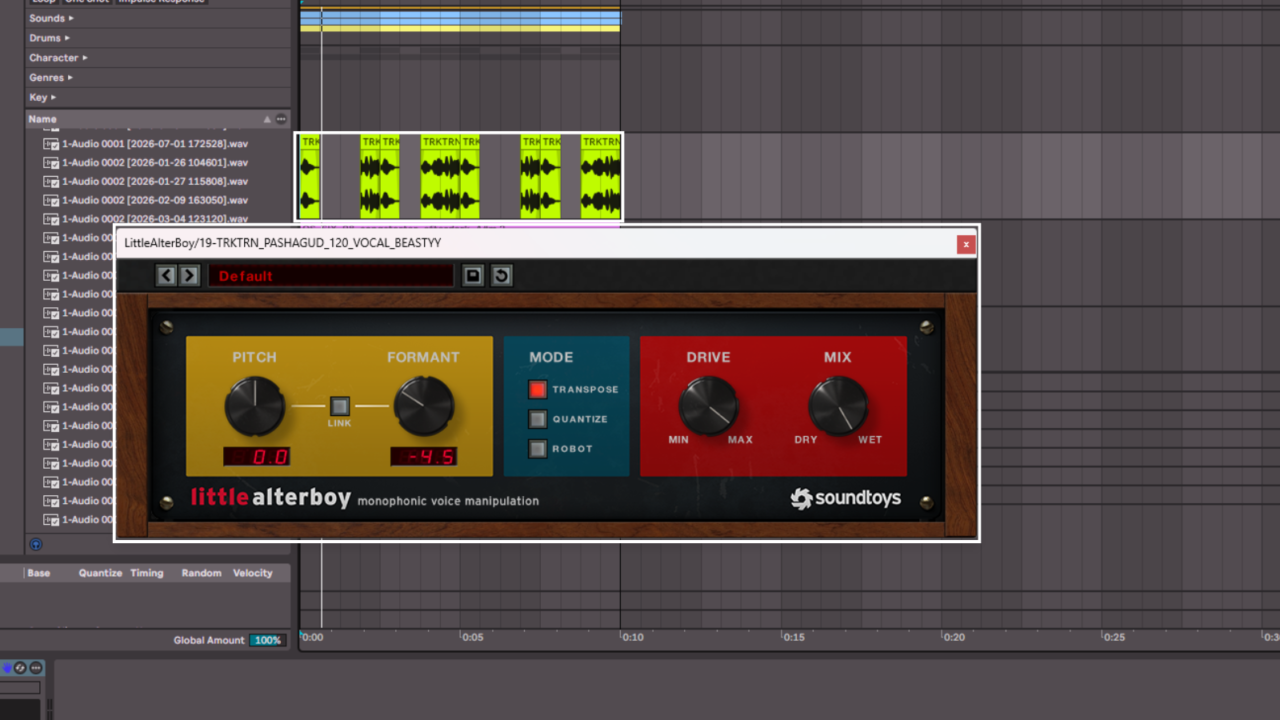
For processing, I just slapped on Little Alterboy by Soundtoys. This allows you to change the pitch and formants of the vocals, as well as add some distortion. As you can see below, I’ve not touched the pitch, but I’ve lowered the formants a bit, which gives the vocal a deeper and thicker quality. I’ve also absolutely smashed the drive here to get some intense distortion. This gives the already energetic sample more energy, plus it softens the transients of the sample so it works a lot better in the background.
Keys
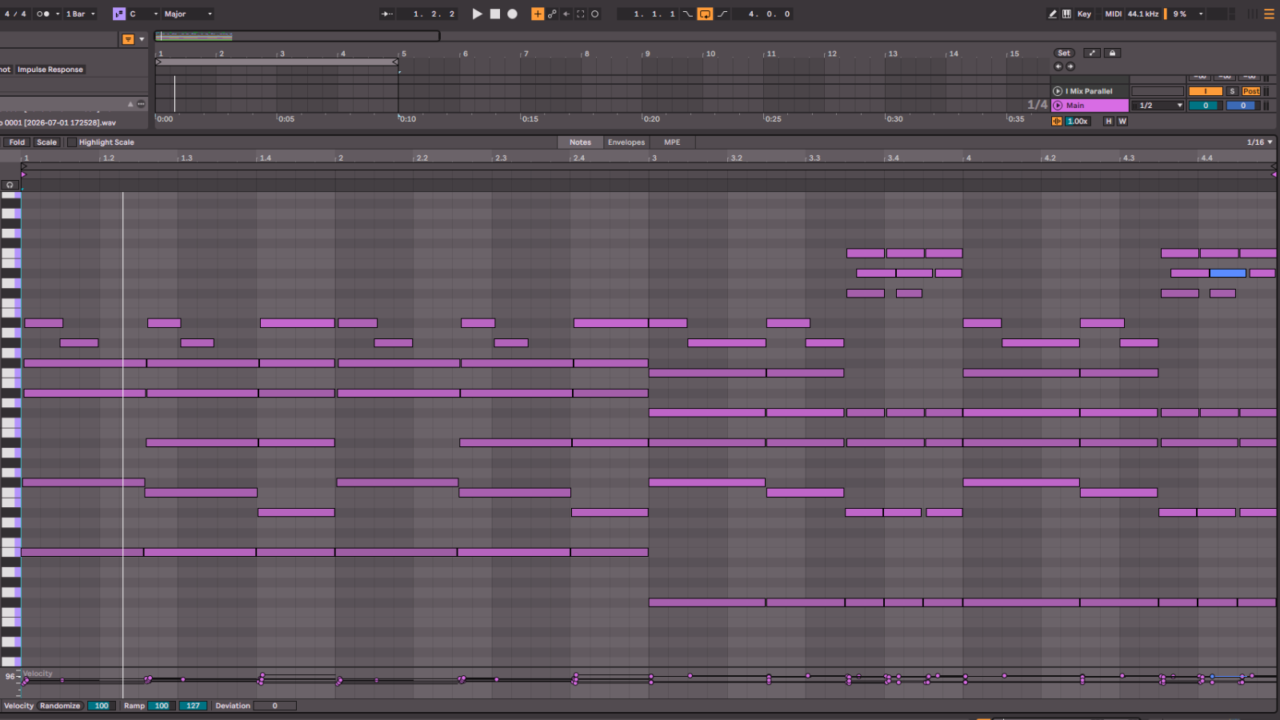
For the chords being played on the keyboard, it’s very much based on the sample in its most basic form. There’s two chords, but the chords themselves have embellishments throughout.
Let’s start really basic. Forget about all the MIDI notes you see up there — in its most simple form we have a B Major and a F# Major. These are just the two chords that the sample was using.
I won’t go too technical here, but a Major chord (or triad) is made up of three notes of the scale of the key: the root note, the major third, and the fifth. For B Major this is B, D#, and F#. You can play these notes in any order of pitch — they are all variations of the same chord.
If you look above at the MIDI you will see these three notes for each chord. I’ve then also added the seventh note of the scale (for B Major it’s A#), so the chord becomes a B Major 7. This instantly feels more ‘Jazz’. Then to add interest I’ve added little melodies within the chords which are simple enough to not be the main focus, but add a nice bit of movement. Some of these melodies are further based on the sample, others are just parts I wrote to fit the vibe.
To get a more live sound I am going to play the chords on a midi controller to get a more human sound. I can use the velocities and timings to really add a groove and character to this part.
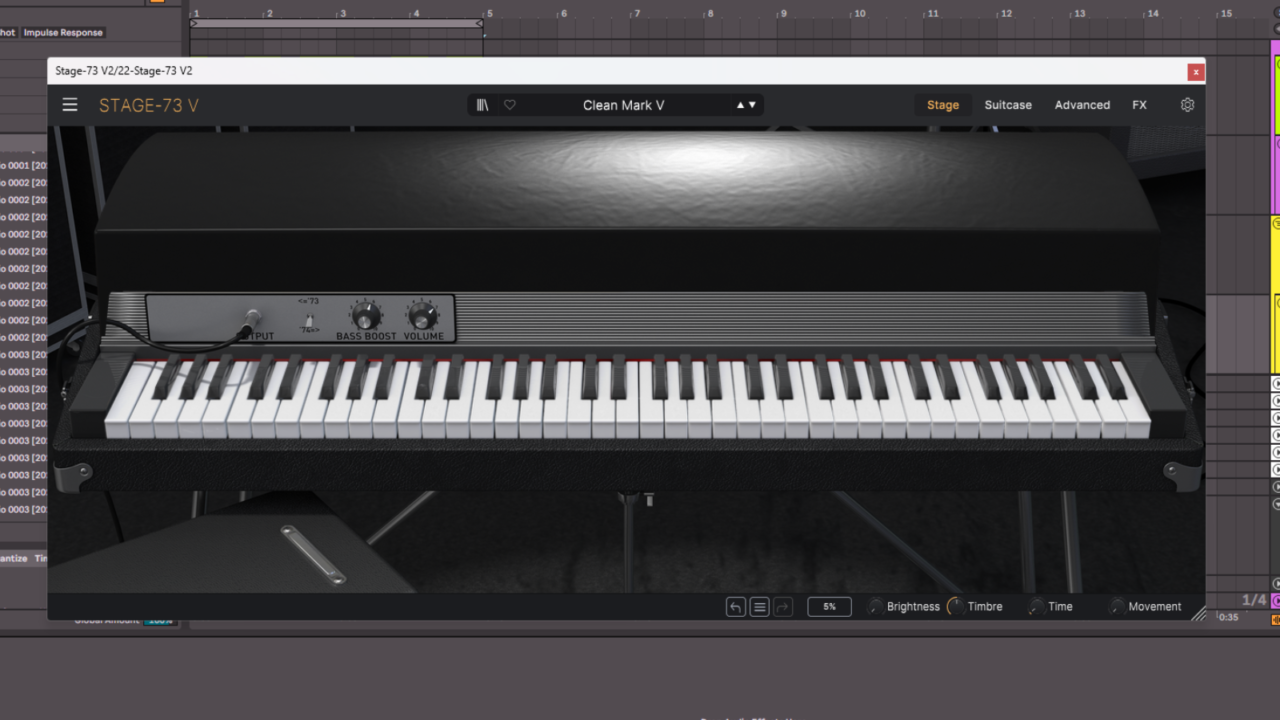
The instrument I am using here is the Stage 73 by Arturia, which is a wonder Rhodes virtual instrument. It’s a classic keyboard sound and has a character to it that you’ll hear in a lot of Modern Hip-Hop. If you want to listen to some other Rhodes style virtual instruments Berk has done a review of the 10 Best Electric Pianos Here!
Drums
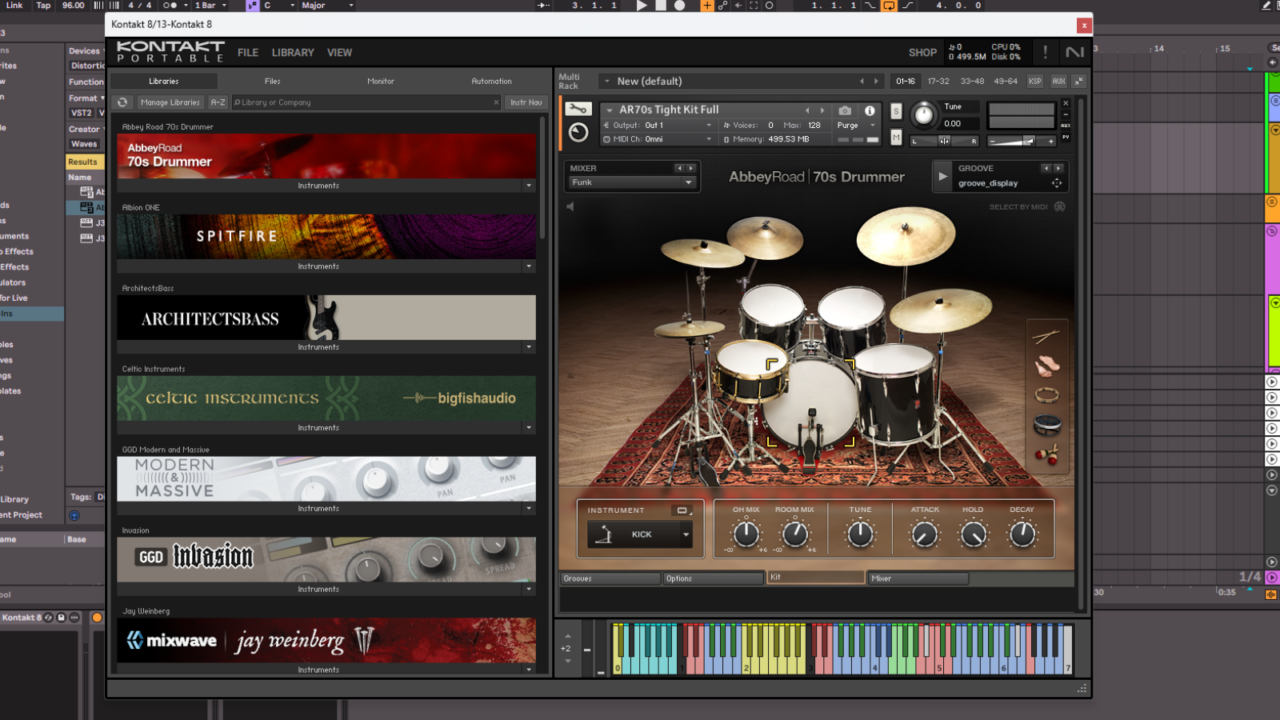
For the drums, I started off by writing them using a drum library, to get a more acoustic and live sound from the start. Here I am using the Abbey Road 70s Drummer library by Native Instruments. Of course, use whatever you have or want to. For me this kit just sounds really great in Modern Hip-Hop, and has more of a warm and analogue feel to the way it was sampled.
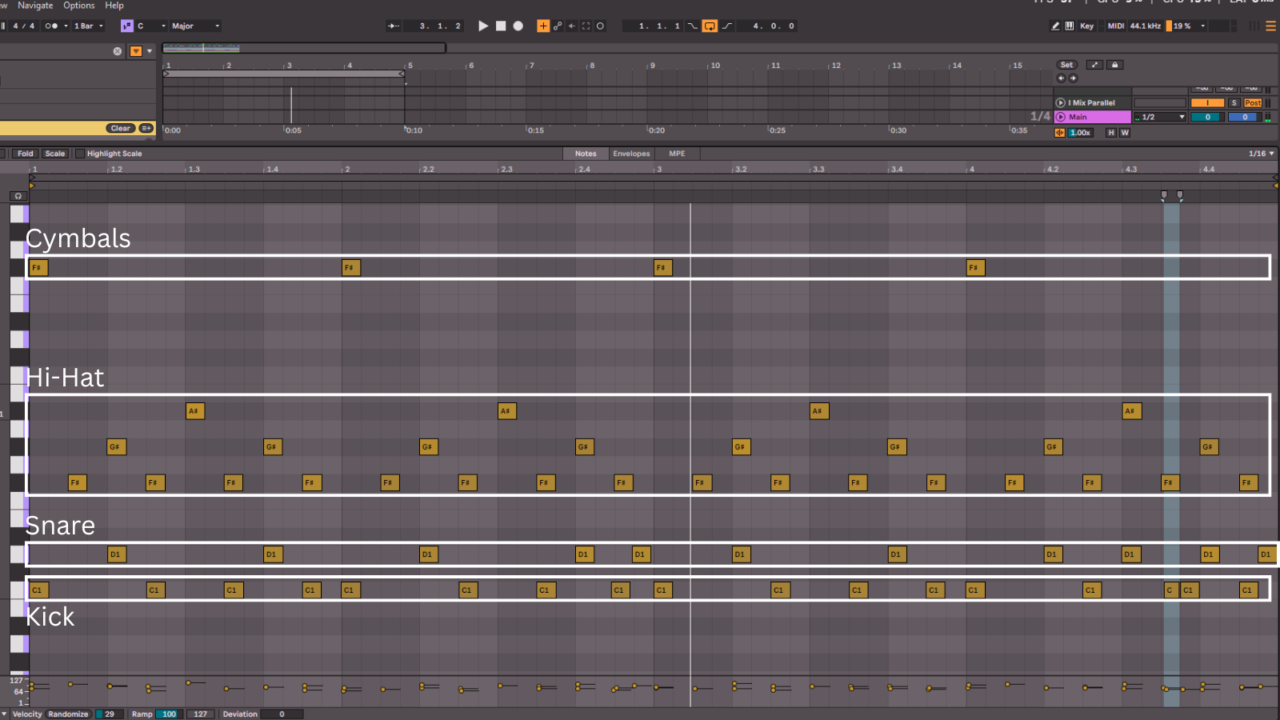
Here is the beat I ended up with, which remember was based on the rhythm of the sample chops.
The kick is what is mostly defined by the sample chops. I wanted each of those chops to have a kick hit, then I added some extra ones in to solidify the groove and add interest.
The snares are mostly on beats 2 and 4, which some variations in there. Then the hi-hats are actually triggered through 3 different samples. The lowest is the most closed hi-hat, the middle is a loosely closed hi-hat, and the top is fully open. This really helps to accent the groove and adds the variation needed to keep this feeling live.
Finally I have a crash at the start of each beat just to add a bit of impact. After playing around with the timing and velocities until I was happy, I ended up with the MIDI below.
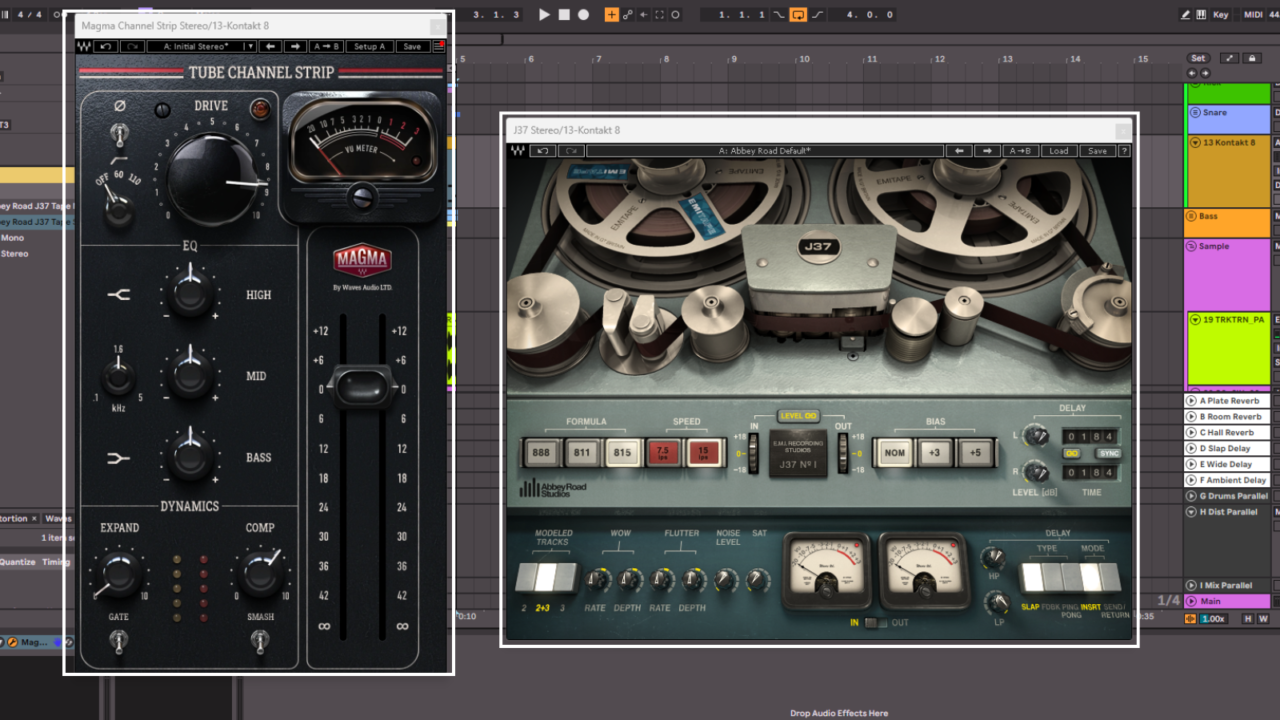
The processing on the drums are pretty simple. I have the Magma Tube Channel Strip by Waves adding some saturation and compression, then the J37 Tape Emulation by Waves to add another layer of subtle saturation and get the whole thing feeling more glued together, warm, and analog.
Here’s how it sounds after processing:
Now that we have a solid beat, it’s time to thicken it up. Let’s add some kicks to beef up the low end. The samples I chose are based on what I felt was missing from the kick. I found a sample with a lot of low end thump, and another with a lot of high end attack. Blended together with the drum library the kick starts to sound way more full and modern.
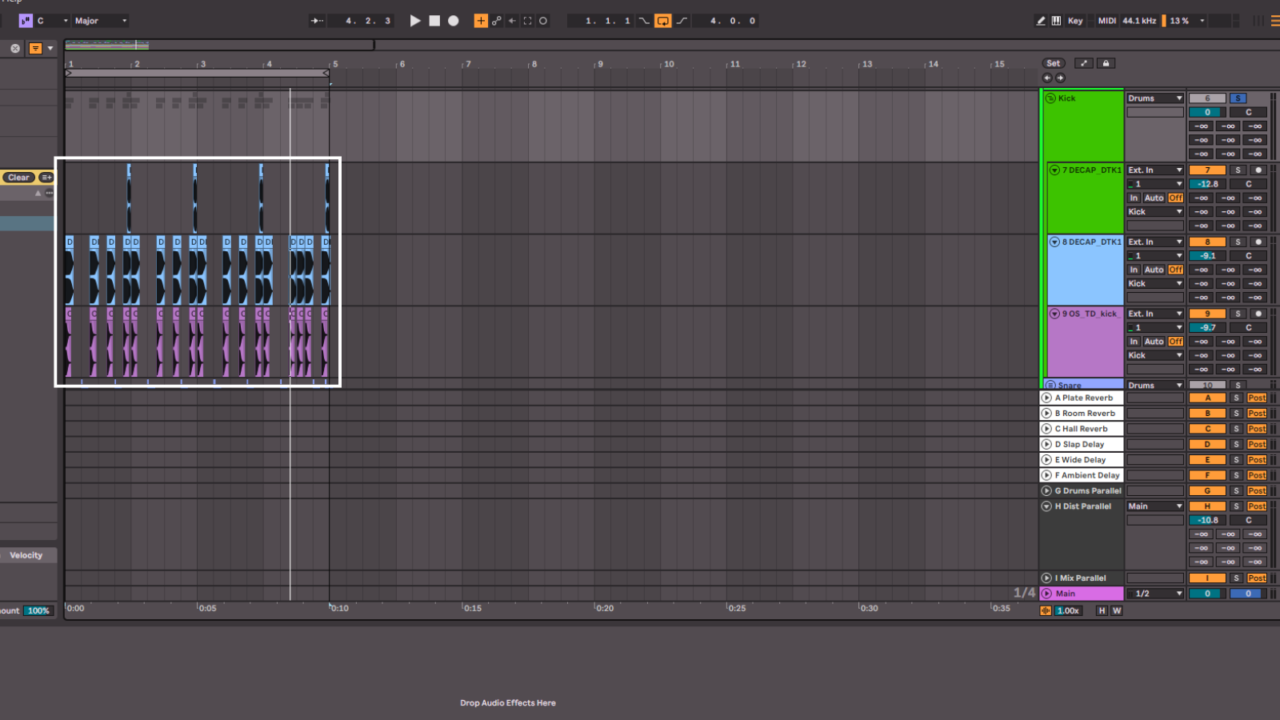
I also took the low end sample, reversed it and shortened it to act as a swell up at the end of each bar. This is a classic Hip-Hop trick, made famous by Dr Dre, and it really creates a pushing and pulling effect for the beat. This is what the kick samples sound like on their own:
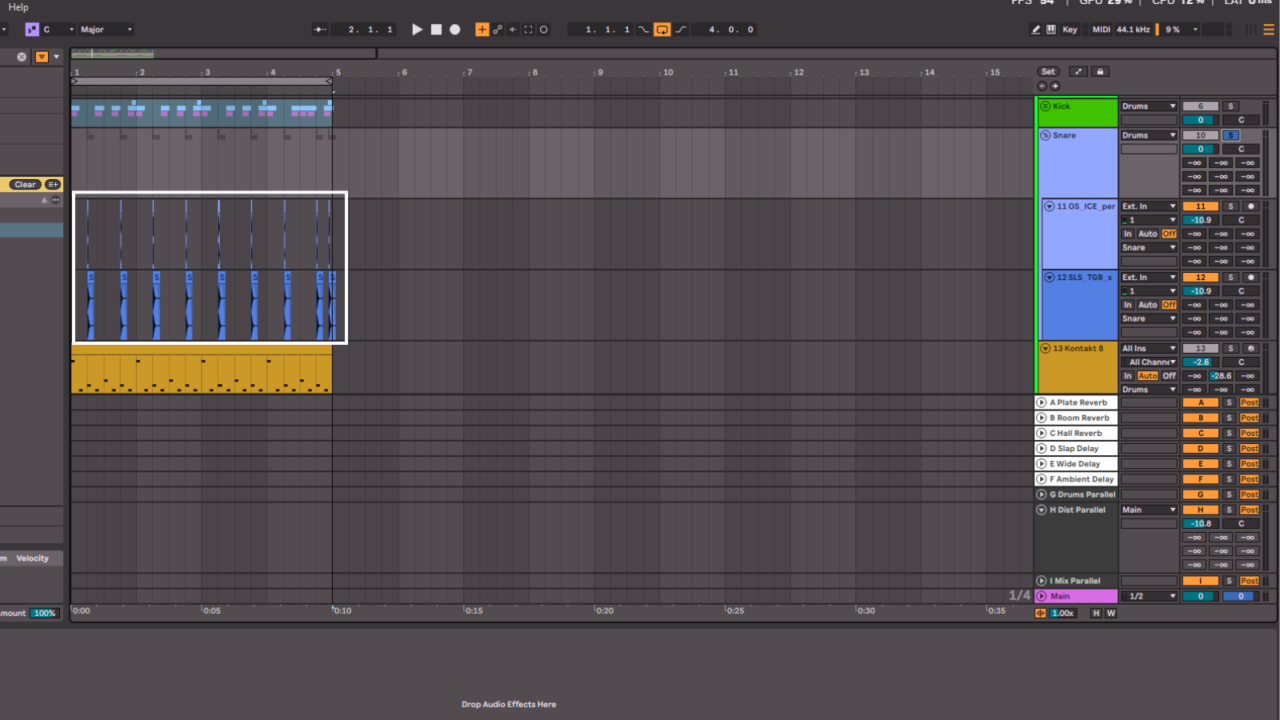
Then I wanted to add more snare sounds to round out the beat. The kick and the snare are the core of the beat so it’s important that they hit hard. One of them is a more mid range sample, almost with a nasal quality, but supports that area of the frequency range for the snare that I felt was lacking. The other is a vintage acoustic snare sample, with a nice round top end. Together they sound like this:
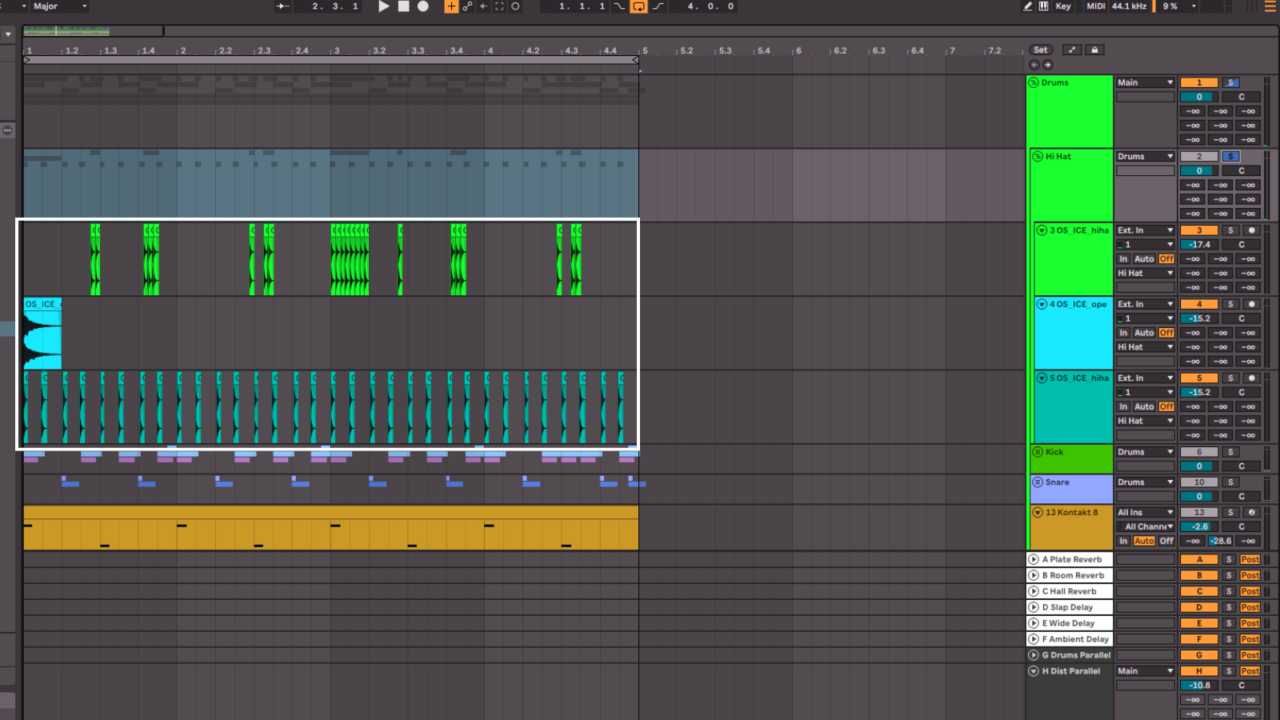
With the hi-hats, this is where I really start to fuse the modern with the raw character of the sound. I’ve got one open hi-hat sample at the start of the phrase to just open up the beginning and add a bit of sparkle at the start of the beat. Then I have two closed hi-hat samples, with one playing on every eighth note and the other coming in for faster fills.
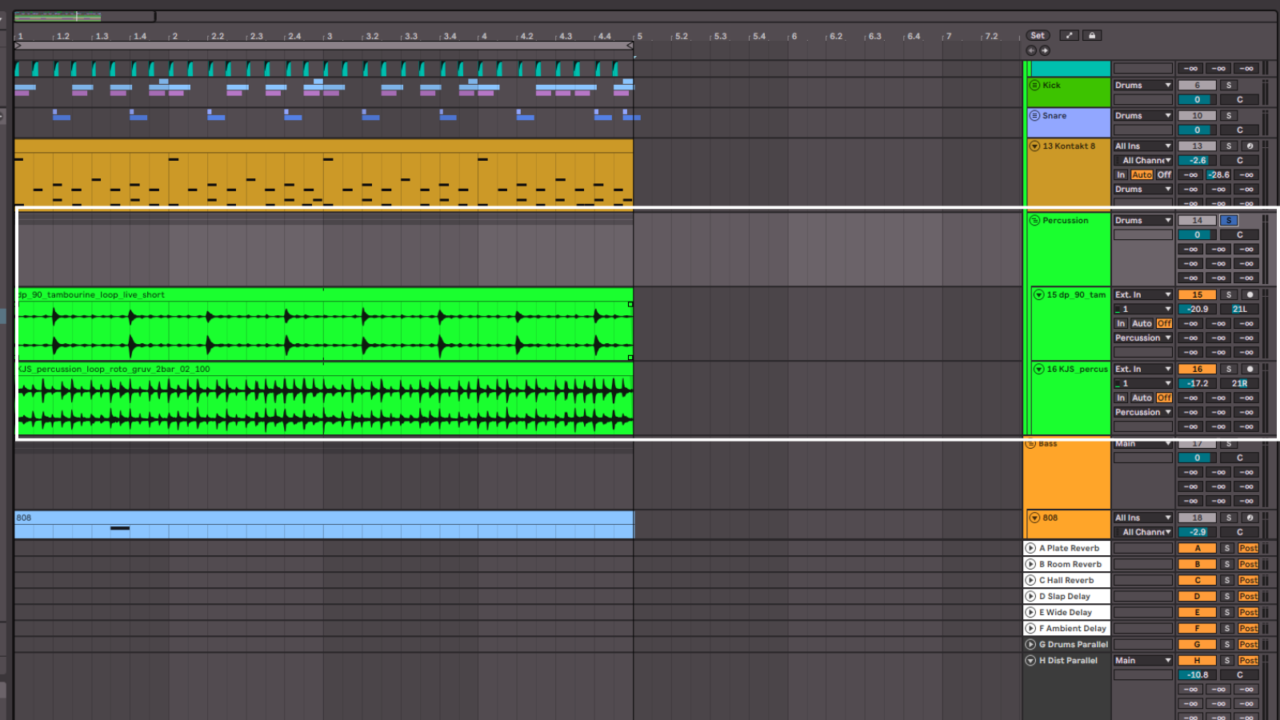
Finally I wanted to add some percussion to add some more life to the beat. There are two samples panned slightly left and right to enhance the stereo image. One sample is a tambourine and the other is some metal percussion being played. These are loops I found on Splice that were recorded live. It’s subtle but really helps to bring out the human element.
So with all of these drum parts together, we have this:
Bass
For the bass in a Modern Hip-Hop track, I have a mixture of three different sounds: an 808, a sub-bass, and a bass guitar.
The 808s and sub-bass here is used to really anchor the low end. Playing on the main beats, as you can see in the MIDI below.
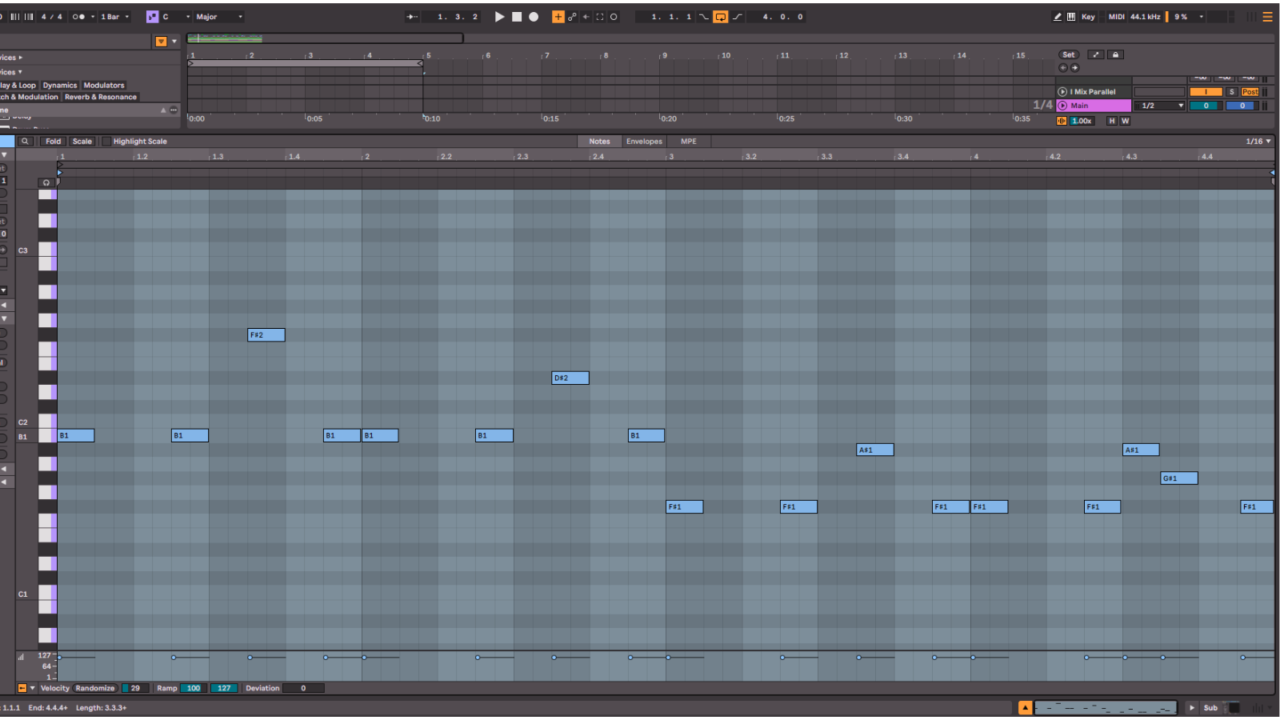
For the 808 sound I found a one-shot sample that I liked and placed it into the sampler in Ableton Live. I liked how gritty it sounded, but still had the weight that you want from an 808.
The sub-bass was created using a similar process, and this really is more felt than heard in the mix. It’s providing all the low end frequencies that the other elements can’t.
Then the bass guitar is almost used as a filler between those main beats, with some improvisational lines to add more interest in the low end.
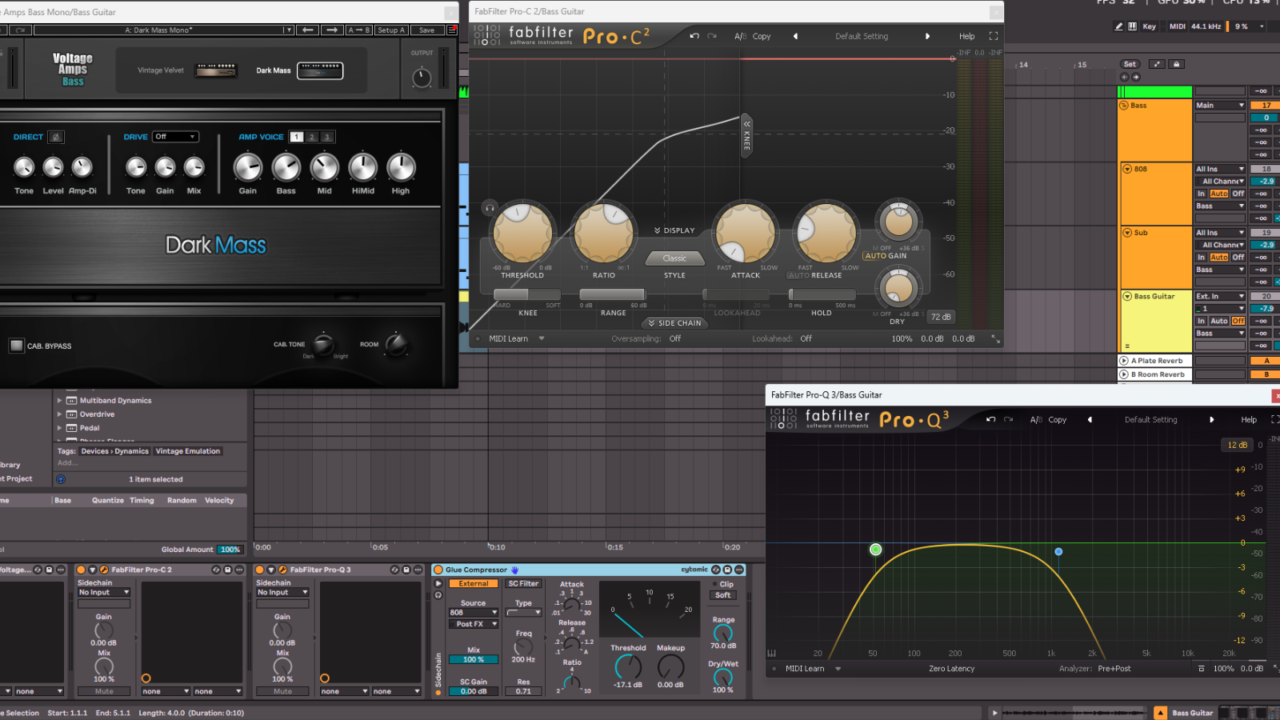
In terms of processing the bass guitar, I used Voltage Amps Bass by Waves for my amp sim, then compressed it a healthy amount with FabFilter Pro-C, and cut a lot of high-end and even some low-end using FabFilter Pro-Q. The bass guitar is intended to be an extra layer, not the main bass sound, so by removing those clashing frequencies we ensure it doesn’t clutter up the low-end.
Conclusion
All together, with a quick mix, we have this:
So now that you have the building blocks of a Modern Hip-Hop track, you can start your own! Modern Hip-Hop rewards experimentation, so don’t be afraid to bend these techniques to fit your own sound. If you can find a rapper to work with, even better, as that’s when your music will really come to life.

I am a music producer, songwriter, mixing and mastering engineer, sound designer, composer, multi-instrumentalist, vocalist, and musical artist. Yeah, I know, it’s a mouthful. Basically, if it involves music, I am super into it. I recently became a full-time freelancer in the music space, having dabbled in it for around 10 years. I started playing guitar at 7 years old, and I am now almost 30 (almost!). Music has been a main part of my life since I formed memories. I literally cannot remember a time before music. I adore every aspect of creating and working on music, from starting a song to mastering and polishing the final piece. It’s all incredible.
I’ve worked on many projects over the years, including my own. I release pop/indie music where I do everything, from writing to recording to mixing to mastering, and I even create all the content around it. I do this under the name Mauve Shores. A big passion of mine is metal/alternative music, so I release music with my band Midnight Paradise. The band is literally me and my best mates, so it’s super fun. I do everything except for play drums and bass in that. The final project I release under is called Heavy Blink, and I put out LoFi Beats. I’ve even had tracks reach over 250k streams on Spotify.
Outside of my own projects, I have worked in a variety of genres. I’ve written, produced, mixed, and mastered pop songs for the artist No False Feelin’, one of which got in the UK Top 40 Spotify playlist and has almost 1 million streams. I currently create drum and bass remixes for a client, some of which have over 2 million streams. I’ve done mixes for events such as a dance recital and a business event. I’ve also done some audio cleanup and sound design for a live voice over group that do their anime in person. Right now I am working on a mixture of my own stuff, and with clients. For example, I am beginning to produce, mix, and master a death metal album, and also at the same time a teen pop style song. I love the variety that comes with this line of work.
I am also super nerdy about the gear and technology revolving around music. I could talk for days about my favorite plugins for specific things. Don’t even get me started on EQs. I began as just a guitar player, so my gear obsession has definitely been more towards pedals, but the more I got into production, the more this expanded to everything.
Outside of music, I am into a lot of different things. I love to connect with nature, whether this is through hikes or even making terrariums. I really enjoy skateboarding, playing rugby, and running. I’m also into creating things in general, I always have some DIY projects going, whether that is woodwork, or electronics. Before going full-time as a freelancer, I was a software developer for 6 years, so programming is something I still enjoy and do in my free time. Of course, we can’t forget about how much I enjoy spending time with my wife and my friends.