
People tend to be curious sometimes, and we get interested in doing things we aren’t supposed to do by some unwritten rules that aren’t even real rules.
When you hear terms like “electric guitar” and “acoustic guitar amp,” it is not imaginable for them to work in a symbiotic relationship with each other. The unwritten rule says that only electric guitar amplifiers work with electric guitars and that you can’t plug your electric guitar into an amplifier made for acoustic guitar or acoustic into an amp made for electric guitar. This article will explore the possibilities of connecting the electric guitar through the acoustic guitar amplifier and many more.
So, Can I Play The Electric Guitar Through The Acoustic Amp?
Yes, because the reason is that an acoustic amplifier works like a PA system, unlike an electric guitar amplifier that tends to distort the sound waves, thus creating the more mid-range based tone. You need to know there are certain limitations regarding tone versatility.
To simply put it into perspective, the acoustic guitar amplifiers are there to produce crystal clear sounds without making any distortion. Acoustic guitar amps have a different frequency response than amps used for amplifying other instruments. Acoustic amps are perfect for playing bars, restaurants, or any other minor gig that doesn’t require much power.
Will I damage the acoustic amp speaker if I plug an electric guitar?
No, because the primary function of the acoustic guitar amp is to make your guitar louder rather than modifying the input sound. You could plug in any other instrument out there since the acoustic guitar amplifier has a very wide frequency range, and those actions would be very safe.
Numerous jazz musicians are going straight into acoustic guitar amplifiers with their electric guitars, primarily because this type of amplifier gives them the most sterile sound possible. You may experience some loss at different frequencies, which can be unpleasant sometimes. The only thing you need to have on your mind is to pay attention to the volume and how much you drive the amp because, like any other amp, you could blow up the speaker.
Many acoustic guitar amps come with two or more inputs with separate sound controls, which allows you to connect two or more instruments simultaneously. That will be perfect if you want to sing and play the guitar, and still, you don’t want to have another amplifier with you.
To sum everything up:
- No damage to the speaker or amp whatsoever,
- Expect a thinner, non-shaped sound,
- Suitable for jazz.
- Good for multi-instrument/instrument-vocal amplification
What would my electric guitar sound like with the acoustic amp?
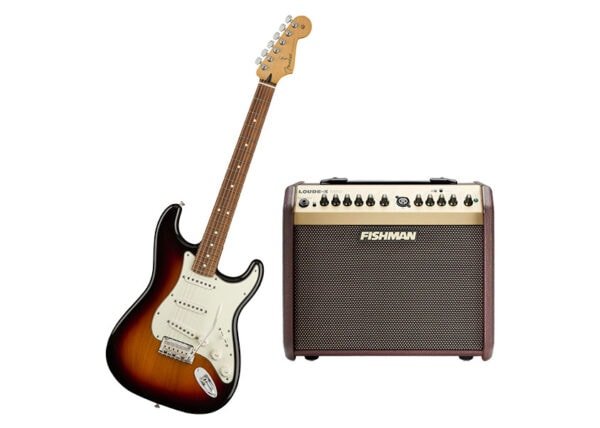
Your electric guitar output sound will be a lot thinner in the case of an acoustic guitar amp. Acoustic amps tend only to make the sound louder rather than distorting it. It means that frequencies behave differently than the electric guitar amp frequencies.
It will sound decent if you do not turn the distortion pedal on. Excessive-high frequencies will make the sound come out harsh. If you’re into jazz or any other style based on clean tone, you will be pretty much covered up and be more than satisfied with the output sound.
Okay, if I put a distortion or overdrive pedal in front of the acoustic guitar amp, it won’t sound good, but what is the case with other pedals?
Pedals are very useful for making your electric guitar tone better. The problem is that every amp is different. The identical pedals, in some cases, won’t work the same between two acoustic guitar amps. EQ, Reverb, Delay, and Chorus are the go-to pedals that might make your sound more pleasant.
Can you connect the acoustic guitar to the electric guitar amp?
Yes, you can do it, and it is completely safe. Like you can connect the electric guitar to the acoustic guitar amp. To plug in your acoustic guitar to any amp, you will need an input jack and a pickup or piezo system installed—that way, the amp could pick up the signal.
One thing is certain, don’t you expect a good acoustic guitar tone coming from an amp designed for the electric guitar. Acoustic guitars require much wider frequency span. PA systems or amps designed for acoustic guitar come in much handier in this case.
Are there any other ways to amplify my electric guitar rather than having an actual amp?
Yes, and there are many different ways to plug in your electric guitar rather than having an actual heavy acoustic or electric guitar amp that could take some space in your house or any other place. Also, amps are more expensive than the following alternative methods.
Considering that, here is the list of many different ways you can plug your electric guitar that might suit all your needs.
-
Using speakers to reproduce the sound
This alternative way of plugging your guitar might be the simplest. You can’t just plug in straight into speakers and except to get a sound. If you have good speakers, the only other thing you’ll need is a preamp. The preamp amplifies and sends the signal to speakers, which they process and output the sound. There are specific preamps for this method on the market, made for connecting the electric guitar to your home stereo speakers.
Our recommendation: Line 6 AMPLIFi TT
-
Using headphones to reproduce the sound
Imagine yourself in a situation where you can’t play your guitar loud because everyone is sleeping. Headphones come in handy in that situation. You can play as loud as you want, and nobody will hear anything. It’s the same case as speakers, and you will need a preamp or an audio interface to plug your headphones in. Once you’ve plugged the headphones and your guitar in, you are ready to go. Headphones are also compatible with every way of connecting your electric guitar.
Our recommendation: Beyerdynamic DT990 PRO
-
Using PC to play your electric guitar
One of the ways that you should consider is playing the guitar through PC. You can practice guitar, record it, dial some great tones, and all that for the much lower price of an actual good tier amp. Accompanied with an audio interface and additional software, some free, some not, it is the best alternative out there.
-
Audio interface
The audio interface plays a most important role in playing your guitar through a PC. What the interface does is that it transforms the input sound of a guitar into a format that is recognizable by your PC, so it can process the input sound in the way you want to. Every audio interface has headphones or/and speakers input jack to hear the output sound.
Our recommendation: Focusrite Scarlett 2i2 audio interface
Software
If you want to sculpt the input sound the way you want, record some playing, and edit the tracks, you will need additional software and plugins. The most desirable guitar software and plugins are the following:
- DAW
Stands for Digital Audio Workstation. As its name says, it is the audio workstation where you can do recordings, audio production, arranging, and many more music-related things. Some of the most popular Digital Audio Workstation software are Ableton Live, Logic Pro, FL Studio, Cubase, Pro Tools, etc. Their price on average is about $400, but it can be cheaper because sellers offer many different packages. You can choose the one that suits you and your wallet the best. - Standalone Amp modeling software
Software with many amp sims and lots of effects that you can choose. The most popular Standalone Amp modeling software are Bias FX2, Amplitube 4, and Guitar Rig 5. Some standalone Amp modeling software offers direct recording without requiring any DAW. - VST Plugins
Perfect if you know the exact amp model or effect you want. For example, suppose you desire a certain amp and don’t want any other. In that case, you will buy or download only that one amp model, unlike the Standalone Amp modeling software, where you have many different amps, cabinets, and effects you might not need. You can also find some good free VST Plugins compatible with any DAW, and it is important to know that this might be the cheapest solution for you.
Using iOS device
Yes, you can even use your mobile device to play, record and practice your electric guitar. But you can’t just plug your guitar straight into your mobile phone. Instead, you will need a small audio interface called iRig, designed for compatibility with iOS-powered mobile phones. Alongside the iRig device, you will need to download the IK Multimedia Amplitube app that comes in free with purchasing the iRig device.
After downloading the app, you need to connect your iRig to your iOS device with the 1/8″ TRRS adapter. Then, plug in your guitar and headphones, and you are ready to go.
The device also comes with the 1/4″ output jack so you can connect it to an external amp, extending its possibilities.
The next table is about different guitar amplification methods and their comparison in everyday use regarding budget, simplicity, and more.
| Type of amplifier | Good for practice | Suitable for recording | Simplicity | Budget | Can you gig with it? |
| Standard guitar amp | Maybe, if not loud | Yes, but with the additional microphones | Not that practical | $-$$$ | Certainly |
| Home stereo | Yes | Probably not | Fairly Practical | $-$$ | No |
| Headphones | Yes | No | Very practical | $ | No |
| PC | Yes | Yes | Very practical | $-$$$ | Yes, if you have a good laptop |
| iOS | Yes | Yes | Very practical | $ | Yes |
Is it worth practicing electric guitar without an amp?
No, the electric guitar is very quiet by itself. Even if you have a semi-hollow electric guitar, it’s not enough volume you can workaround. The simplest thing you can do is getting a small practice microamp that could also provide you with distortion, one of the most used effects in music history.
Microamp
Microamp can be a cheap alternative for the standard-size guitar amplifier used only for practice. Their advantage is that they are very simple to use because you only need the device powered by batteries or a 9V DC adapter. One more advantage is that you can use them to listen to music and make it act like a portable speaker. You could play with or without headphones, depending on the situation. But it is recommended to play it through the headphones because microamp speakers are tiny and quiet. Another great thing is that they’re lightweight and portable so that you can practice anywhere and anytime. Almost every microamp provides the aux input so you can jam along to music you like.
Here are some examples of good sounding microamps:
Bottom line
People tend to be very curious sometimes, which makes us people. We have many things to ask, many things to answer, and many more things to try out. We won’t know unless we try something, even if it’s something that isn’t worth trying. This topic is just all about that. Unless you try, you wouldn’t know even if it seems impossible. Who would know that you could actually connect the electric guitar to the acoustic guitar amplifier and even make it sound decent?
I hope you learned something and overcame your dilemma of whether you can or can’t plug in the electric guitar into an amplifier made for the acoustic guitar. This article also explored many other ways you can plug your electric guitar, which could be very helpful if you are looking for an alternative to the actual electric guitar amp for practice or any other use. Thank you for tuning in, and stay safe.

The Integraudio Editorial Team consists of experienced music producers, audio engineers, and plugin enthusiasts dedicated to providing in-depth reviews and guides for music production software.