

If you’re curious about the audio plugin industry in 2025, here is all the necessary info and statistics!
If you’ve opened a DAW anytime in the last decade, chances are your project window is stuffed with plugins. These little pieces of software have gone from being handy add-ons to absolutely essential tools for music, film, gaming, and even live broadcasting.
In 2025, the plugin industry isn’t just alive and well; it’s thriving. From virtual instruments to AI-driven mastering assistants, plugins are shaping the sound of everything we hear.
The interesting part? It’s no longer only about the big studios. Home producers, indie filmmakers, game designers, and podcasters are all pushing demand higher. That’s why the plugin market is expanding at a steady pace, with billions of dollars in play and some fascinating shifts happening under the hood.
In order not to make things more complicated and hard to understand, well, we are musicians, not statisticians or economists, I won’t throw lots of numbers at your face, but talk more about the interpretations and the outcomes. But, if you need the numbers, here are the reference statistics!
Market Growth and Size
The audio plugin industry is currently valued at around $1.37 billion in 2024 and is expected to grow to about $2.28 billion by 2033. That’s a solid compound annual growth rate of 6.6%, which shows that this is no passing trend. It’s an ecosystem that’s maturing while staying innovative.
What’s interesting is that growth isn’t coming from just one place. Traditional music production still dominates, but there’s a rising demand from sectors like film post-production, gaming, and broadcasting. Independent creators are also fueling a fresh wave of purchases. More bedroom studios mean more DAWs (Digital Audio Workstations), and more DAWs mean more plugins.
On top of that, new technologies like AI-based noise reduction, spectral editing, and immersive audio tools are helping the market expand even more. It’s clear why this sector keeps growing, and it doesn’t seem like it’s slowing down anytime soon.
The Role of DAWs in Shaping Plugin Usage
It’s impossible to talk about plugins without mentioning DAWs. Digital Audio Workstations are the backbone of modern production, and each DAW has its own ecosystem that nudges users toward certain plugin formats. For example, Logic Pro users are tied to Apple’s Audio Units format, while FL Studio, Ableton, and Cubase prefer VSTs. Pro Tools is still the stronghold for AAX, especially in professional post-production houses.
This means plugin usage isn’t just about features or pricing; it’s also about what’s compatible with your main workspace. If you’re a beginner using FL Studio, you’ll likely build a collection of VST plugins. Meanwhile, a sound engineer working on Pro Tools for film or TV production will focus on AAX tools that offer precision.
Even the popularity of DAWs shifts the market. As Ableton Live and Studio One continue gaining ground, the demand for cross-platform compatibility only grows. That’s something worth considering if you’re just getting into the game or planning to upgrade your tools.
When it comes to plugin formats in 2025, the landscape is both predictable and constantly evolving. VST still holds the crown, dominating the majority of installations and purchases worldwide. Its versatility and compatibility with most major DAWs make it the go-to choice for many producers.
Audio Units also hold a significant share, particularly in macOS environments where Logic Pro dominates. Plus, GarageBand continues to introduce new users to this ecosystem, which helps keep AU relevant.
As for AAX, it remains a niche format favored by professional studios in industries like film, TV, and broadcast. While it doesn’t have the same volume as VST, it’s still crucial in areas where Pro Tools is a non-negotiable standard.
RTAS, on the other hand, has faded into legacy status. It’s still used in some older systems, but it isn’t a major player anymore. At the edges of the market, newer formats like CLAP are starting to gather interest, particularly among developers looking for more flexibility and open standards. While it’s not yet a mainstream force, it’s exciting to see how the plugin world keeps evolving.
Application Segments: Music, Film/TV, Gaming, and Broadcast
The plugin market isn’t just about music anymore. While music production still accounts for most of the revenue, the industry has expanded into a lot of different sectors. For example, film and television post-production teams need precise tools for noise reduction, spatial audio, and advanced reverbs to place dialogue in the right acoustic environment.
With the growth of streaming platforms commissioning original content, demand for post-production plugins has risen significantly.
The gaming industry is another exciting area. As VR and immersive audio become more common, game developers rely heavily on plugins to create realistic, three-dimensional sound. Whether it’s footsteps behind you or environmental effects reacting to gameplay, plugins are key to making game audio believable and immersive.
While broadcast and live sound make up a smaller share of the market, their needs are critical. Plugins that ensure loudness compliance, provide real-time mastering, or guarantee stability under live conditions are essential. With the explosion of live streaming and online broadcasting, this segment’s influence has never been greater.
Overall, it’s clear that the audio plugin industry is growing and diversifying. Whether you’re a music producer, sound engineer, or game developer, there’s a lot to look forward to in this space.

Waves CR8 Creative Sampler
Regional Insights and Global Market Distribution
Looking at the market geographically, North America continues to lead the way. Home to many of the biggest plugin developers and some of the most active professional studios, it dominates revenue and shapes many of the industry’s trends.
Europe follows closely, with countries like Germany, the UK, and France serving as hotbeds for both music technology development and professional production. Educational institutions in Europe also play a key role, training the next generation of producers and engineers who become plugin customers early in their careers.
However, Asia-Pacific is where the fastest growth is happening. The boom in home recording, fueled by affordable computers and mobile-friendly DAWs, has created a new wave of producers hungry for plugins. Countries like Japan, South Korea, and China are also seeing strong uptake in professional media industries, with local developers starting to enter the scene as well.
Emerging markets in Latin America and the Middle East & Africa are smaller for now, but they’re gaining momentum. As internet infrastructure improves and global access to DAWs and plugins becomes easier, these regions are expected to contribute more significantly to the overall market in the coming years. The real story here is that plugin adoption is no longer concentrated in just a handful of territories; it’s becoming a truly global industry.
Pricing Trends and Licensing Models
One of the most noticeable shifts in recent years has been the way plugins are sold. The traditional model of buying a perpetual license hasn’t disappeared, but subscriptions are becoming increasingly popular. Companies like Slate Digital and Native Instruments have shown that many users are willing to pay a monthly fee for access to a wide library of tools, rather than buying each plugin individually. This model lowers the barrier to entry and gives beginners the same tools as professionals, at least for as long as they keep paying.
At the same time, smaller independent developers are thriving with affordable one-time pricing, often releasing plugins that sell for under fifty dollars or even offering free versions. The culture of plugin sales and discounts also plays a big role in pricing trends. Seasonal promotions and flash sales have conditioned users to wait for deals, which has created a kind of “plugin economy” where timing purchases is just as important as choosing the right product.
This mix of licensing models has made the market more flexible but also more competitive. For users, it’s never been easier to build a professional-sounding toolkit without breaking the bank. For developers, the challenge lies in balancing sustainability with accessibility.
Emerging Trends: AI, Immersive Audio, and Cloud Integration
Perhaps the most exciting part of the plugin industry in 2025 is the wave of innovation. Artificial intelligence has moved beyond being a buzzword into something practical. Plugins that can automatically balance a mix, remove background noise, or even suggest chord progressions are no longer novelties. These tools save time for professionals and open doors for beginners who might not yet have the technical skills.
Immersive audio is another huge trend. With Dolby Atmos and other spatial formats becoming mainstream, the need for plugins that can handle multi-dimensional sound has skyrocketed. Producers are now thinking beyond stereo, creating mixes that surround the listener in a 360-degree field. This shift is influencing everything from music to gaming to virtual reality.
Cloud integration is also reshaping workflows. Some plugins now allow for preset sharing, collaborative editing, or cloud-based licensing that makes it easier to move between machines. In a world where remote collaboration is normal, these features have gone from optional to essential. Together, AI, immersive formats, and cloud-based workflows are setting the stage for the next generation of audio production.
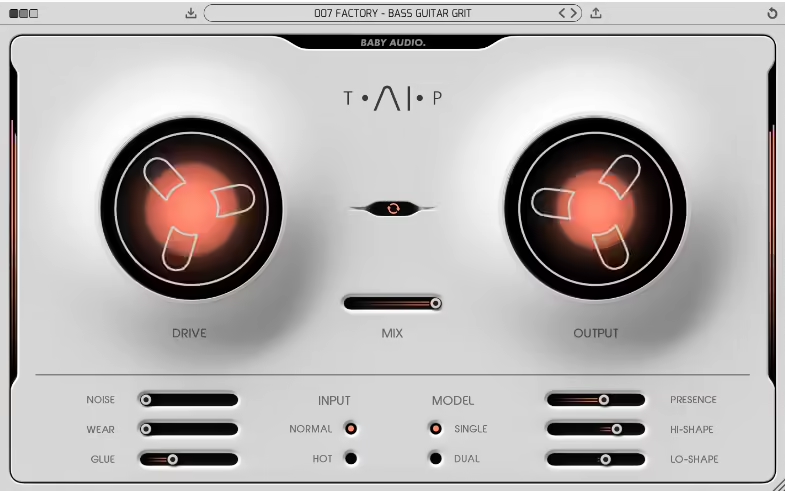
Baby Audio TAIP AI saturation plugin
Challenges and Opportunities for Developers
Even with all this growth, the plugin market isn’t without its headaches. Piracy remains a persistent issue, with cracked versions of popular tools circulating online within days of release. For developers, this means constant investment in copy protection, which can sometimes frustrate paying customers as much as it deters pirates.
Market saturation is another challenge. With thousands of plugins already available, standing out requires more than just solid sound quality. Developers need to deliver unique workflows, sleek interfaces, or creative features that solve real problems for producers.
Yet, the opportunities are just as big. AI integration gives developers a chance to offer smarter, more intuitive tools that appeal to both beginners and seasoned professionals. Mobile-first production is another untapped space, with more musicians creating on iPads and even smartphones. And niche plugins designed for specific genres, from cinematic scoring to lo-fi hip hop, can carve out profitable micro-markets. In many ways, the abundance of competition is what drives the innovation that keeps the industry fresh.
Future Outlook: Where the Market is Headed by 2030+
Looking ahead, it’s clear that the plugin world will continue to expand, but the shape of that growth will change. Subscription models are likely to become more common, perhaps even the dominant way people access plugins. The idea of “owning” software may feel outdated in a decade, replaced by monthly plans that guarantee constant updates and access to a broad library.
AI will almost certainly reshape workflows even further. Imagine plugins that not only suggest EQ moves but understand the emotional tone of a track and adapt processing to match. Formats like CLAP could gain more traction if developers and DAWs rally behind open standards, but it will take time to challenge the dominance of VST and AU.
Meanwhile, immersive audio is not going away. As more devices and platforms adopt spatial playback, producers will expect their plugins to be capable of handling three-dimensional mixes.
What’s most exciting is that the barriers to entry will keep lowering. By 2030, anyone with a laptop and an internet connection could have access to the same tools as the top producers, blurring the line between amateur and professional creativity even more than it already has.
Last Words
The audio plugin industry in 2025 is a picture of steady growth, constant innovation, and expanding reach. From its $1.37 billion market size today to its projected $2.28 billion by 2033, the numbers show a sector that isn’t slowing down. But behind those numbers are the stories of musicians, filmmakers, game designers, and broadcasters who rely on these tools every day to bring their ideas to life.
Plugins have always been about possibility, stretching what a studio can do, breaking down barriers for new creators, and pushing sound into new territories. Whether it’s AI mixing assistants, immersive spatial tools, or subscription models that make high-end production affordable, the trends shaping this market are also shaping the future of how we create and experience sound.
If you’re a user, it’s an exciting time to be making music. If you’re a developer, it’s an equally exciting time to be building the tools that will define the next decade of audio.

Berk is a multi-instrumentalist musician from Istanbul, Turkey. He has been playing guitar, handpan, and percussion for over ten years, developing a sound that blends melodic sensitivity with rhythmic depth.
He began his musical journey as a teenager, learning guitar and performing in several bands. In 2016, he discovered the handpan, an instrument that immediately resonated with him on a deeper level and gradually became central to his artistic identity.
Since then, he has performed in streets, festivals, bars, and concert venues across different countries, connecting with diverse audiences through both intimate and large-scale performances.
Alongside his live work, Berk is deeply involved in studio production. He works from his home studio, where he composes, records, and produces his own music. His studio serves as a creative space for layering handpan, guitar, and percussion with modern production techniques, allowing him to shape fully realized, atmospheric compositions from start to finish.
His music explores a wide range of genres and textures, combining organic acoustic instruments with detailed studio production to create immersive and expressive soundscapes.