

String quartets and orchestral ensembles are great sonic tools to make your track stand out. They add character, dimension, and depth to any song, no matter which style. For example, some great pop songs, like The Beatles’ “Yesterday” or Coldplay’s “Viva La Vida.”
They wouldn’t have the same power if there weren’t an orchestra backing them up, creating the perfect atmosphere for it.
It’s a bit hard to have an entire ensemble available at your home studio, but gladly plugins and sample libraries are a common thing in the 21st century. In the past, recording that many musicians would require a large studio, excellent microphones, and many musicians ready for you.
This work is now limited to the software companies, which guarantee to capture each instrument’s essence as closely as possible so you can use it however you’d want.
This list gathers some great options regarding orchestral VST plugins and Kontakt libraries available. Most are paid, but some freeware options can get you started in orchestral arrangement.
1. Spitfire Audio – Abbey Road One Orchestral Foundations
More Info & Price
This plugin features samples recorded in a coveted studio room and brings cinematic quality to your orchestral sounds.
Abbey Road’s Studio One has seen a lot throughout its history. This room is famous for its sonic capabilities and adequate space to fit an entire ensemble, from iconic bands to ambitious recordings.
Thinking of such big standards, Spitfire Audio carefully recorded a 90-piece symphonic orchestra with great microphones, acoustics, engineers, and the best players available. As a result, every instrument gets the deserved attention, so it’ll sound as it should, with precision regarding sonic details and dynamics.

Key Features:
- Five distinct libraries:
Each of five distinct Abbey Road One libraries is designed to evoke a particular aspect in your project. “Vibrant Reeds” adds brilliance and color to your track by pairing oboes and clarinets with oboes and Cor Anglais at the same time; “Grand Brass” merges horns and tube with horns and cellos for maximum deepness; “Wondrous Flutes” brings more brilliance with flute and piccolo performances; “Legendary Low Strings” combines the cello and bass sections for a beautiful low-end; and, finally, “Sparkling Woodwinds” adds the deserved higher harmonics to everything.
- Articulations and dynamic layers:
This collection features 69 different articulations paired with five distinct dynamic layers. You can also find your perfect sound by selecting up to 10 individual mics (with great options like a pair of RM1B and some ribbons mics) with two mix signals.
- Iconic spot:
Abbey Road is perhaps the most famous recording studio globally, but there’s a reason for that: the unique recording rooms, with their exquisite acoustics, make everything played there sound fantastic.
- A cinematic experience:
The sections are organized into ensembles, featuring different instrument combinations that can inspire you quickly and easily. The strings are divided into “Low” and “High,” brass section into “Low,” and horns, trumpets, and woodwind into “Low” and “High.”
2. Heavyocity Symphonic Destruction
More Info & Price
A deconstructed orchestra library, ready to push your inspiration up to its limits.
Heavyocity’s Symphonic Destruction delivers innovative results to hybrid orchestral scoring by blending traditional combinations, ingrained sound design, and profound braams in one single library. As a result, all sounds will be fresh and revamped, as this collection aims to deconstruct the orchestra ensemble as we know it.
A massive collection of cinematic elements – from full orchestral portatos to detuned staccatos – allow you to create infinite soundscapes, all worthy of much energy and vigor while maintaining the characteristic huge sound aspect that only an orchestra can provide. So be ready to unleash your most audacious and wild ideas instantly.

Key Features:
- Three different instrument types:
Symphonic Destruction provides you with three different instrument types: “Performers,” which consists of instruments that can have key switches to alternate between different sounds, “SD Designer,” tailored for deep sound designing, and “SD Loop and Braam Designers,” a variation of the previous type but designed to playback and layer any loops or braam noises.
- Spaced out:
A distinctive “Space” section contains two cherished effects on one single page. Here you’ll find a delay and reverb that can help you instill the proper ambiance and sense of acoustic. The delay features five different controls (“On/Off,” “Time,” “Feedback,” “Width,” and “Amount”) that can be tweaked at your will, while the reverb features only three commands (“Delay,” “Size,” and “Mix”), in addition to all impulse responses being fairly fixed in their character.
- Three microphone positions:
Every sample was recorded with three different microphone positions, so you can expect to alter these in any way you want to. Including “Main,” “Hall,” and “Rev FX” positions, the mixer allows you to set each value accordingly through specific faders. You also have “Mute,” “Solo,” and “Pan” options in each position.
- Modulators:
There are two modulators: “Gate” and “Dynamics.” Each can create a different approach to your instruments, either by modulating the output volume (“Gate”) or by controlling the dynamics level of the instrument (“Dynamics”) over time to create rhythmic effects. You can set the “Rate,” “Steps,” and “Range” in each section to instantly achieve new sounds and textures.
3. NI Symphony Series String Ensemble
A partnership between NI and Audiobro results in the creation of this enormous 60-player string orchestra.
Like any other string section of a symphonic orchestra, four sections form the basis of this ensemble – basses, cellos, violas, and violins. In addition, a fifth Ensemble preset is included for a whole string section mapped across the MIDI controller.
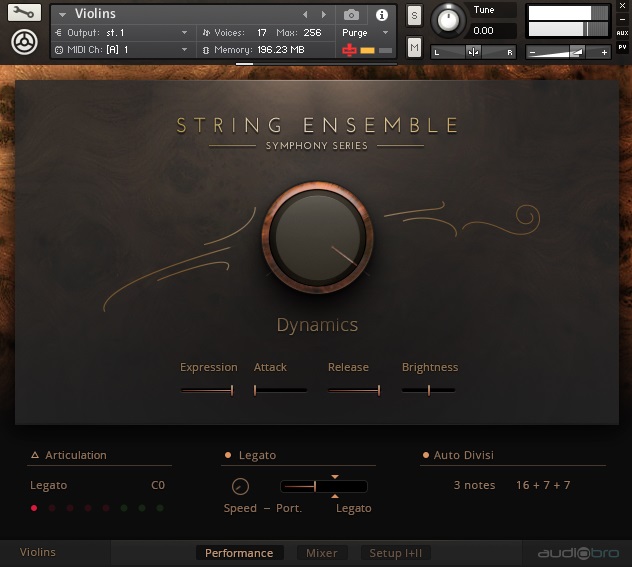
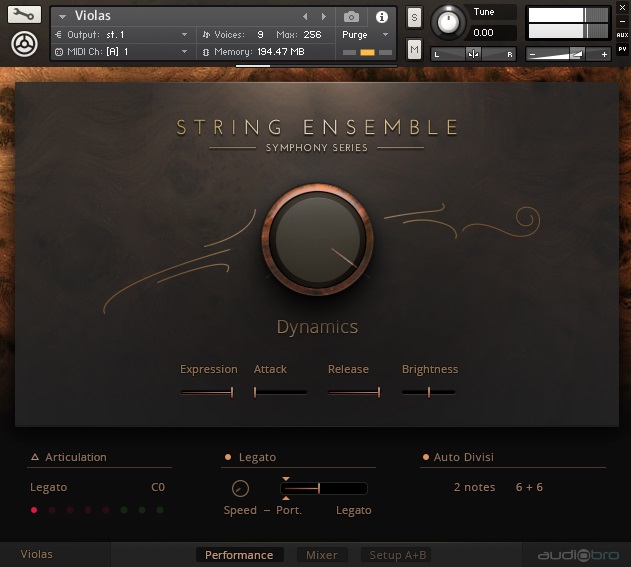
The GUI is simple and intuitive, creating an easy user experience. It is divided into three sections or tabs – Performance, where the dynamics, envelopes and articulations can be adjusted; Mixer, for balancing the sound and sound-shaping with effects; and, Setup, where you can decide the size of the orchestra.


Key Features:
- Legato:
A subject for discussion about string libraries is the legato since it’s the most important feature. But be at ease; the legato in SSSE is very well-implemented. The transitions to portamento are controlled by velocity and trigger when kicking below the threshold; this threshold can be adjusted with the slider.
- Section Setup:
The size of the orchestra can be determined with the controls on the Setup tab, allowing users to split the instruments into smaller sections for a more intimate sound. It’s also possible to achieve more control and detail over the articulations and dynamics for each section using the options available to control Divisi A and B individually.
- Divisi:
Besides being able to decide the number of players in the string sections, the other reason they were recorded in A and B parts is to implement the Divisi function, which uses the same scripting as the LA Scoring Strings. The violins allow up to four Divisi splits since they’re 30 players separated into two sections (I and II) and go as follows: 2 notes = 16/14, 3 notes = 16/7/7, and four notes = 8/8/7/7.
- Mixer and FX:
There are 4 microphone channels for each patch – stereo, close, mid, and far – to adjust the ensemble’s placement perception; this section also comes with panning sliders beside the faders.
For sound-shaping, there’s a parametric EQ with three bands, a compressor, and a convolution reverb with 104 impulse responses, most of them made by Audiobro, including 4 cinematic ambiences.
4. Native Instruments Lores
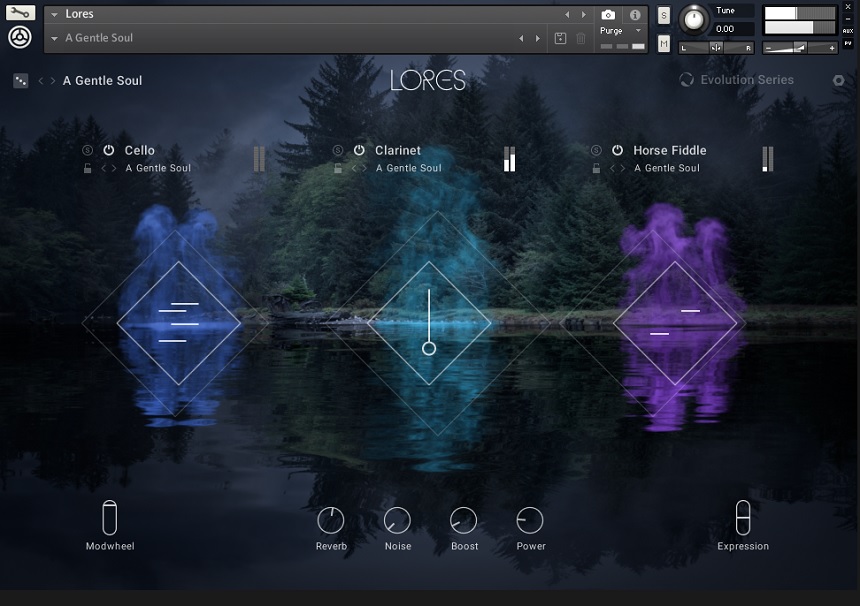


A special scoring tool for adding mystery, ambiance, and beauty to your tunes, Lores blends rich layers of traditional and ancient sounds.
Native Instruments releases LORES in collaboration with the Evolution Series. The new tool provides quality sounds, vibrations, and melodies in different genres.
A set of expressive and realistic instruments has been made by Native Instruments. The new Kontakt library provides a wide range of sound creation options in conjunction with the Evolution Series and is guaranteed to be a useful addition to any producer’s toolset. LORES is available now from the Native Instruments website.
Key Features:
- Samples:
LORES also includes 72.3 GB of audio files, and 373 factory presets. You may get into the engine and build brand-new soundscapes from scratch, or you can utilize the supplied presets for fast enjoyment. For example, you may amplify sounds with dynamic effects or stage them inside three-dimensional smoke plumes.
- Instruments:
Over 300 hand-played joints and 16 instruments make up the core. Woodwinds, traditional strings, rare chordophones, and unusual instruments like the guitar, shakuhachi, Mongolian violin, or medieval pipes are some sound sources used in the compositions.
- Humanizer:
The human experience of telling stories via song is universal, and LORES carries on this long tradition with unique embellishments. On the performance level, unpredictable swells, unanticipated tremolos, and stray harmonics produce genuine movement in the music played by the musicians who sampled.
5. VSL Synchron Pianos Bundle
More Info & Price
This collection gathers the best and most beautiful pianos, hand-picked and recorded in Vienna.
Vienna Symphonic Library offers a variety of orchestral-oriented sample libraries with solid quality and diversity. Synchron Pianos Bundle is focused on iconic and great-sounding grand pianos. It is based on the Synchron Player Engine, designed to deal with multiple microphones being recorded simultaneously and efficiently.
The bundle comprises six different pianos: Bösendorfer Imperial, Steinway & Sons D-274, Yamaha CFX, Blüthner 1895, Bösendorfer 280VC, and Bösendorfer Upright. Each features a specific sound profile and bears some special characteristics, but they all sound great in their own way.

Key Features:
- Handy presets:
VSL included some factory presets that might be useful in nailing the perfect tone. There are three different versions of the presets: “Room-Mix Presets,” “Decca Three Multi-Mic Presets,” and “Surround To Stereo Downmix Presets.” The first one features as few microphones as possible but with a well-balanced mixing that ensures a great sound from the moment you load it.
- Play and Mix view:
This plugin can offer two primary visualization interfaces, a “Play” and “Mix” dedicated views. The “Play” features controls that influence your final sound, such as “Volume,” “Reverb,” “Dynamic Range Control,” “Soft,” or “Sustain Pedal,” and “Body.”
- Microphone positions:
Multiple plugins offer this configuration, but VSL brought many options to tweak from. You can choose between three different “Close” and two “Mid” microphones, including Royer ribbons, Neumann, and Sennheiser options.
- Channel FX
Aside from the usual reverb and delay options, you’ll get more effects options than usual with a “Saturator,” which emulates tape distortion or tape overload, a “Cabinet,” which simulates famous cabinets, like the AC30 or the Marshall 1960B, a “Compressor,” an “Expander” and “Limiter,” and even a “Noise Gate”!
6. NI Symphony Series Brass Ensemble
More Info & Price (Trial Available)
A 32-piece symphonic brass section was developed in partnership with Soundiron.
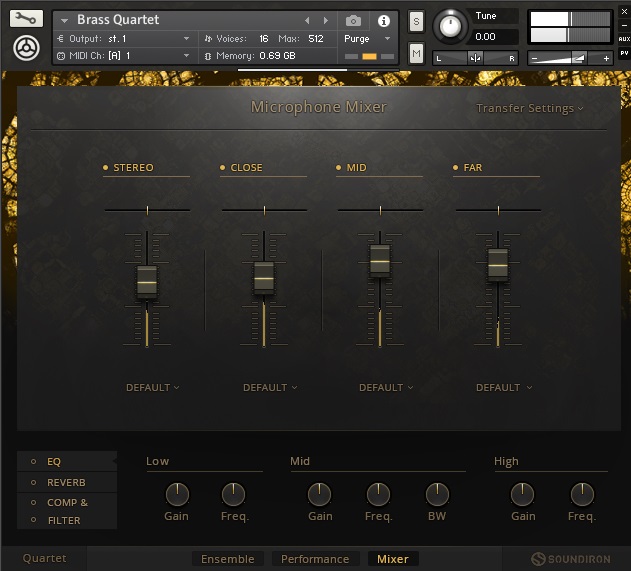
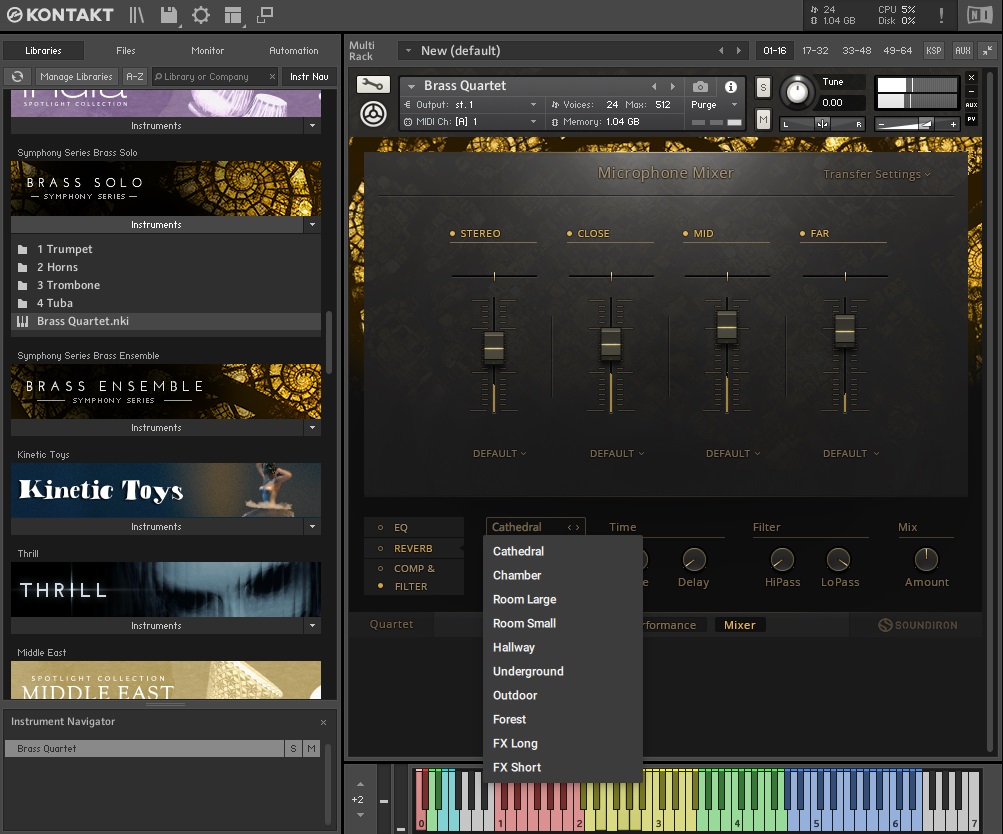
Recorded in St. Paul’s Church in San Francisco by Soundiron, this collection is comprised of two libraries: Solo and Ensemble, each one including the four instruments of a symphonic brass section (trumpet, French horn, trombone, and tuba) and a group section or Ensemble (Quartet for Solo).
The ranges of the instruments in the Ensemble and Quartet patches can be adjusted and also overlapped when unlinked. Also, instruments can be deactivated – which helps save CPU usage – in case you need just trumpets and horns or trumpets and trombones, for example.



Key Features:
- Articulations:
Over 100 articulations were recorded and provided to the instrument sections.
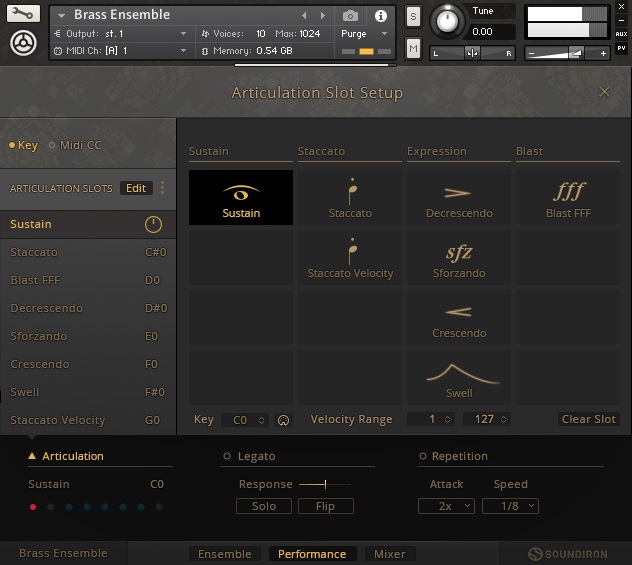
They’re distributed across all the sections and solo instruments of which each come in six types of preset: Effects, Expression, Legato, Staccato, Sustain, and a general-purpose one with the name of the according instrument – meaning that, for example, the trumpet section would be reflected in Trumpet Effects, Trumpet Expression, Trumpet Legato, Trumpet Staccato, Trumpet Sustain, and Trumpet; and so on with the rest of the instruments.
- Repetition Tool:
You can repeat short note strikes two or three times or keep it repeating indefinitely with this feature while pressing down on a key without releasing when activated. Also, this feature allows to create patterns of 1/8th notes or 1/16th notes with accents. This is very useful for playing rhythmic sections or ostinatos.
- Dynamics:
The upper segment of the main page in the GUI features the dynamics knob, which controls a combination of volume and intensity and can be mapped to the mod wheel. There are also slider controls for attack, release, tightness and motion to fill the performance with realism and expression.
- Mixer & FX:
This section features a four channel mixer with stereo, close, mid, and far microphones – stereo being a combination of the three aforementioned as a RAM-friendly option – with toggle on/off controls and panning sliders.
7. NI Cinematic: Rise & Hit
Rise and Hit is a massive collection of cinematic and orchestral sounds created by Native Instruments.
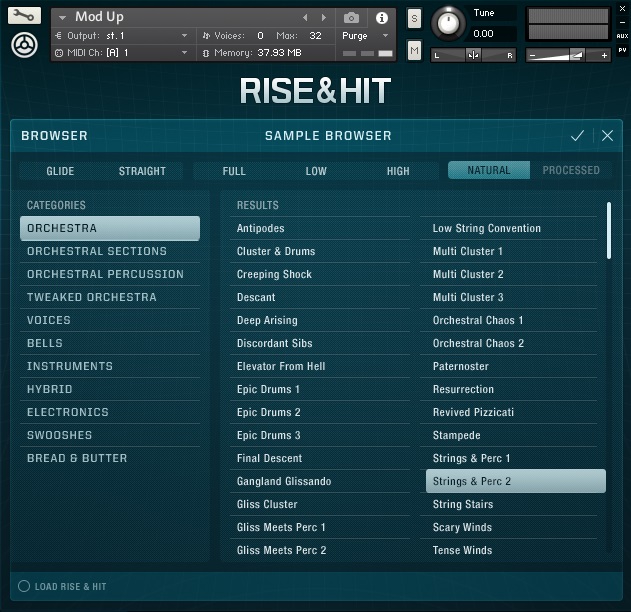
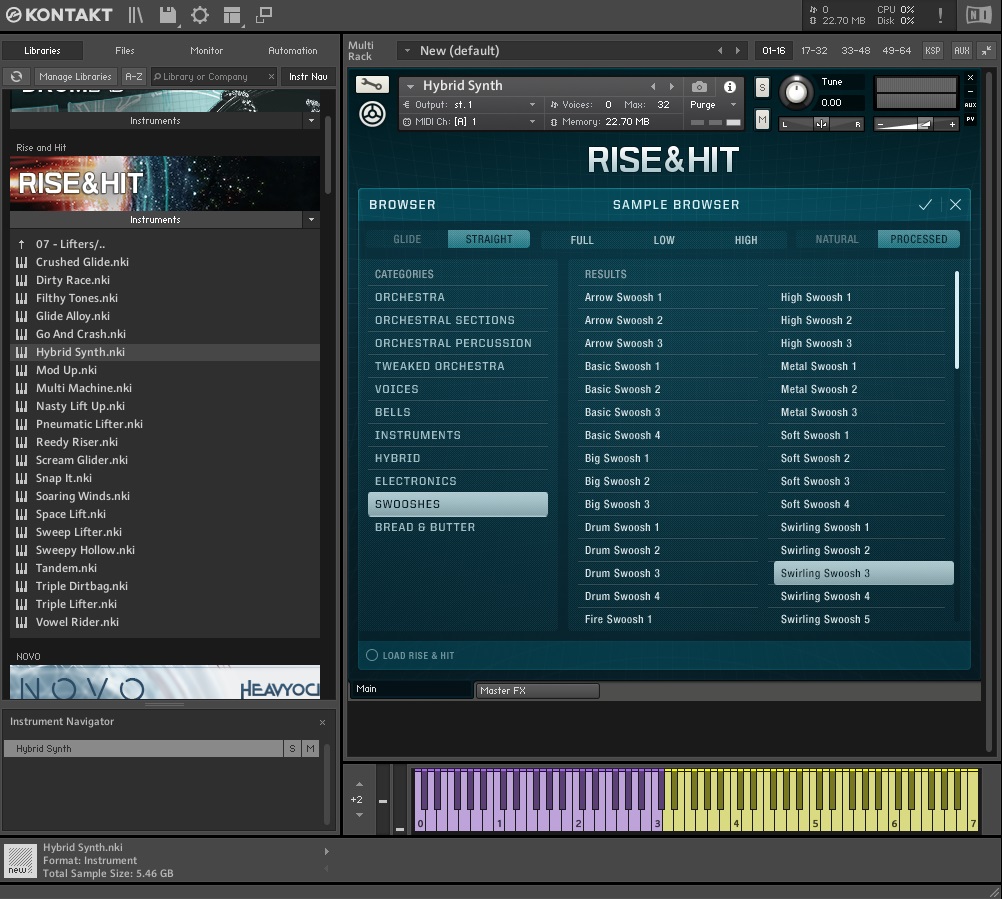
This Kontakt instrument is perfect for adding tension to your tracks. It has over 650 Risers and over 1000 Hits, all created from a wide range of sources within the over 8GB library.





Key Features:
- Built-in Effects:
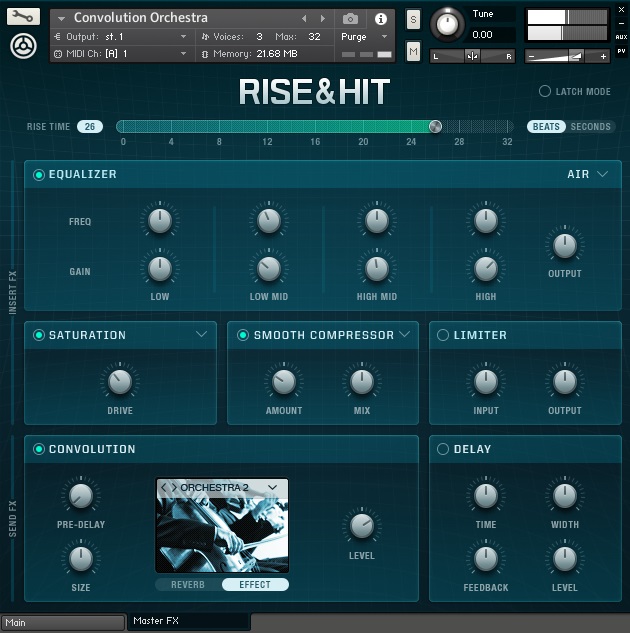
Within Rising and Hit, many built-in effects help you shape your sounds. There are fine-tuning controls, compression, saturation, multiple EQs, 26 different filters, dynamic controls, distortion controls, and classic reverbs and delays. All these effects can be used on each layer for even more control over the sounds you create.
- Multiple sample lengths:
Each built-in sound within Rising & Hit has multiple sample lengths. This means that once you’ve found a sound you like, you can use it in multiple ways. So whether you want a quick Woosh-type riser or a slowly built-up riser, then Rise & Hit has you covered, and the quality of the sounds will not be affected, no matter how long or short.
- The Interface/Design:
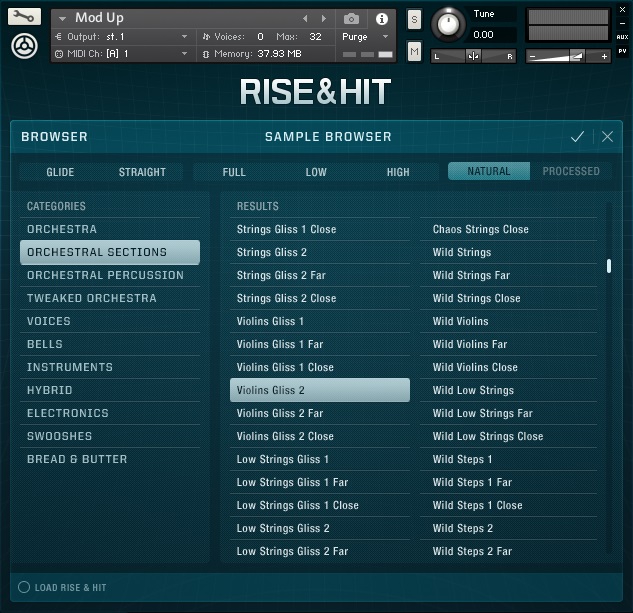
Rise & Hit is a very visually pleasing plugin. All the controls are labeled appropriately, so you don’t need to guess what the control does. The visual feedback when shaping your sounds is also useful when you start, as it gives you a better understanding of how the controls affect the audio.
8. Orchestral Tools Berlin Woodwinds
More Info & Price
This woodwind bundle will get the colors and shades into your next symphonic track.
Orchestral Tools’ second plugin in our list reinforces what the company wanted from the beginning: to re-invent orchestral sampling. They’ve achieved so by offering first-class orchestral sounds with enough detail, consistency, and dedication to make it stand out among other options in the market.
Berlin Woodwinds consists of instruments like flute and clarinet, which can contribute to a colorful and rich sound spectrum in an orchestral production. All instruments were recorded with extreme care and attention to detail, making your track stand out and be as realistic as possible.

Key Features:
- Woodwind runs:
The woodwind section is one of the most suitable for scale runs. Flutes, oboes, clarinets, and piccolos usually go very well, with fast lines played up and down the octaves, shimmering over the orchestra with much brilliance and presence.
- All figurations present:
It’s definitely not easy to recreate all woodwind gestures and figurations and translate them into MIDI, as many articulations are required to sound simultaneously in order to deliver a decent, realistic performance.
- Recorded with excellence:
All material contained in the Berlin Series was recorded in one of the best acoustic spaces for orchestral productions, the Teldex Scoring Stage. This iconic space features quality acoustics, ideal for large ensembles such as orchestras and renowned with multiple award-winning recordings.
- Balanced techniques:
All instruments, dynamic ranges, articulations, and microphone positions are balanced to keep a natural orchestral ambiance in the Berlin Series. The articulations present a soothing combination between one another, inciting realism and fluid playability, and each dynamic range of the contained instruments is modeled after reference recordings done with an authentic ensemble.
9. IK Multimedia Miroslav Philharmonik 2
More Info & Price
A fully-featured symphonic workstation with its own built-in DAW included in the package.
Miroslav Philarmonik 2 is a ground-breaking vision from a master artist incorporated into a brand new virtual instrument that can help you with any orchestral arrangements. All instruments were performed with the best musicians possible to ensure the overall quality.
Everything is gathered in a single display that should take care of your regular needs, such as leveling each instrument and adding whichever effects you’d like. The interface, by the way, resembles a friendly digital audio workstation that gives you access to every section or single instrument among the various included.

Key Features:
- Synth engine:
Can you imagine running an entire orchestra through a synthesizer? Well, that’s entirely possible now. Accessing the “Edit” mode will unveil a section with multiple controllers to adjust your tone better, but the unusual thing is to have a synth with three different sampling engines and ten filters that can be used to shape and transform your sound. You can set the perfect and most audacious sounds right away and expand your creative needs once and for all.
- Multiple FXs:
There’s a considerable number of effects present in Miroslav Philarmonik 2. All of the 34 options are from the acclaimed SampleTank 3 plugin, including five equalizers, four dynamic processors, seven filters, nine modulation effects, and nine reverb and delay effects. They’re all very versatile and easy to use, allowing for professional productions to be created instantly.
- SampleTank integration:
Without any additional installations or conversions, MP2 can work with SampleTank 3 for coherent integration into your existing music production workflow. You can manage and edit every sample the way you want to in a simple and effective user interface. The T-RackS features are also included, especially in all processing effects present.
- Macros editing:
Deriving from the SampleTank 3 integration, the macros editing provides eight of the most critical controls that could be present in software such as this: “Expression,” “Attack,” “Release,” “Cutoff,” “Start,” “Low,” “Mid,” and “High” knobs are there to be tweaked in any instrument and suit its sound in your production.
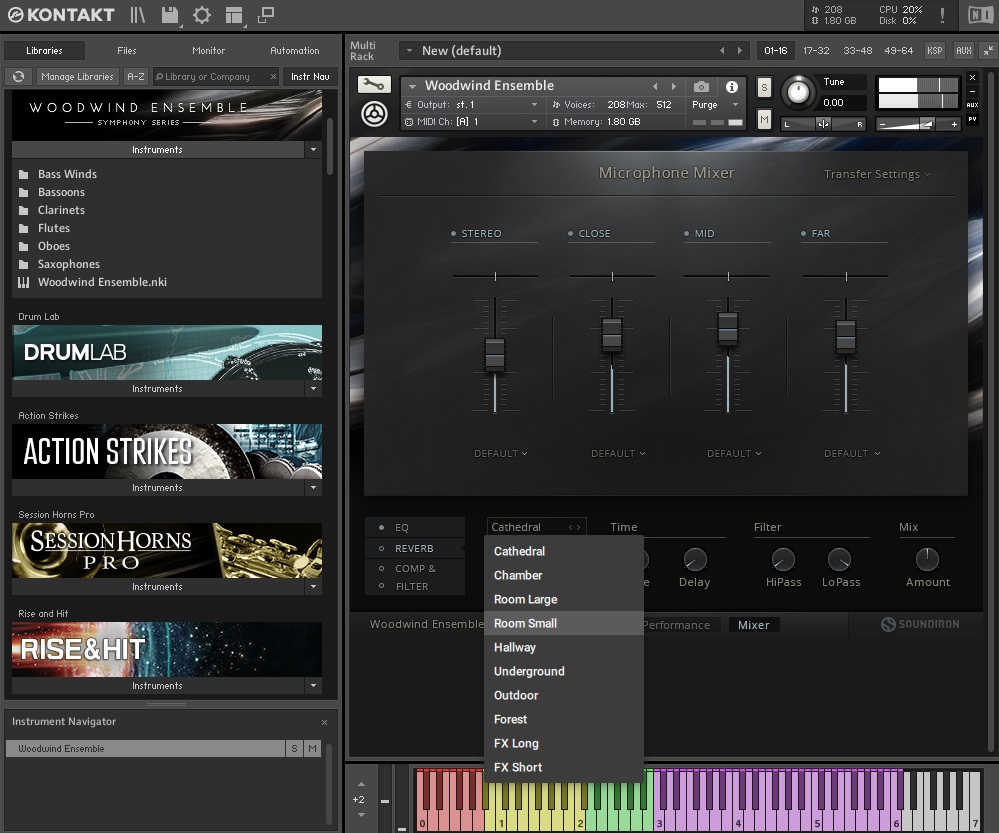
10. NI Symphony Series Woodwind
A contemporary woodwind ensemble with top soloists for both classic and modern composition.
Two libraries are included in this collection, one for solo instruments and one for the ensemble. Each library includes flute, oboe, Bb clarinet, bassoon, tenor saxophone, and contrabassoon. The ensemble library also includes bass and contrabass clarinet.
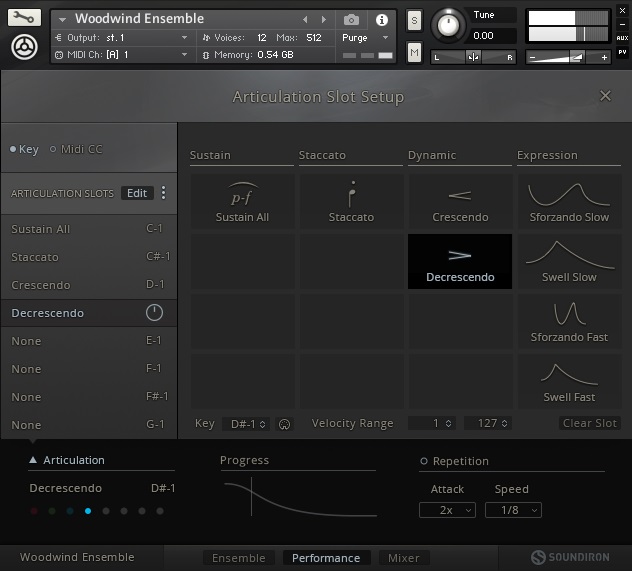
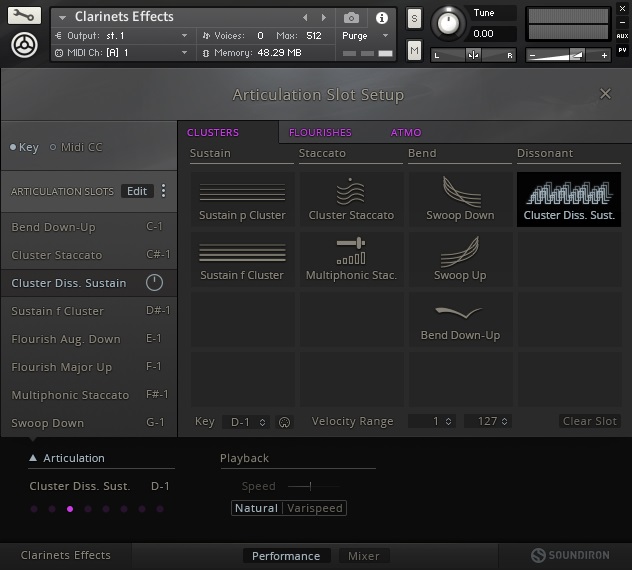
This collection was recorded in collaboration with Soundiron at Montclair Presbyterian Church in Oakland, capturing the church’s natural reverb. Additionally, 314 articulations were recorded and provided to the single patches in each library to ensure users get plenty of options to satisfy their needs playstyle-wise and stimulate their creativity.





Key Features:
- Articulations:
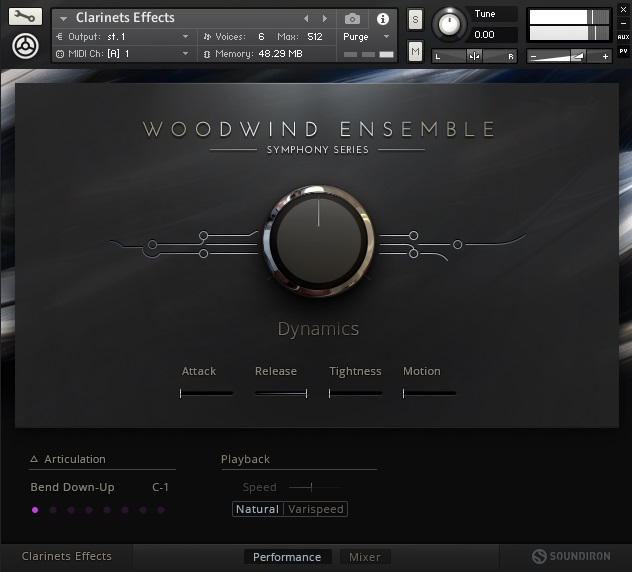
This library comes with several patches (or NKIs) across which the articulations are distributed, meaning that one single NKI does not contain all the articulations.
- Arpeggio Runs Tool:
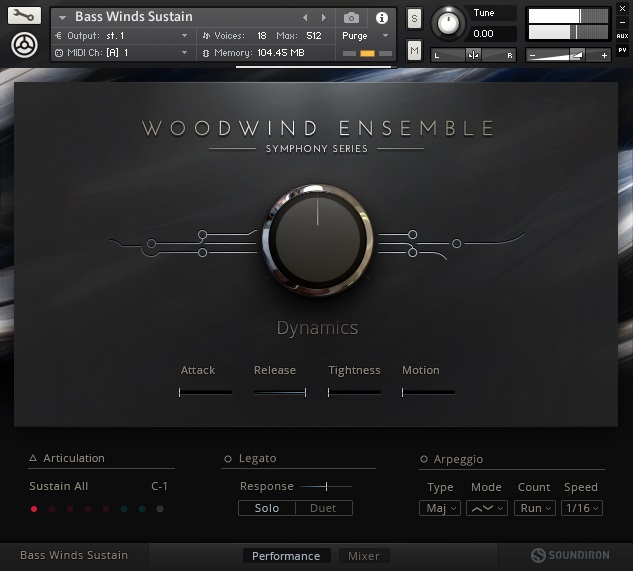
This tool is featured in the main, legato, and staccato articulations. Hundreds of combinations come with controls for the type of run, speed, number of notes in the run, and MODE. This mode has run up, down, up and down, down and up, as played, and random. In addition, you can choose between major, minor, augmented, diminished, trills, and KEY runs in the TYPE selection menu.
- Mixer & FX:
In the mixer tab, we find four channels: stereo, close, mid, and far; each one with panning controls and a dedicated section for effects with a three-band parametric EQ, a compressor, filters, and convolution reverb with many impulse responses to choose from.
- Dynamics:
In the Performance tab, we find all we need to shape the performance.
11. Strezov Sampling Jade Ethnic Orchestra
More Info & Price
A breathtaking collection of beautiful Asian instruments with many configurations to tweak around.
George Strezov partnered with composer Seth Tsui to deliver a definitive collection of Chinese and Mongolian virtual instruments, and gladly they got it just right. Seth is an American film composer, erhu player, trombone virtuoso, and sound engineer established in Beijing, China.
He conducted and produced every sampling session that resulted in Jade Ethnic Orchestra.
Strezov Sampling has attempted to bring more ethnical-focused libraries in the past, most notably the “Balkan Ethnic Orchestra,” which gave the team enough confidence to attempt something similar with Asian instruments.
The library consists of 50 instruments spread across over 100 patches, with the option to choose between multiple categories and instrument sections.

Key Features:
- Microphone positions:
Recorded in Tweak Tone Labs in Beijing, the samples benefit from three different microphone positions that can be rearranged to your taste. The “Close” and “Decca” are a sum of different mics used in the recording session, allowing for a free shaping of the sound color and ambiance.
- Syllabuilder engine:
This engine is fantastic simply because it gives you the ability to “write” the words on the choir included. To do so, a specific dashboard is prepared to include some syllables in any order you’d like to. You can also further tailor them by including staccato, sustain, connecting multiple syllables, crossfading between different ones, and even adding legato.
- Chord patches:
Some instruments in this library, such as the daruan and the liuqin, were recorded playing chords to deliver a realistic feel of multiple notes being played together. Those patches are distributed in a different keyboard layout to facilitate composition, divided into blue and green segments.
- The instruments:
Featuring a variety of unique instruments, Jade Ethnic Orchestra includes erhus, zhonghus, morin khuur, ikh khuur, pipas, guzhengs, as well as bowed versions of some of these. Other fiddles, such as banhus and jinghus, are listed alongside guqins, zhongruans, and daruans, just to name a few. The list goes on and on, with multiple variations of the same instruments also included.
12. Cinematic Studio Brass
More Info & Price
Rich, extensive, and powerful brass sounds are delivered straight into Kontakt, with multiple variations.
Cinematic Studio Brass results from years of recording, editing, and programming, showcasing brilliant performances from the best brass players and recorded in one of the best scoring stages in Australia. This sample collection will add color and life to your score with much detail and intensity that only a brass section could provide.
There are multiple versions of each instrument included, such as trumpets, French horns, trombones, and tubas, with all the respective articulations and techniques that make them sound as authentic as possible. You can also throw in some reverb to make it sound as close as possible to the actual scoring stage in which everything was recorded.
Key Features:
- Special articulation functions:
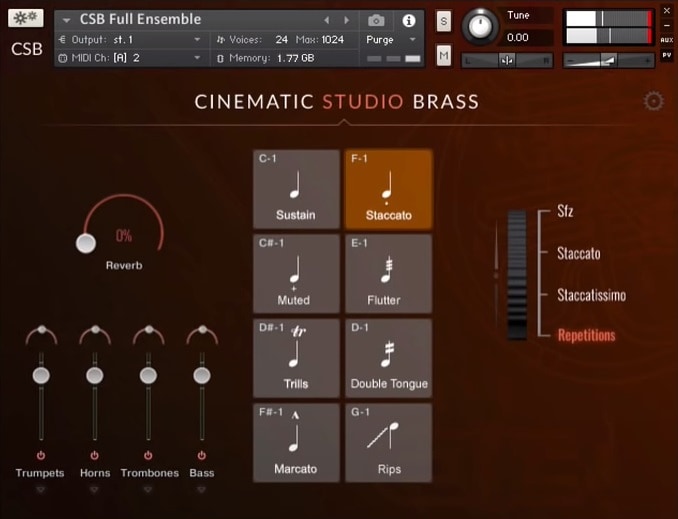
On two specific articulations – “Staccato” and “Pizzicato” – you can have an extra menu to the right of the center of the screen. You can use your mod wheel to select between different articulation variations. Taking “Staccato” for example, you’ll have “Sfz (sforzando),” “Staccato,” “Staccatissimo,” and “Spiccato” options to further vary your dynamics. It can be deactivated by right-clicking on that same area.
- Double tongue articulation:
The “double tongue” is a specific extra articulation that applies to brass instruments, allowing for a stream of fast repeated notes to be played. You can either sync the phrases played to your DAW’s tempo or manually apply any BPM you desire.
- Mic positions:
This library was masterfully recorded using an array of microphones, and gladly you can set them as you wish. On the lower left corner, the four fades are responsible for the main ambiance of the ensemble: “Close” gets all the instrument’s details just right, “Main” delivers a realistic conductor’s perspective, and “Room” captures the whole essence of the space the ensemble is playing on, and “Mix” is a blend of all three previous faders, with a specific “out-of-the-box” nice sound.
- Velocity-sensitive key switches:
Most key switches included are velocity-sensitive, which means that the velocity at which the key switch is played will trigger additional actions. For instance, the “Muted” key switch will provide short notes if played between 0-64 velocities, and longer notes will be played when going from 65-127. Below you will find all the velocity values for each articulation.
| Key switch | Velocity & Function |
| Staccato | 0-32: repetitions; 33-64: staccatissimo; 65-96: staccato; 97-127: sforzando. |
| Muted | 0-64: muted short notes; 65-127: muted long notes. |
| Marcato | 0-64: repetition overlay off; 65-127: repetition overlay on. |
| Legato | 0-64: legato off; 65-127: legato on |
Top 6 Free Libraries
1. Spitfire Audio — BBC Symphony Orchestra Discover
More Info & Download
Collection played by one of the best orchestra ensembles in the world, free to use.
Spitfire Audio always offers one of the best libraries and plugins when it comes to sampling technology. The best thing about this plugin, which costs $49, is that you can get it for free. You simply have to register your email address, fill out a questionnaire, and in 14 days, you’ll receive your copy in your email. As simple as that!

Key Features:
- Inspired by another library:
All sounds included in BBC Symphony Orchestra Discover are also included on their $999 bundle entitled BBC Symphony Orchestra Professional. The difference between them is that Discover features way fewer samples than its bigger brother, but that doesn’t mean you won’t get some great instruments.
- Intuitive interface:
The minimalistic user interface was designed to make you work with intuition in mind.
2. Orchestral Tools Layers
Layers is a way to add a classical touch to your subsequent productions.
This orchestral library is intended to be used with the SINE Player, a free virtual instrument plugin provided by the same company, Orchestral Tools.
All samples provide pristine quality regarding each section – woodwinds, brass, strings, and full orchestra – while maintaining a fluid workflow in a minimalistic and straightforward user design interface. You can also download each of these four sections separately if you prefer.

Key Features:
- Recorded with dedication:
You can notice that this library features a generous amount of quality samples, especially when talking about a freeware option. All samples were recorded at the Teldex Scoring Stage, in Berlin, with the main goal to work as pristine and efficiently as possible with the software.
- Simplicity at its best:
Don’t worry about controlling multiple settings at the same time. The Layers library was developed to bear an intuitive interface, suited for beginners and more advanced producers as well.
3. Sonuscore – Free Orchestra Chords
More Info & Download
A unique library that gathers all warm and massive orchestral sounds and tools in a single interface.
Sonuscore offers a great collection of samples to you at no cost at all and the same controls and configurations every major plugin or library also offers. The interface is very minimalistic and simple but produces sounds worthy of the most celebrated cinematic productions.
You can play chords with the whole ensemble, layer it with additional lower strings, or add that perfect high-pitched scale run that will add energy to your score.

Key Features:
- Reverb knob:
The only visible command at your starting screen is a “Reverb” knob alongside another curious control. The reverb itself doesn’t need much explanation – simply twist that knob to get a perfect ambiance going – but the “Velocity = Mode” command displays whether the chord you’re playing it’s major or minor.
- Key switches:
Sonuscore added some useful key switches to this program to further expand the versatility behind this software. You’ll activate certain ensembles by clicking certain regions of your keyboard/MIDI controller.
4. ProjectSAM – The Free Orchestra
A little over 1GB of high-quality cinematic samples, just for free.
This free collection features a wide range of orchestral sounds and includes all 12 original presets (with two new ones!) from ProjectSAM’s Symphobia 4 library. It also has a collection of layered presets that reutilize existing sounds to get new, creative instrument layers.

Key Features:
- Twelve instruments:
You’ll get 12 different instruments in the ensemble, with horns, orchestral percussion, cellos, contrabasses, violins, woodwinds… The list goes on and on. The catch is that the instruments are separated by presets, each channeling a specific sonic atmosphere.
- Easy to use interface:
With minimal tabs, windows, or controls to choose from, everything you’ll need is on the main screen. Aside from usual controls, like envelope and reverb, you also get “Quick Equalization,” “Octaver,” and “Reverse Sample” options that further expand its versatility.
- Bonus control:
Each specific preset will benefit from a “Bonus” knob, which delivers a specific effect. Located at the bottom row of three knobs, first from left to right, it changes according to which preset you’re using.
Compatibility:
This library is available for macOS 10.12 or higher (latest update) and Windows 7 or higher (64-bit only and latest Service Pack required). It works in Kontakt Player or Kontakt version 6.2.1 or higher is required.
Summary:
This collection is a nice starting point if you’re beginning at composing scores and soundtracks, as the controls are easy to operate and the overall library size is significantly small. The audio quality is good enough, and all presets are great sounding on their own capabilities.

The Integraudio Editorial Team consists of experienced music producers, audio engineers, and plugin enthusiasts dedicated to providing in-depth reviews and guides for music production software.