
What Is Modern Metalcore?
Well first, what even is Metalcore?
Metalcore comes from the blending of two genres, Hardcore Punk (the ‘core’ aspect) and Metal (the ‘Metal’ aspect, obviously). It has the aggression and high energy of Punk, plus the riffing and chugs of Metal. Also, Metalcore isn’t Metalcore without a big breakdown that gets the mosh pits going.
Bands who pioneered this sound (with links to their BandCamp Profiles) include:
Modern Metalcore has evolved into quite a different beast now. It’s much more produced and polished, it has huge melodic choruses, lots of electronic sounds, and is massively influenced by the arrival of Djent.
Artists at the top of the Modern Metalcore space (with links to their BandCamp or Label Profiles) include:
So let’s actually make a track. To keep this article from being a book, I will focus on what I consider the two main elements of a Modern Metalcore song. This will be the main riff and the chorus. You get these right, you’re most of the way there.
I’ll be using Ableton Live 12, but you can use any digital audio workstation that you prefer.
Producing A Modern Metalcore Song
Guitars
We will start with guitars, as really that’s what is dictating the entire feel off the song. Of course, the other elements are contributing massively too, however I feel it’s always best to start with a good riff.
We need low-tuned guitars. Very low. So tune it down as low as you think, then tune it down further. I am going to be in drop G for this. Yes, you read that correctly. One of the most notable changes in the modernization of Metalcore is that the guitars are no longer in drop D or drop C, now it’s not uncommon to find songs in double drop D. That’s tuning to drop D and then dropping the entire guitar down an octave. So if you have an extended range guitar (more than 6 strings), now is the time to get it out.
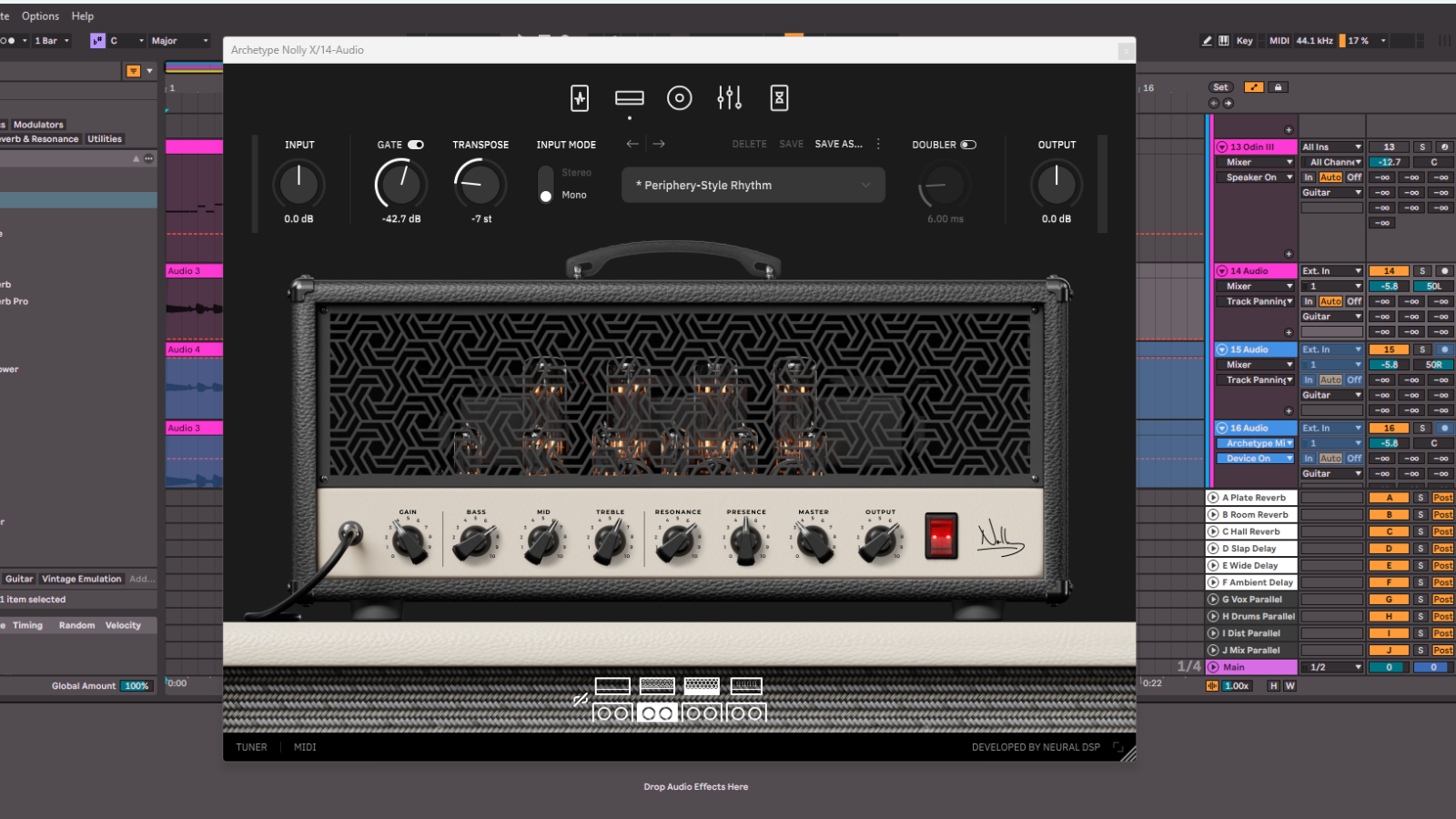
Luckily, we can use plugins to drop the pitch for us. These plugins will also allow us to get really amazing modern sounding amps without having to physically record an amp that you may or may not own. There are a lot of choices out there when it comes to amplifier plugins, however I will always recommend Neural DSP. They sound amazing, and they also make the Quad Cortex amp modeller that your favourite Metalcore bands most likely use. I will be using the Nolly X plugin from them, as it sounds amazing, has a Peavey 5150 amp in there (which is a staple in this genre), and Nolly (a.k.a. Adam Nolly Getgood) has mixed a bunch of albums that are considered the holy grail of Modern Metalcore, including Holy Hell by Architects.
Other great amp plugin choices include:
Another quick note, when recording guitars it’s extremely common to double track, if not quadruple track, the guitar parts. This means recording the same part twice or four times and panning then all the way left and all the way right. This way you have a very wide sounding guitar riff, and it leaves room in the middle for the vocals, bass, kick, and snare.
Main Riff
The main riff of a Modern Metalcore song is absolutely key. It’s the first hook of the song. It’s going to be repeated after choruses and usually at the very end of the song. It has to groove, it has to be catchy, and it has to be very heavy.
In terms of notes, you’ll find that a lot of riffs are based around a similar note selection. On a guitar the frets on the lowest string would be 0, 1, 3, and 4. In the tuning of drop G that we are using here, that’s G, G#, A#, and B. So I have based my main riff around this, adding some little fills at the end of the second and fourth phrase.
I’ve written out the MIDI of the riff below, to show you exactly what notes are being played.
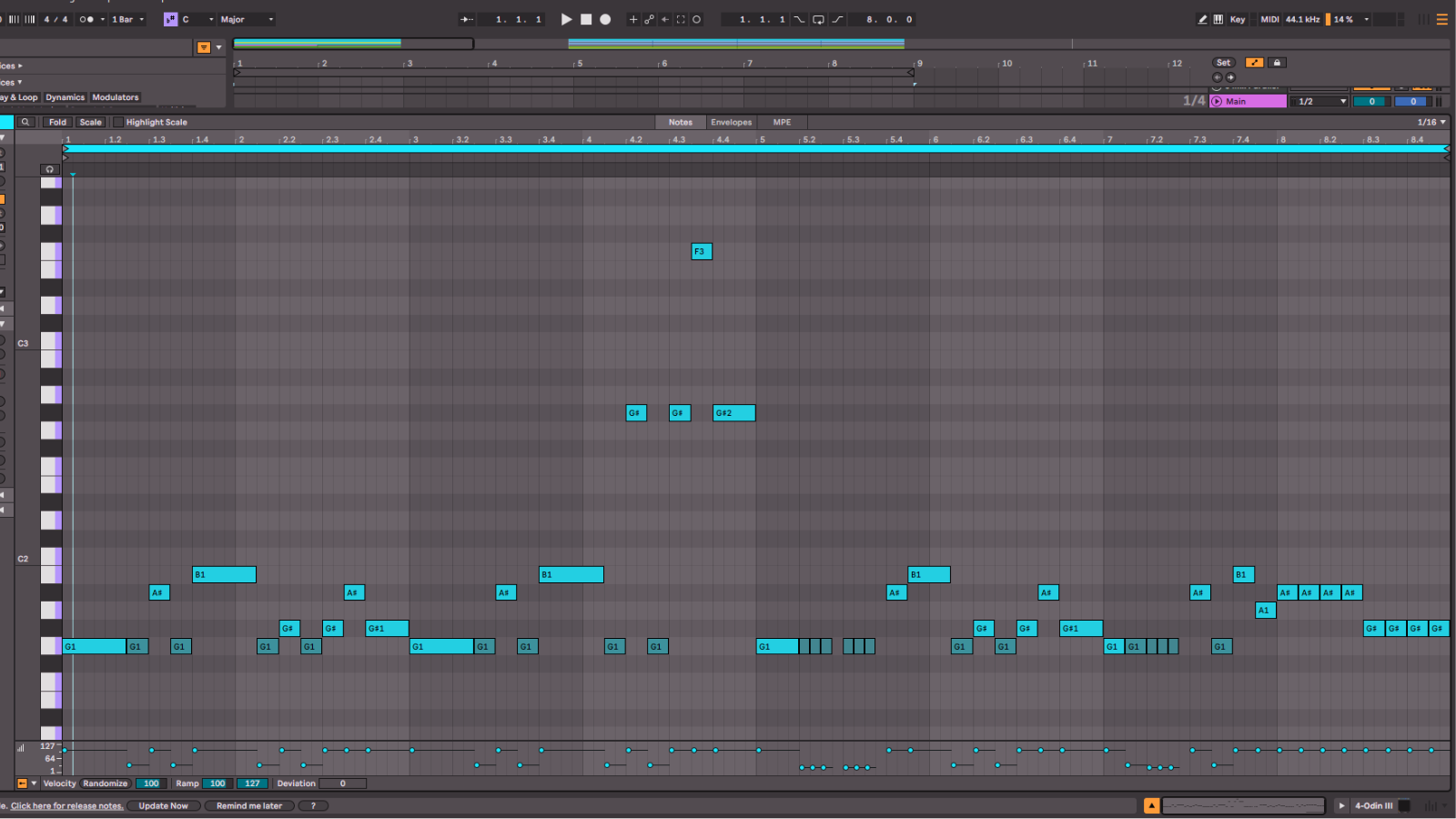
I recorded this part three times, twice with the same amp and I panned them both left and right respectively. For the third one, I used a different amp with an octave pedal, giving us the lower octave, just to really fatten the guitar sound up. This is placed in the center of the stereo field. Here’s how it turned out:
Chorus
Now we want a massive, melodic chorus. The guitar parts are going to be single note, rather than playing chords. There are two reasons for this. Firstly, it’s very common in this genre, and secondly it leaves a lot of room in the production for all the synth sounds that we are going to be adding later. Because we want that huge, Pop-like chorus, the notes are inspired from Pop music. The basic structure of notes for our chorus is based around the following phrase of notes: G, F, A#, D#, G, F, C, D#. Of course, there are small variations and little fills, but you can think of these as our main chords. This is what the MIDI looks like:
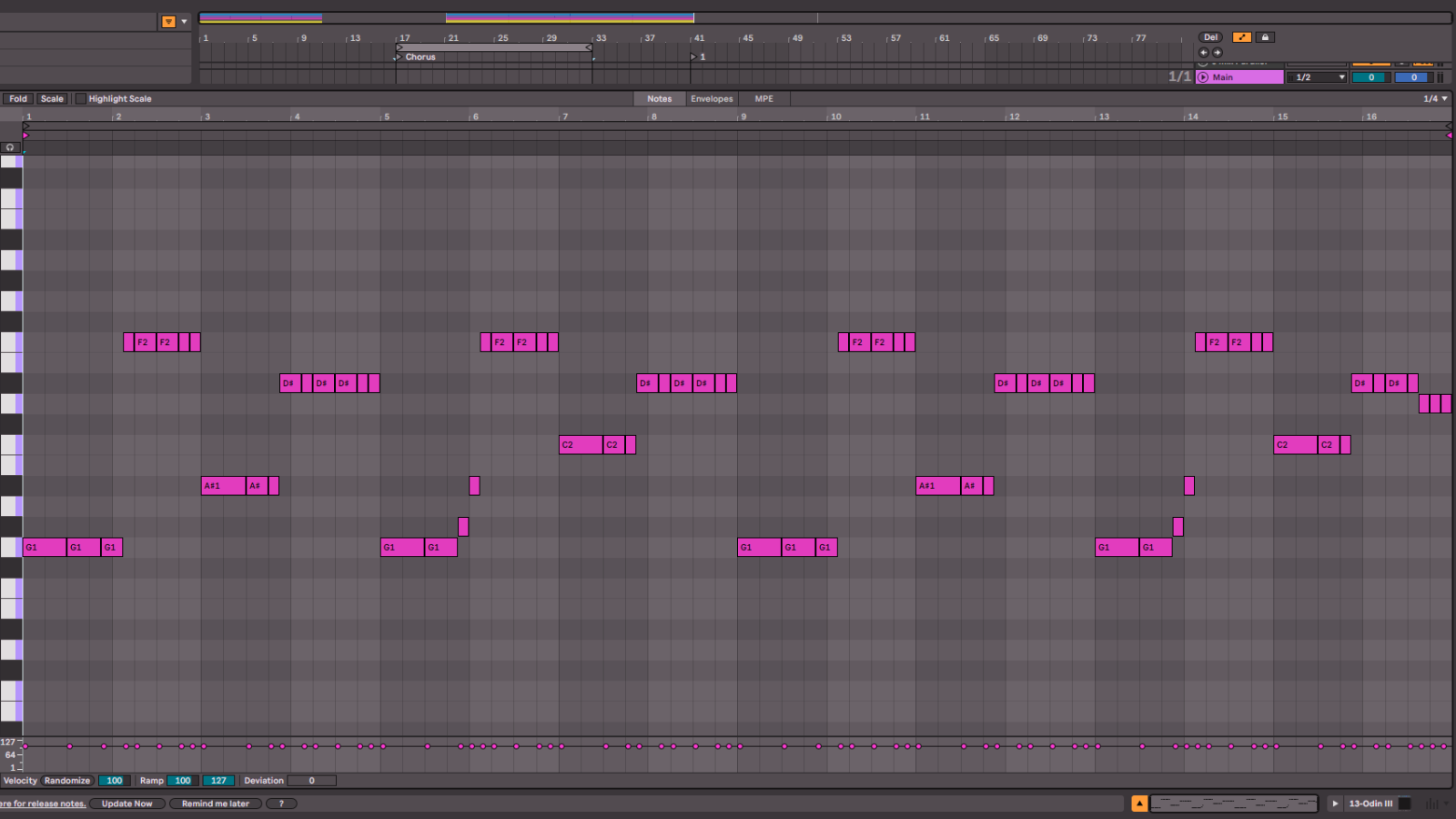
Then, after recording and panning the same way as I did for the main riff, we have:
But we aren’t done with guitars yet. For the chorus, we want a lead guitar line. Something simple, melodic, and quite spacious, both in the amount of notes and the types of effects used on it. You can think of this as a countermelody. Something that sits under the vocals but pokes up out of the chorus to give it even more of that catchy, melodic vibe that we are going for. This is what I recorded:
Drums
When it comes to drums for Modern Metalcore, you really have two options. The first is to record a drummer. This involves a skill set, and frankly a lot of equipment, that are out of the scope of this article.
The second is to use drum libraries. These are multi-sampled drum sounds which include every possible velocity and often multiple drum options. A lot of the techniques we use here can be applied to a well-recorded drum kit. So if you want to learn to record a drum kit and then come back to this, that will work.
For this tutorial, you can use whatever drum library you prefer, but I will be using Invasion by GetGoodDrums. This loads inside of Native Instruments Kontakt and just sounds amazing, with so many options for the kit. There is a guide on Kontakt HERE
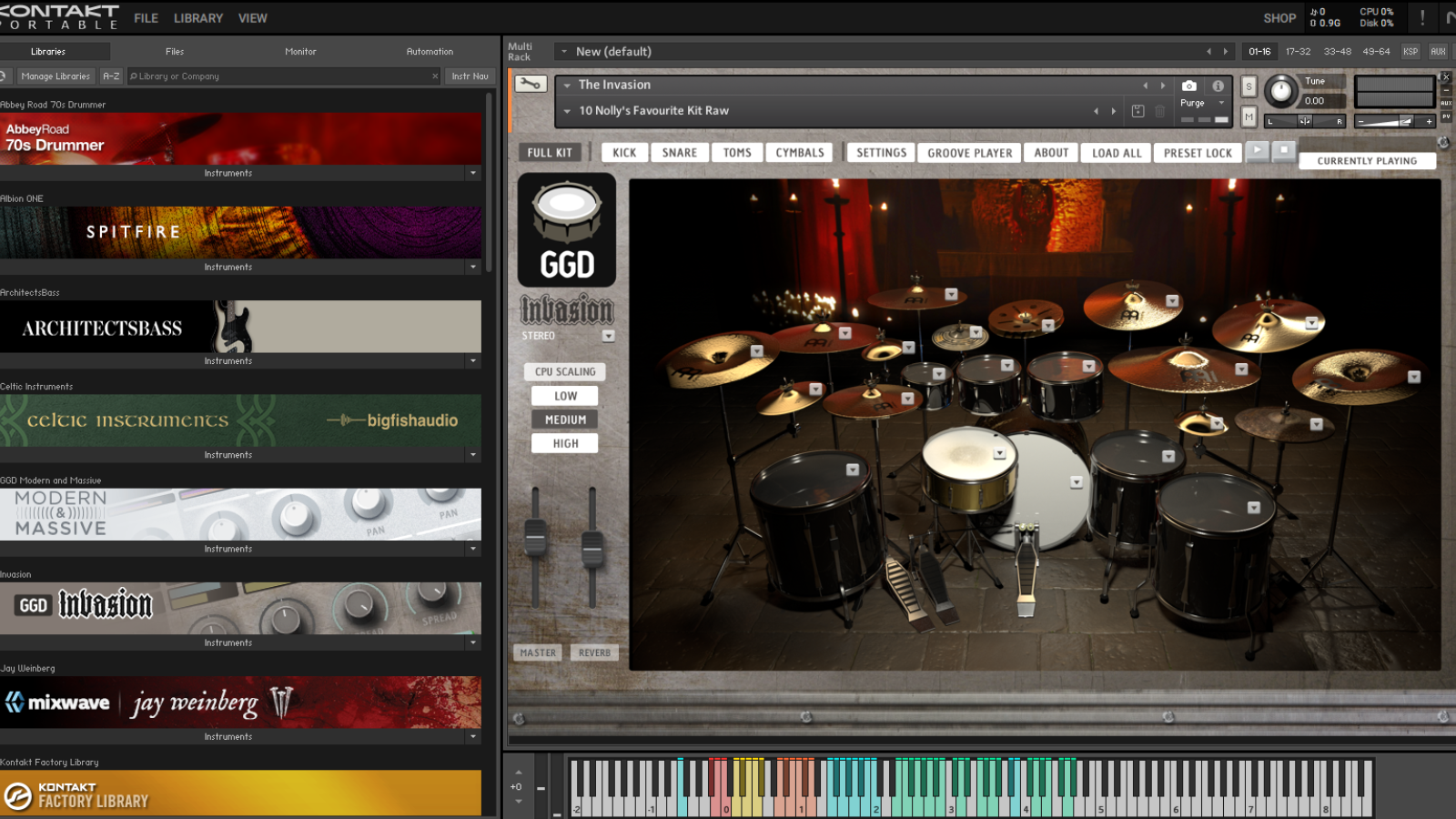
I will also be layering one-shot drum samples on top for the kick and snare, as this is also super common in the genre and makes the drums hit that much harder. I am also using a percussion loop in the background just to give it some more groove and interest.
Main Riff
The combination of the guitar riff and the drums are what create the groove of this section. So the drums are pretty locked to the guitar part, especially the kick drum. Below you can see the MIDI for the drum groove. We have the kicks playing the same pattern as the riff, the snares on the third beat of each bar, a cymbal hit on each beat, and of course some fills at the end of the second and fourth phrase of the riff.
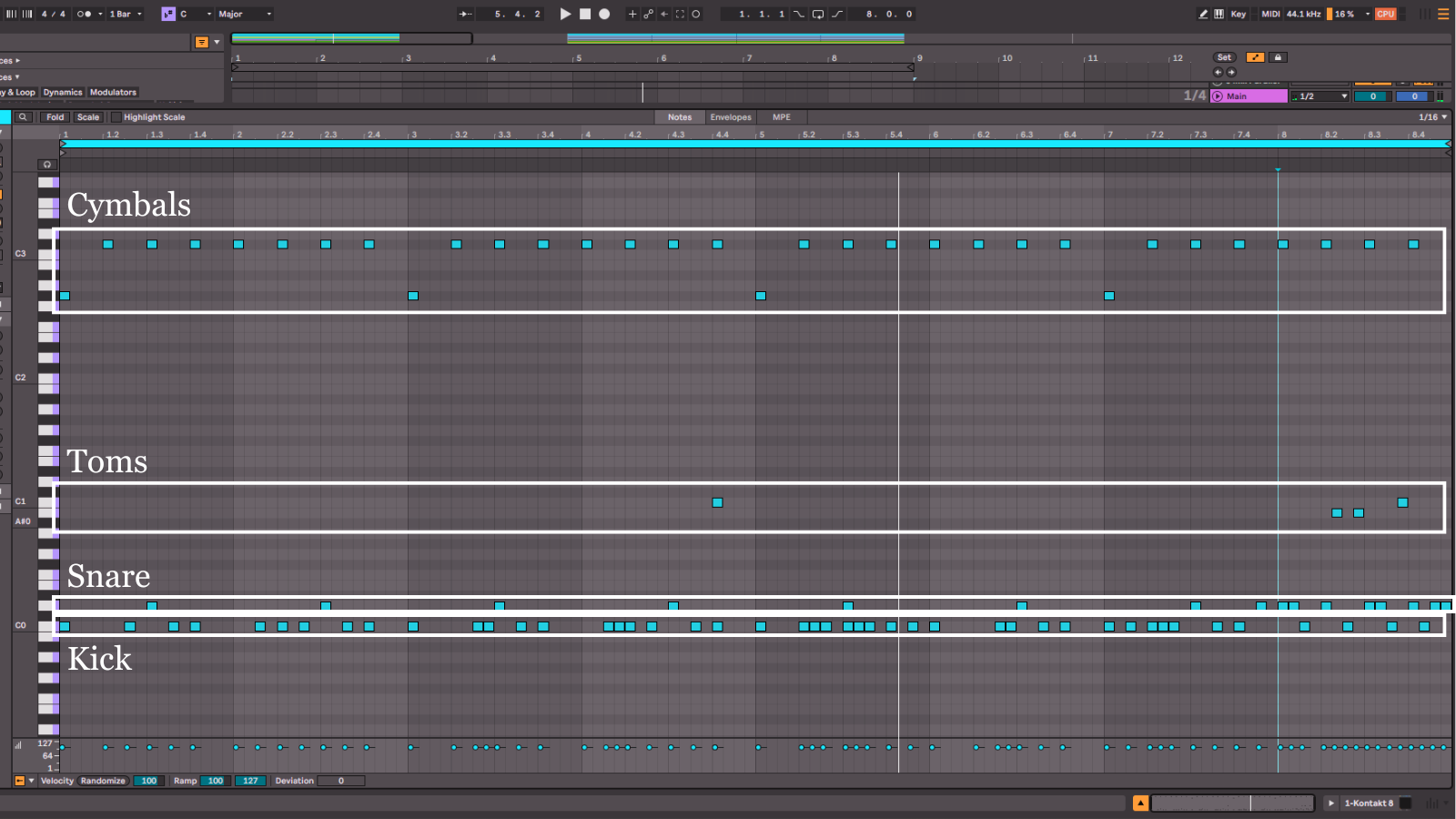
Then I’ve also added the extra kick and snare samples on top, which literally consists of finding a sample I liked on Splice and then copying the MIDI pattern for each from this pattern above. To show you the difference here is the drums without the extra samples:
And here are the drums with the extra samples, and the percussion loop:
Chorus
I always think of the main riff as being quite tight and on edge. Then, when the chorus hits it completely opens up the song and gives that relief. So the drums reflect this. For the chorus, we have a much simpler, almost laid back, type of rhythm.
The kick is laying down a very basic groove, loosely based on the guitar parts, the snare is playing on the third beat of each bar, and the cymbals are still on each beat. I also added in an open hi-hat on the offbeat of each bar (this is the ‘and’ when counting, e.g. ‘one-and-two-and…’). These extra embellishments just add an extra groove and nod to the chorus, while still feeling open. Of course, at the end of the phrases we have little fills. Here is the MIDI I wrote for this song:
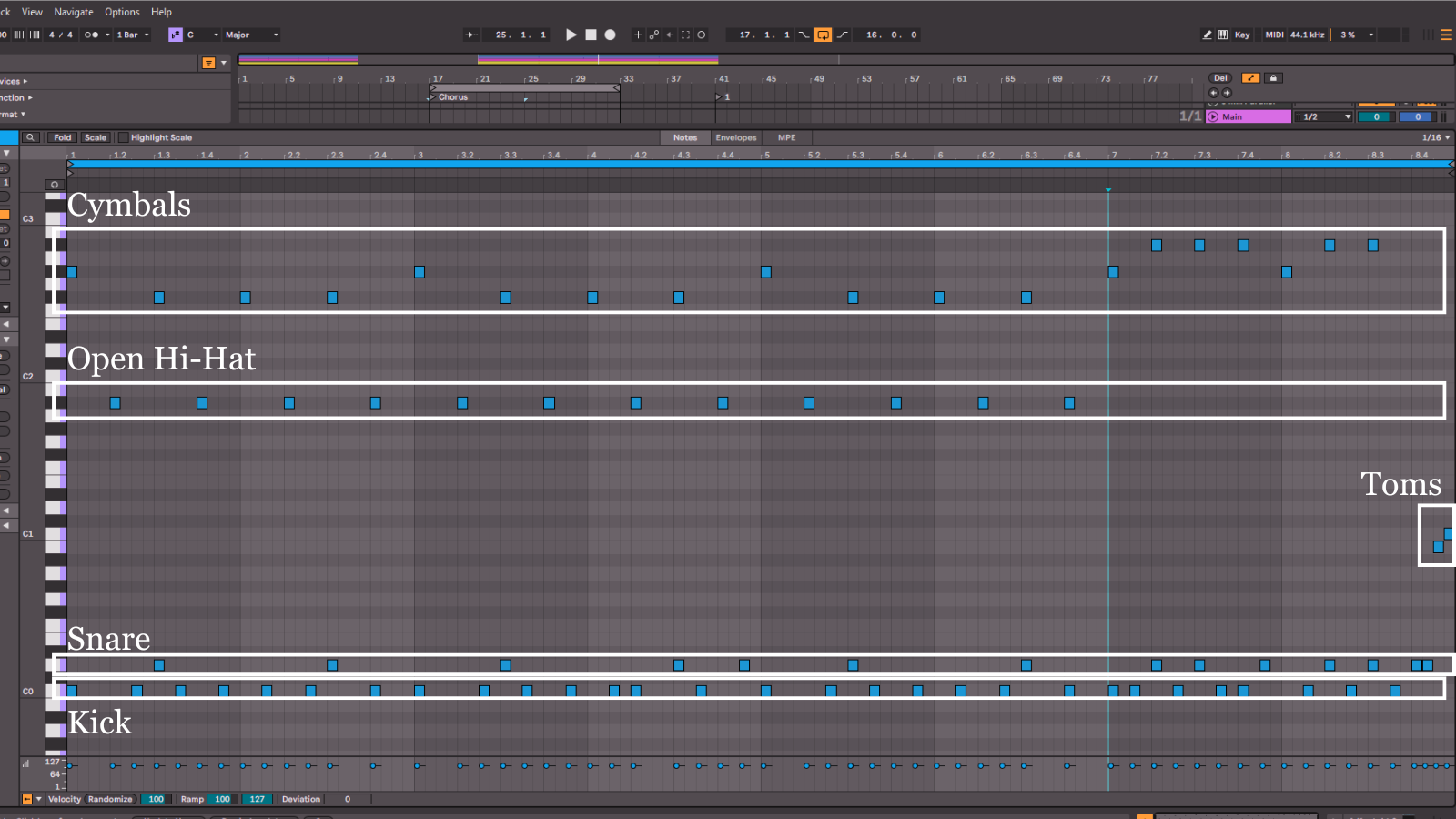
Combined with the samples from before, we now have this:
Bass
Just when you thought that the guitars were going to go as low as we can, let’s talk about bass. And yes, this is a full octave below the guitars.
The bass parts I have here are a mixture of a recorded bass that’s been pitched down, and a synthesizer sub-bass (specifically a Mini V from Arturia). This is to really round out the bottom end and give us that extra body that Modern Metalcore has really embraced. That’s going on throughout each section, so I wanted to mention it before diving into the specifics.
Another part worth mentioning is that for the bass guitar parts, once recorded, I duplicate the track and treat the sub frequencies a bit differently to the rest of the recording. This is to give a more controlled low end, which is especially helpful with such low tunings. Below is the processing for the sub frequencies:
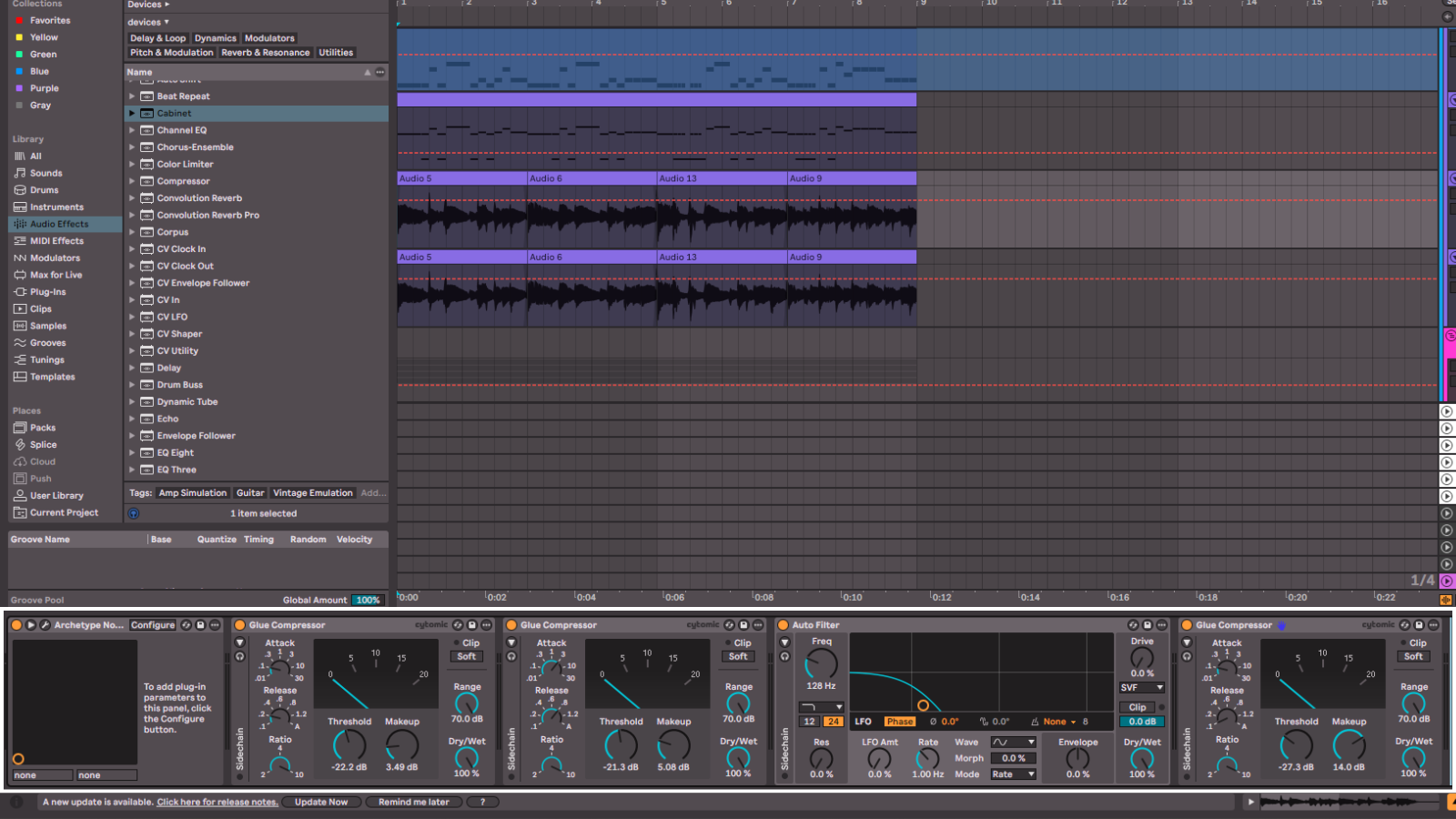
I am using the Nolly X plugin again on here, but purely for the pitch shifting. Everything else in the plugin is turned off. Then we have two of Ableton’s Glue Compressors, which are basically an emulation of an analog desk’s bus compressor.
The first compressor is just catching the harsh transients that are poking out to even out the dynamics a bit, before going into a more gentle compressor that then smooths the whole audio out.
Then I am using a filter to remove everything above 128Hz. This leaves us with only the sub freqencies, which I then compress again. The result is a very consistent low end that doesn’t peak out, and maintains the thickness throughout the song.
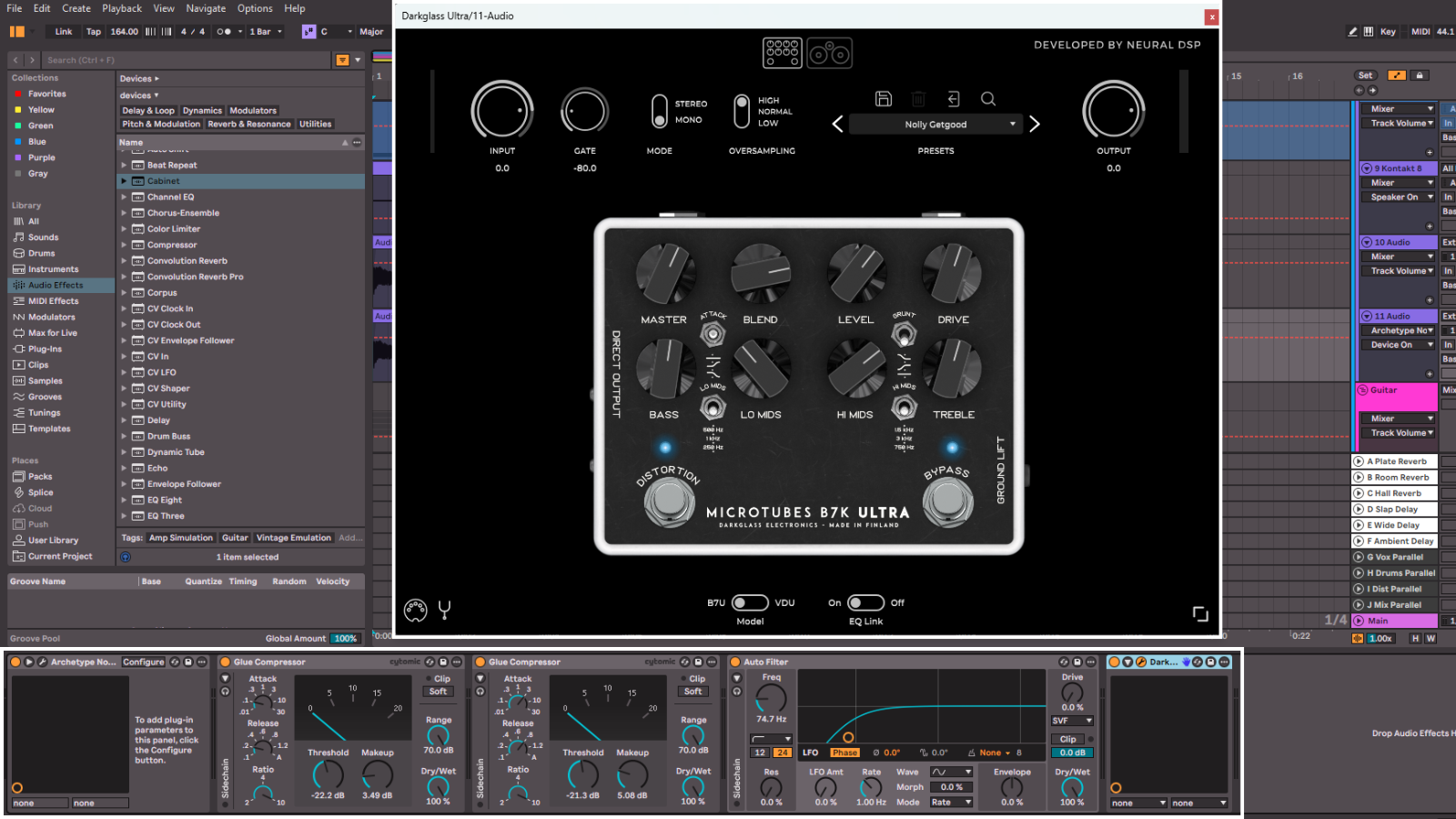
Then for the other bass track in the image above, we have the same pitch shifting and two compressors at the start, then the filter is removing everything above 75Hz. This will just remove the really subby frequencies and make the amp sound more manageable. Then I am using the Neural DSP Darkglass Ultra plugin, modeled from the pedal with the same name. This is a staple bass pedal in this genre. It’s basically an amazing sounding bass amp with the option to blend distortion with the clean sound.
Main Riff
For the main riff, it’s very similar to the guitar parts, with just one change. This change is when the guitars play some high notes, and I preferred to keep the bass in the lower register here. Other than that it is locked into the drums and guitar, acting as the glue between these two parts. Here is the MIDI for the main riff:
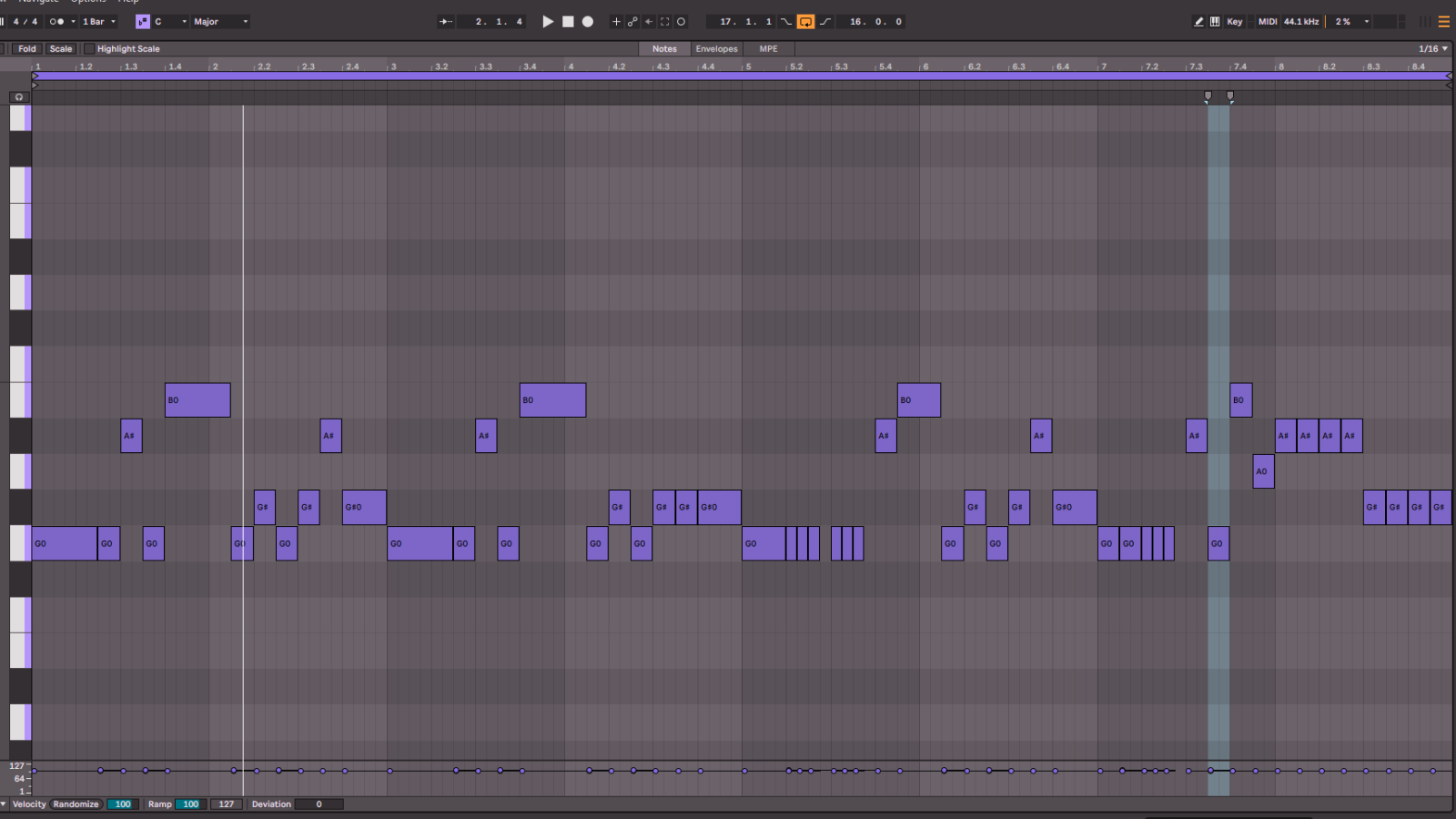
This is what the sub bass synthesizer is using, and then I recorded the bass guitar, playing it the exact same way. With the processing mentioned above, we end up with a bass sound for the main riff that goes like this:
Chorus
Now for the chorus, the bass is literally playing the same as the guitar, just an octave lower. I’ve included an image of the MIDI below, but it’s literally the same.
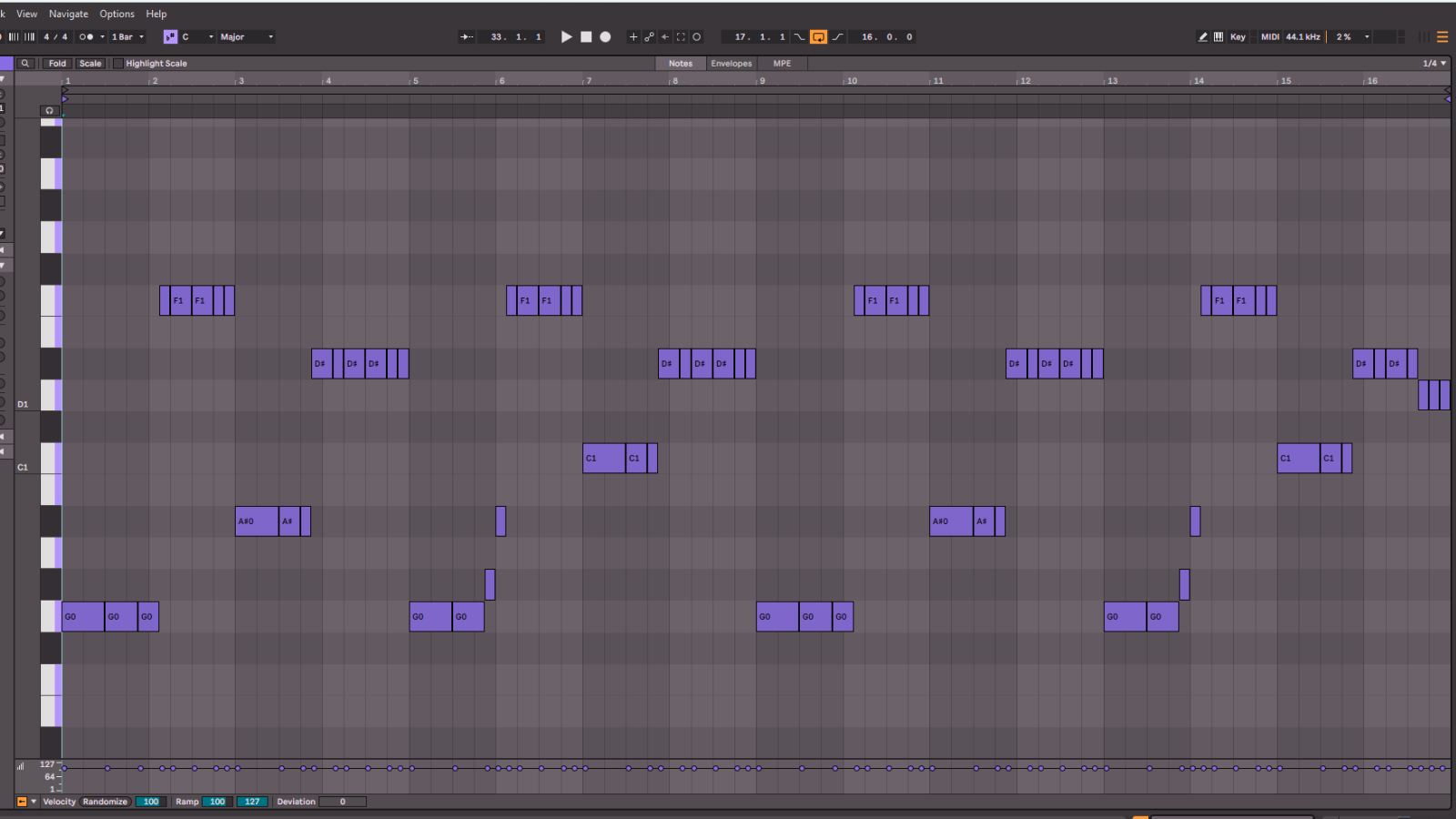
Processing wise we are also doing the same as the main riff. Here it’s even more important to have a consistent bass sound, as the chorus needs that foundation to hold down the fort whilst the other instruments are delivering the melodies on top of it all.
Synth
Another key difference between older Metalcore and newer Metalcore is that there is a lot more production. The mixes are less raw, the choruses are huge, and the use of synthesizers is everywhere. Specifically, ambient electronic sounds have become a mainstay in this genre.
Main Riff
For the main riff, we aren’t really adding any extra melodic information, as the riff is the key part, but we are adding some more ambient soundscapes. Here is the arrangement for the main riff:
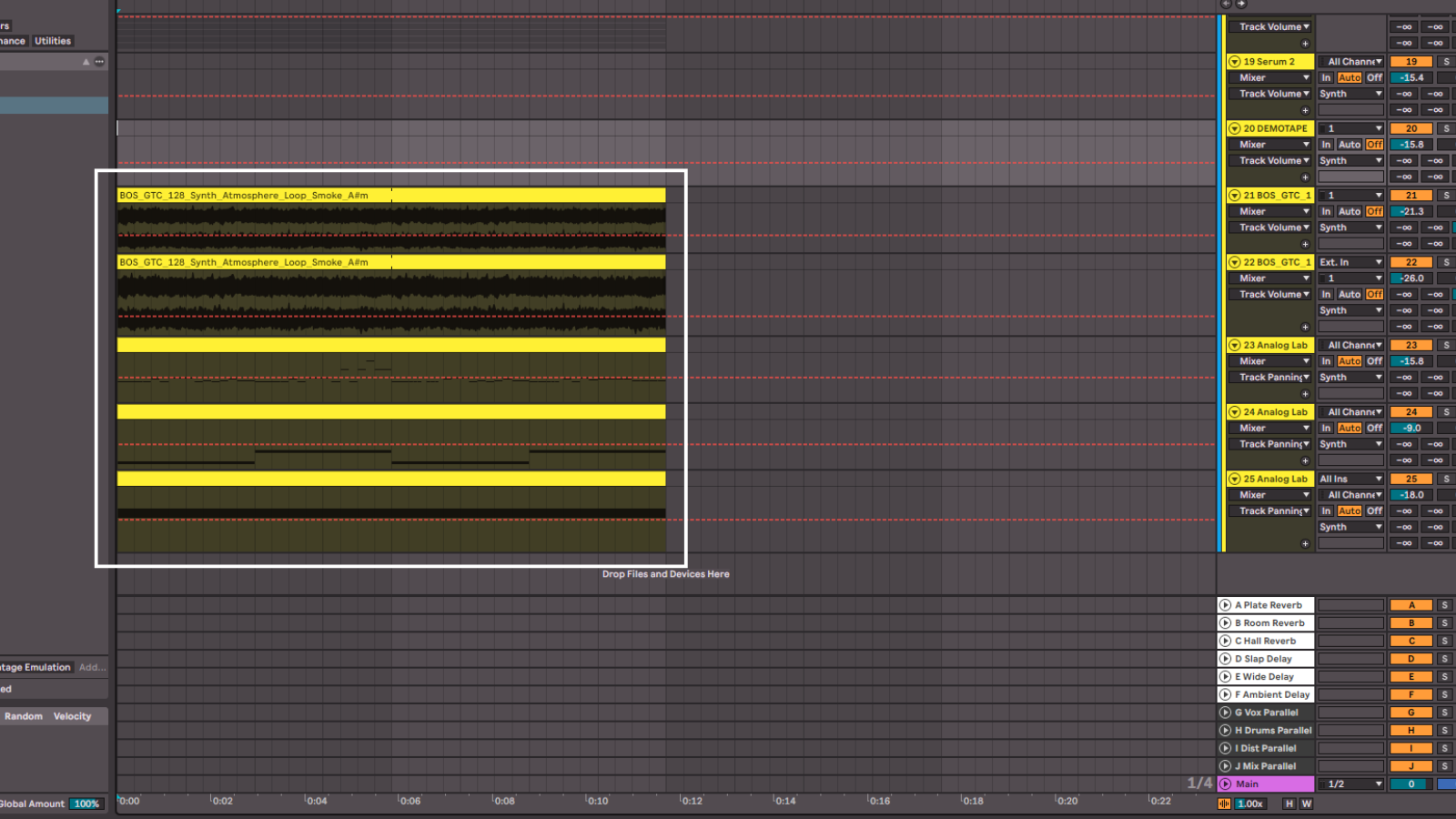
You can hear down below that this is a mixture of a few different arpeggiated synths, a synth copying the riff line, and some ambient loops. Together they sound like this:
Chorus
Now in the chorus, we introduce a new layer of melody, as you can see below:
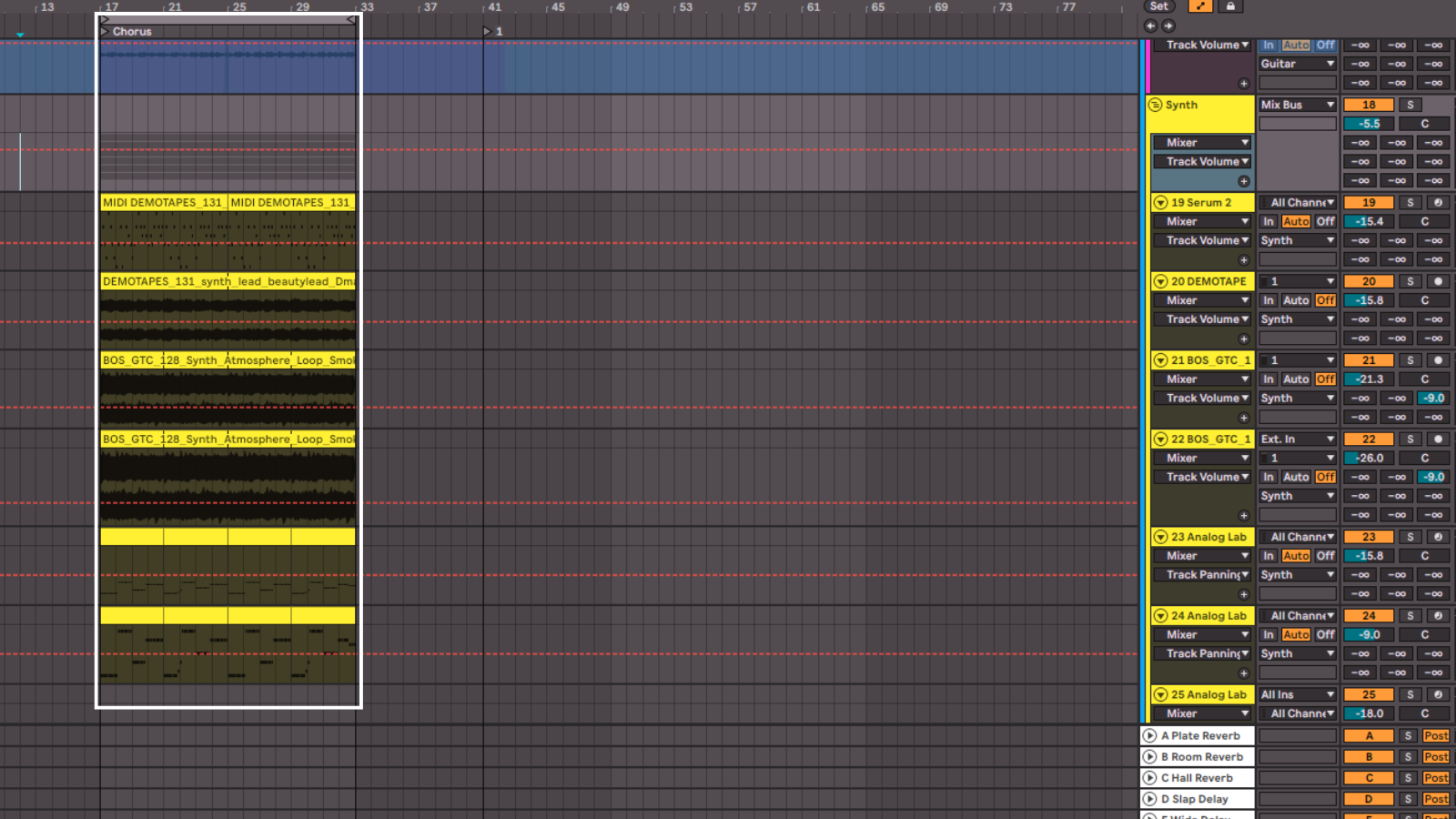
This melody is a combination of an ambient loop and then a synthesizer programmed to play the same thing as the loop that I found, as I wanted that melody to come out more. The result is this:
Conclusion
To end all of this, let’s listen to the full sections that we’ve built. Here is the main riff:
And here is the chorus:
Now where can you go from here? Well you have the two most key sections of the songs down now, so try writing the rest. Listen to your favourite songs in this genre and identify the different sounds based on what you learnt. Of course it can be an intimidating genre, but now you have the foundation to really understand how these songs are built. Enjoy!

I am a music producer, songwriter, mixing and mastering engineer, sound designer, composer, multi-instrumentalist, vocalist, and musical artist. Yeah, I know, it’s a mouthful. Basically, if it involves music, I am super into it. I recently became a full-time freelancer in the music space, having dabbled in it for around 10 years. I started playing guitar at 7 years old, and I am now almost 30 (almost!). Music has been a main part of my life since I formed memories. I literally cannot remember a time before music. I adore every aspect of creating and working on music, from starting a song to mastering and polishing the final piece. It’s all incredible.
I’ve worked on many projects over the years, including my own. I release pop/indie music where I do everything, from writing to recording to mixing to mastering, and I even create all the content around it. I do this under the name Mauve Shores. A big passion of mine is metal/alternative music, so I release music with my band Midnight Paradise. The band is literally me and my best mates, so it’s super fun. I do everything except for play drums and bass in that. The final project I release under is called Heavy Blink, and I put out LoFi Beats. I’ve even had tracks reach over 250k streams on Spotify.
Outside of my own projects, I have worked in a variety of genres. I’ve written, produced, mixed, and mastered pop songs for the artist No False Feelin’, one of which got in the UK Top 40 Spotify playlist and has almost 1 million streams. I currently create drum and bass remixes for a client, some of which have over 2 million streams. I’ve done mixes for events such as a dance recital and a business event. I’ve also done some audio cleanup and sound design for a live voice over group that do their anime in person. Right now I am working on a mixture of my own stuff, and with clients. For example, I am beginning to produce, mix, and master a death metal album, and also at the same time a teen pop style song. I love the variety that comes with this line of work.
I am also super nerdy about the gear and technology revolving around music. I could talk for days about my favorite plugins for specific things. Don’t even get me started on EQs. I began as just a guitar player, so my gear obsession has definitely been more towards pedals, but the more I got into production, the more this expanded to everything.
Outside of music, I am into a lot of different things. I love to connect with nature, whether this is through hikes or even making terrariums. I really enjoy skateboarding, playing rugby, and running. I’m also into creating things in general, I always have some DIY projects going, whether that is woodwork, or electronics. Before going full-time as a freelancer, I was a software developer for 6 years, so programming is something I still enjoy and do in my free time. Of course, we can’t forget about how much I enjoy spending time with my wife and my friends.