
We searched the web to pick the 20 best kontakt sample libraries for you in 2026.
In this Kontakt library list, you will find synths, choirs, sequencers, orchestral instruments, pianos, guitars, ethnic instruments and more!
Native Instruments Kontakt is arguably the most famous and influential sampler available today. In addition to the developer’s sample libraries, thousands of paidbest kontakt libraries.png and free libraries are available for the sampler.
Many of them have become staples for most music producers today. Hence, it’s only natural that I’m talking about the best of those libraries you can find this year. The list includes ethnic instruments, analog synths, granular synths, scoring instruments, beat-making toolkits, etc.
Native Instruments provides two versions of the software: the free Kontakt Player and the paid Kontakt. The free version lets you use the sample libraries, whereas the paid version lets you edit the samples deeply under the hood.
However, note that not all libraries open in the free version. So, make sure you check under the Compatibility section of each library on the list.
Now, without further ado, let’s have a look at the…
20 Best KONTAKT Sample Libraries 2026 (All Categories)
Native Instruments Vocal Colors

NI Vocal Colors is a Kontakt library that offers a wide range of expressive vocal samples and powerful modulation controls, making it a versatile tool for crafting hybrid textures that bring emotion to your music.
It explores the synergy between speech and synthesis, delivering inventive sounds that push the boundaries of the human voice. Whether working on cinematic compositions or forward-thinking pop productions, Vocal Colors provides hypnotic hues that ignite your creativity or add the finishing touches to your tracks.
Vocal Colors includes over 19 GB of eclectic, double-tracked vocal samples that blend electronic and organic elements. These samples offer diverse vocal expressions, from gentle whispers to passionate shouts, allowing you to create unique and expressive sounds for your music.
It has five tabs: Arpeggiator, two Layer tabs, Particles, and Global. The arpeggiator tab can help you create interesting vocal chops and movements. The Layer tabs consist of parameters for editing the sonic characteristics of the sound, like Formant, Dynamic, ADSR, Breath, etc.
- Presets: You get to customize over 250 presets or create sounds from scratch. You can choose from various arpeggiator presets, like Single, Chord, Straight, Syncopated, Mixed, Free, Continius, Odd, Slow, Fast, Random, etc. Similarly, multiple Layer(s) presets consist of loops, one-shots, rhythm, reverse, and other samples categorized as Pure, Designed, Vowel, Consonant, Percussive, Bright, Smooth, etc.
- Expressive Vocal Samples: Over 19GB of double-tracked vocal recordings spanning gentle whispers to passionate shouts, giving you a genuinely wide emotional range to pull from.
- Arpeggiator tab: Turns any loaded vocal sound into rhythmic chops and movement, with presets like Single, Chord, Syncopated, and Random covering everything from simple pulses to complex, evolving patterns.
- Enhanced COLORS Engine: The core synthesis engine driving all five tabs, blending the double-tracked samples with synthesis-style modulation for hybrid textures that sound neither purely vocal nor purely synthetic.
- Specialized Vocal Shaping Controls: Dedicated Formant, Dynamic, ADSR, and Breath parameters per layer let you sculpt the vocal character far beyond what a standard sampler offers.
- Powerful Effects and Modulation: Built-in processing across the Layer and Global tabs means you can shape a finished, mix-ready sound without reaching for outboard plugins.
Compatibility:
- VST2, VST3, AU, and AAX for Windows and macOS. Runs in the free Kontakt Player or full Kontakt.
Summary:
- Vocal Colors is a genuinely distinctive hybrid instrument — if you want vocal-based textures that feel more designed than sampled, the five-tab workflow (especially the Arpeggiator and Global pages) gives you real depth to build something unique.
Wavelet Audio Secunda

Secunda is an another library that explores throat singing, capturing the essence of the human voice and combining it with modern synthesis.
It consists of rich textures, ancient vocal harmonics, and powerful storytelling instruments based on Kaargya-style throat singing, packed in a huge 9 GB instrument. It is divided into 4 instruments: Main, One Shot, Phrases, and Stems, and it can add depth and haunting resonance to various projects, including soundtracks, film scores, trailer music, folk tunes, and electronic compositions.
Key Features:
- Flexible LFO Control: Route modulation across the instrument’s parameters to add movement to sustained drone and throat-singing textures, rather than relying on static, unchanging tones.
- Customizable Vowel Settings: Shape the vocal character of the throat-singing samples to fit your specific mix, rather than being locked into one fixed tone.
- True Legato and Round Robin Sampling: Smooth, natural transitions between notes plus sample variation on repeated notes, avoiding the mechanical repetition that can plague vocal-based libraries.
- Layered Drone Atmospheres: Combine the Tonal, Percussion, and FX layers into a single evolving soundscape, useful for building tension in trailer and film work without stacking separate plugins.
The plugin includes 3 distinct layers—Tonal, Percussion, and FX—each contributing to a rich soundscape consisting of melodic and percussive elements in drone sounds.
Compatibility:
- Kontakt Player or full Kontakt 6.5 or higher, VST2, VST3, AU, and AAX for Windows and macOS.
Summary:
- Secunda fills a genuinely narrow niche well — if your project calls for authentic Kaargyraa-style throat singing rather than a generic choir patch, this is one of the few libraries built specifically for that texture.
Native Instruments Ignition Keys

Ignition Keys is a Kontakt library for piano sounds with modern textures.
It’s one of the best piano libraries with a versatile range of sounds, from lush pads to grand synth leads to warm retro style presets, classic EPs, organs, deep Rhodes pianos, etc. In addition, the plugin has windows like FX, SEQ, and Macros to edit sounds, so the FX and SEQ windows are switchable, all packed in an intuitive and attractive interface.
The instrument has two layers of sounds: A and B, which could be tweaked and edited individually with parameters like transpose, tune, pan, volume, etc., such that you can apply two LFOs, two envelopes, and other modulators on the sound. There are also MACRO controls that you can assign and order them.
It’s great for modern Pop, RnB, K-Pop, pop-rap, pop punk, synth-pop, the 80s, and EDM genres like future bass, future pop, house, etc. Ignition keys are a diverse and flexible instrument with tweakable settings, making it suitable for sound designers.
Key Features:
- Presets: The presets in the library are labeled as Hazy Piano, GoTo Piano, Arcade Piano, Icy Piano, Glass keys, Dream Keys, twilight keys, etc. There are 151 presets like these, with 106 sounds and preset categories.
- Effects: The effects section is where most of the sound design happens. You can add many effects like compressor, reverb, flanger, phaser, eq, etc., to enhance your sounds, and add more depth, character, and room.
- Modulations: The library allows for deep modulations. You get two ADSRs, one for amplitude and the other for modulations. In addition, you can make the velocity, aftertouch, modwheel, and two LFOs the modulation source.
Compatibility:
- VST2, VST3, AU, and AAX for Windows and macOS. Runs in the free Kontakt Player or full Kontakt.
Summary:
- Ignition Keys sits nicely between a piano library and a synth — strong for modern pop, K-pop, and EDM-adjacent genres where you want keys with more texture and movement than a straight acoustic piano patch.
Ethno World 7 Complete

Key Features:
- 382 Instruments & Voices across 1,000+ patches, combining all previous Ethno World editions
- New Regional Content including Gamelan, alpine folk, and Indian, Turkish, and West African instruments
- Optimized Browser for faster navigation across the massive library
- New Microtonalities & Impulse Responses for more authentic regional tuning and ambience
- Full NKS Support for Komplete Kontrol and Maschine integration
Compatibility:
- Requires the full version of Kontakt (not the free Kontakt Player) — check the current minimum Kontakt version on Best Service’s product page before buying, since this may have moved up from earlier editions.
Summary:
- Ethno World 7 is the definitive version of the library for a reason — it’s every previous Ethno World edition plus a genuinely large batch of new regional content. If you already own Ethno World 5 or 6, the upgrade price is far cheaper than buying fresh, and it’s still the deepest single library on this list if you’re starting from scratch.
Native Instruments Mysteria
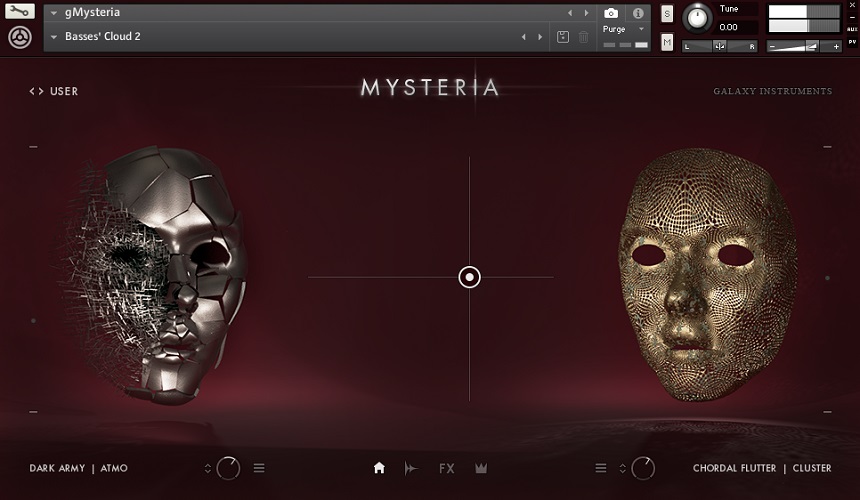
Mysteria is a distinct and immersive vocal/choir library excellent for scoring films and trailers.
It has you covered whether you want to evoke a sense of terror, wonder, dread, or ethereal beauty. It uses a variety of choir “clusters” that you can mix and manipulate to produce highly expressive sounds. Depending on the needs, the clusters include recordings of elegant harmonies or chaotic discord.
Thanks to its unique and inviting interface design, you can start with calm and beautiful sounds while smoothly transitioning into the unsettling chaos of dissonant voices. Furthermore, quick automation results in stark changes that act like impact percussions. Similarly, processed, hybrid sounds add an even more distinct quality to Mysteria’s abundant sound palette – there are over 800 sound sources, 600 layer-presets, and 350 presets to your disposal.
Key Features:
- Layers: Mysteria features two layers, each capable of loading a sound. You can then morph between them using an XY-pad on the interface.
- Incredible Recordings: Mysteria employs four choirs in its recordings. These include an epic 48-singer choir, a 24-female singers alto/soprano choir, a 24-male singers tenor/bass choir, and a modern quartet choir.
- Source Page: A small waveform icon at the bottom of the user interface opens the Source Page. Here, you can change the fundamental parameters like amp envelope, pan, tuning, mic variations, etc. The settings vary depending on the preset types loaded in each instrument layer.
Compatibility:
- VST2, VST3, AU, and AAX for Windows and macOS. Runs in the free Kontakt Player or full Kontakt.
Summary:
- Mysteria is one of the stronger choice for horror, thriller, and trailer scoring specifically — the ability to morph between clean and dissonant choir clusters on one XY pad makes it fast to find unsettling textures other libraries need multiple patches to achieve.
Native Instruments Choir Omnia

Omnia is 40-voice male and female symphonic choir captured in four independent sections in a virtual instrument.
From fantasy to mystery to gritty to dark, you can create almost any emotion with the versatile and expansive Choir Omnia by Native Instruments. It has over 70 GB of content, across four instruments, with 189 presets for smooth and effortless scoring.
It’s a rare Kontakt library that allows you to build realistic choir parts with deep customizations beyond a typical virtual instrument. Anything from syllables, intonations, phrases, timings, articulations, vowels, and voices can be customized, creating a wide range of dynamics and emotions.
Key Features:
- High-quality samples: The Kontakt instrument consists of samples recorded by world-renowned vocalists and choirs in six weeks, capturing live recordings at Sophia session studio with a world-class signal chain. The samples create an expressive and deeply customized sound design experience.
- Workflow and synth architecture: A layered engine lets you build a full choir arrangement from syllables, phrases, and sustained tones, all controllable from one central interface rather than juggling separate patches per voice type.
- Mic positions: Multiple recorded mic perspectives let you dial in anything from an intimate, close-mic’d choir to a full, reverberant hall sound without needing a separate convolution reverb.
- Keys/Sequencer: Trigger full chord voicings or rhythmic choir phrases directly from your MIDI keyboard, speeding up arrangement work considerably compared to programming each voice individually.
- Expressive capabilities: The plugin is highly expressive, especially with its Dynamic curve that allows you to set how the plugin responds dynamically, and you can set it between soft, normal, and hard. Further, you can adjust the Round Robins and Legato mode settings, the room adjustments using mic positions, genders, articulations, syllables selection, etc., along with forty different voices, allow great expressive capabilities.
Compatibility:
- VST2, VST3, AU, and AAX for Windows and macOS. Runs in the free Kontakt Player or full Kontakt.
Summary:
- With over 70GB of content and genuine control over syllables, articulations, and dynamics, Choir Omnia is one of the deepest choir libraries available — a strong pick if you need realistic, customizable choir writing rather than a static “choir pad” sound.
Heavyocity Symphonic Destruction
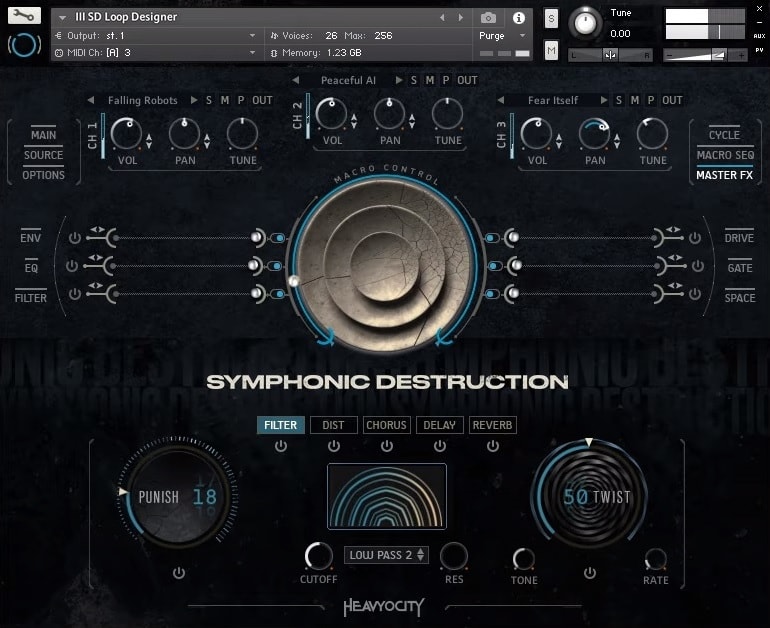
The epic film score and trailer composers receive a treat in the form of this Kontakt instrument.
Heavyocity’s Symphonic Destruction combines traditional and hybrid orchestral sounds with synths, heavy guitars, and impact sounds to deliver a highly usable toolkit for modern film and trailer scoring.
Many of the samples are from Heavyocity’s Novo strings, Forzo brass, and Vento woodwinds libraries, and the distinctive processing from Damage 2 percussions makes them as bombastic as possible.
The library features two classifications of instrument engines: Designers and Performers. Each folder contains engines and instruments dedicated to specific purposes in trailer/film scoring.
From mysterious and malicious quips of staccato passages to action-packed horns and impacts, you’ll find them all. However, there’s more to Symphonic Destruction than merely a collection of samples and loops.
Each engine in the library provides different features that allow you to manipulate and customize the samples or loops to your liking. Furthermore, macros let you control multiple parameters with the turn of a knob or your modulation wheel. This feature makes it a breeze to perform with the library.
Key Features:
- Designer Engine: The core sound-shaping engine, letting you layer and manipulate hybrid orchestral, synth, and impact elements into a single evolving patch.
- Braam and Loop Designer Engines: Dedicated tools for building cinematic braams and tempo-synced loops, pulling from Heavyocity’s Novo, Forzo, and Vento libraries alongside Damage 2’s percussion processing.
- Performer Engine: Turns loaded samples into playable, expressive performances rather than static one-shots, useful for staccato runs and rhythmic hits that need to feel human.
- Repeater: A rhythmic retriggering tool for turning a sustained sound into a pulsing, tempo-synced pattern without manual MIDI programming.
Compatibility:
- VST2, VST3, AU, and AAX for Windows and macOS. Runs in the free Kontakt Player or full Kontakt.
Summary:
- Symphonic Destruction is built specifically for trailer and film scoring impact — if you need bombastic hybrid hits and braams without manually layering three separate libraries, this does that job in one plugin.

Key Features:
- Diverse Synthesis Techniques: Offering various synthesis techniques like wavetable, granular, sampling, and subtractive synthesis, Utopia enables producers to craft various sounds, ranging from classic analog-style tones to modern, cutting-edge textures.
- Dynamic Modulation and Filtering: Deep modulation routing lets you assign LFOs and envelopes across multiple filter types, useful for building evolving pads and sequences rather than static tones.
- Expansive Preset Library: 150 patches spanning uplifting, vocal, hard, dream, tech, and progressive trance styles, giving genre-specific starting points rather than generic synth presets.
- In-Depth Sound Editor: Full access to oscillator, filter, and envelope parameters for producers who want to design from scratch rather than just tweak presets.
- Feature-Rich Effects Editor: A dedicated effects chain separate from the sound editor, so you can process a patch’s tone without disturbing the underlying synthesis settings.
- Powerful 16-Step Sequencer: Built-in step sequencing for basslines and arpeggiated leads, removing the need for a separate sequencer plugin.
- Versatile Assignable Macro Controls.
Compatibility:
- VST2, VST3, AU, and AAX for Windows and macOS. Runs in the free Kontakt Player or full Kontakt.
Summary:
- Utopia is a genre-specific tool done well — if you’re producing any style of trance, the genre-tailored presets and built-in sequencer will get you to a usable sound faster than a general-purpose synth.
Native Instruments Sequis
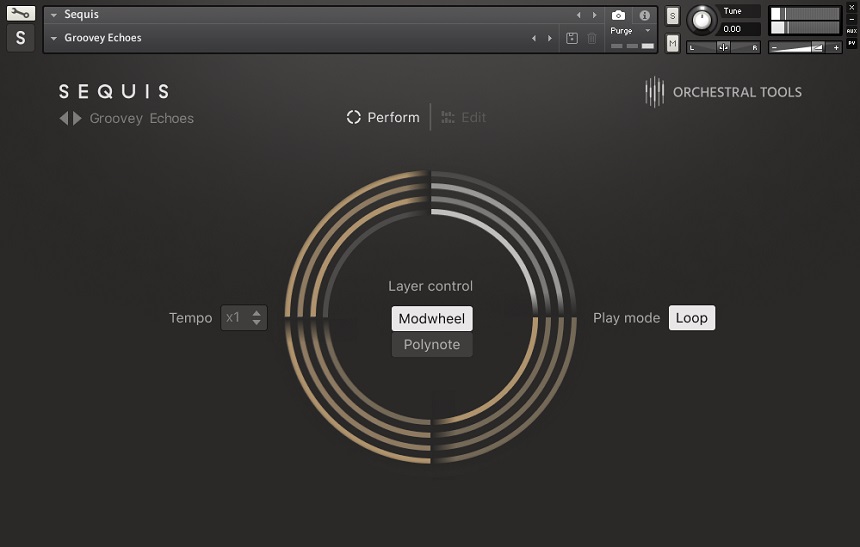
Sequis presents acoustic instrument samples with the unique potential of modern sequencingand processing.
Orchestral Tools has been producing sampled instruments for composition and orchestration for many years. They have now combined their expertise with the brilliant minds at Native Instruments to reimagine the way musicians play acoustic instruments.
Inside, you’ll find various instruments ranging from keyboards and strings to percussions and woodwinds. And you can use a pattern sequencer to play each.
The instrument selector loads a menu that divides the samples into Instruments and Articulations. Under Instruments, you’ll find guitars, dobro, banjo, viola, cello, bass, flues, bass flues, pianos, marimbas, steel tongue drums, cajons, tablas, metal and wood percussions, shakers, hi-hats, female voice, etc.
Similarly, each instrument features multiple articulations. For example, if you click on the Female Vox instrument, you’ll find different syllables, vowels, single vowels, etc., under the Articulations section. These help you add peculiarity to your rhythm.
Key Features:
- Sequencer: A built-in pattern sequencer plays back the loaded acoustic instrument automatically, letting you audition rhythmic ideas without programming MIDI by hand.
- Edit View: Adjust core sound parameters per instrument and articulation, giving control over tone and character beyond just triggering samples.
- Snapshots: Save and recall full sequencer and sound-editing states instantly, useful for quickly comparing different rhythmic or tonal variations of the same idea.
Compatibility:
- VST2, VST3, AU, and AAX for Windows and macOS. Runs in the free Kontakt Player or full Kontakt.
Summary:
- Sequis is a genuinely different way to approach acoustic instruments — instead of playing them directly, you’re sequencing them, which makes it a strong choice for producers who think in patterns and grooves rather than traditional performance.
Sonuscore Elysion II

Dive into the world of the aggressive and driving side of film and trailer scoring with the second iteration of Elysion by Sonuscore.
Elysion II comes with the entire sound palette of the original Elysion instrument (with both the GUIs available), which was a collection of ambient synth samples or highly treated acoustic instruments. Now, Elysion II adds raw and massive-sounding samples alongside a brand-new user interface and a sequencing ensemble engine from The Orchestra library.
Combine the power of the sequencer, the wide variety of the sampled instruments, and its built-in effect processors, and you’ll find Elysion II to be a formidable scoring tool all on its own.
The electronic sounds are best suited for sci-fi and action films, games, and trailers. Although, I love using such sounds combined with acoustic instruments to add impact and space to my scores.
Key Features:
- Layers: Each patch in Elysion II features five instrument slots. You can load an instrument in each to create an ensemble of sounds. Similarly, each layer lets mute/solo, shift the octave and add an arpeggiator/envelope. Note that the latter depends on the kind of instrument you have selected. Only sustaining instruments allow you to use both, whereas hits only allow arpeggiation.
- Theme Browser: Click on the preset’s name at the center to open the Theme browser with over four hundred themes. Here, you’ll find three categories: Spheres, Pulses, and Animated. Spheres feature hits and pad themes.
- Arpeggiator & Envelope: Each layer features an arpeggiator and an envelope editor. The arpeggiator lets you set the time signature, rate, order, steps count, transposition, swing, etc. And you can write custom sequences using the sequencer, where you can draw each note’s value with your mouse.
- Mixing: The Mix Page lets you control the volume, pan, and send levels to the master effects. The master effects include a compressor, delay, and reverb. The reverb is a convolution reverb with impulse responses from reputable effect processors and real-life spaces.
Compatibility:
- VST2, VST3, AU, and AAX for Windows and macOS. Runs in the free Kontakt Player or full Kontakt.
Summary:
- Elysion II is a strong all-in-one option for sci-fi and action scoring — the combination of a five-slot ensemble engine, sequencer, and built-in effects means you can build a complex, evolving cue without stacking multiple separate instruments.
Native Instruments Symphony Series String Ensemble

A 60-piece lush-sounding string orchestra ideal for epic film scores at your disposal.
Following up the release of Symphony Series: Brass, Native Instruments has teamed up this time with world-famous Audiobro, responsible for LA Scoring Strings, one of the most well-regarded and on-demand string libraries of the past few years.
Five patches or Kontakt instruments comprise this library: violins, violas, cellos, basses, and an ensemble option that works great for pads or to draw some ideas. In addition, each section is provided with a fair amount of articulations to assign up to 8 of them.
Key Features:
- Articulations: Each section is provided with up to 10 articulations consisting of sustains, sordino, tremolo, staccato, spiccato, pizzicato, octave runs, and more. T
- Section Setup: This string orchestra, like any other, is divided into 4 sections: violins I and II (conformed by 30 players and divided into 16 and 14 for each, respectively), 12 violas, 10 cellos, and 8 basses.
- Divisi: One issue with many string libraries is that each section is recorded monophonically as one, which is a problem when playing several notes simultaneously as the number of instruments is usually doubled – the more notes you play at the same time, the bigger the section gets in number –; this means that, if you have a 20-piece violin section and play two notes, you’ll have a 40-piece violin section.
- Dynamic Knob: A very large knob can be seen in the centre of the GUI. It enables to control of both volume and intensity by blending several layers of samples. This way, for example, soft bowing with a slower attack can be achieved with a low setting. Below, we find more performance controls for expression, attack, release, and brightness.
Compatibility:
- VST2, VST3, AU, and AAX for Windows and macOS. Runs in the free Kontakt Player or full Kontakt.
Summary:
- Built with Audiobro (of LA Scoring Strings fame), Symphony Series Strings gives you a genuinely lush 60-piece string sound with real divisi handling — a strong pick specifically for epic, large-scale orchestral writing rather than intimate chamber string work.
Native Instruments Symphony Series Woodwind Ensemble

An ensemble with an authentic sound and intuitive GUI aimed at professional composers.
Recorded at Montclair Presbyterian Church, Oakland in collaboration with Soundiron, this ensemble comes with 314 articulations, providing a flexibility and precision with great quality of sound. The user interface is consistent with the rest of the Symphony Series, being very minimalistic and easy-to-use.
Symphony Series: Woodwinds comes with two libraries, one for solo instruments and one for ensemble and feature the regular line-up of a woodwind section: flute, oboe, Bb clarinet, bassoon, contrabassoon, bass clarinet and contrabass clarinet – bass and contrabass clarinet are not included in the solo library. Additionally, the tenor saxophone was included to this line-up too – which regularly is not featured in a woodwind section.
Key Features:
- Legato: Smooth, natural transitions between notes across the full woodwind section, avoiding the disjointed feel that can come from purely sample-triggered playback.
- Arpeggio: Built-in arpeggiation lets you generate flowing woodwind patterns and runs without manually programming every note.
- Sound-shaping: The instruments were recorded with close, mid, and far microphones and are reflected in their respective dedicated channels – plus a stereo channel that is a combination of the three microphones – which, in conjunction with the panning controls, is useful for placing the instruments wherever we need without depending on reverb effects.
- Performance: In this section, we shape interpretation using the dynamics knob, which controls both volume and intensity, and the envelope controls for attack, release, tightness, and motion, which come in the form of sliders.
Compatibility:
- VST2, VST3, AU, and AAX for Windows and macOS. Runs in the free Kontakt Player or full Kontakt.
Summary:
- With 314 articulations and both solo and ensemble libraries included, Symphony Series Woodwinds covers a genuinely complete woodwind section — a strong choice if you need real depth beyond a generic flute-and-clarinet patch.
Native Instruments Piano Colors

If you’re tired of the same old piano sounds in your collections, Piano Colors might spark your creativity back to life.
From overtones generated with plastic pins and hand-plucked strings to strings beaten with mallets/brushes and bowed with electronic devices, you’ll come across a vast library of sounds you never thought possible from a grand piano.
On top of having a strange and exciting sample library, this Kontakt library features various sound modules on its user interface that help you bring vibrant colors to your sonic palette. These modules include multiple layers of sounds, an arpeggiator, effect processors, and more.
Furthermore, the user interface features colorful light columns behind the piano. These light columns represent the sound layers, and their width represents the volume of each layer.
Key Features:
- Noises: Among the layers in this library, one of the most important is the Noise module. When you click on Noises on the main page, you’ll open a new page with five modules. These are the various kinds of noises in the library, including pedal, mechanical, key attack, pianist, and electronic devices’ noises.
- Two Layers: Two of the layers are dedicated to sample playback, and you can load one of the many sampled instruments in this library in each layer. You can see more of their controls when you click on the Layer 1 and Layer 2 buttons on the main interface and open the Tone Page.
- Particles: You can adjust the behavior of the Particles engine on the Particles page. When you play notes on your keyboard, the Particles engine triggers and processes additional samples called particles. It creates a series of notes and tones to create a cloud-like effect.
- Arpeggiator: Turns any loaded piano layer into rhythmic, evolving patterns, letting you generate movement and texture directly from the instrument rather than programming a separate arpeggiator plugin.
Compatibility:
- VST2, VST3, AU, and AAX for Windows and macOS. Runs in the free Kontakt Player or full Kontakt.
Summary:
- Piano Colors is less a traditional piano library and more a piano-based sound design tool — if you’re tired of standard grand piano samples and want something with genuine sonic character, the Noise and Particles engines set this apart from a typical piano patch.
Heavyocity Damage 2
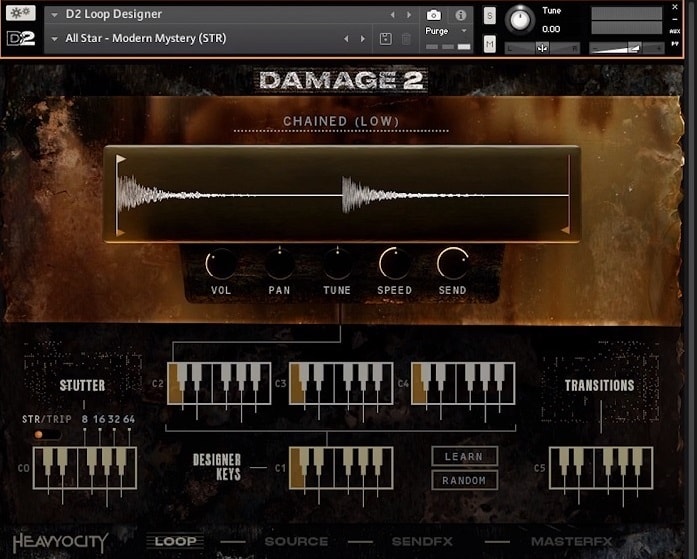
Damage 2 is one of the most extensive libraries of epic cinematic percussions.
The second Heavyocity library on the list is Damage 2, an aggressive hybrid percussion collection with 864 loops and 208 presets spread over three designer engines. You’ll find a range of sounds, from massive gran cassa and taikos to spooky gong scrapes and pristine cymbals.
Many of the sounds feature multiple mic positions, including close, room, hall, LFE, and analog Crush. On top of having a massive sound library, Damage 2 also utilizes its designer engines to produce realistic performances. You can use it for creating rolls, flairs, and even rhythms.
A single instance of Damage 2 with proper customization of the engines can act as full-on percussive backing with a humanized feel. I also like recording its performance into another track as MIDI data and editing the performance there.
Key Features:
- Ensemble Designer: The Ensemble Designer is the most important engine in this library, and it comes with presets in ten categories. Among these, the “All-Star Presets” category showcases a lot of what the engine can do. In the designer engine, you can use the Stage page to load different instruments or “sources.” Each patch can load up to thirty-six sources spread across your keyboard. If you load a bank (a preset of 12 sources), the sources will spread across an octave.
- Kit Designer: Following the Ensemble Designer, we have the Kit Designer, which is essentially a typical drum machine. You can load drum sources using the sixteen drum pads on the lower part of the Mix page, which is the default view. From C1 to D#2, these drum pads follow the GM format to keep things simple.
- Loop Designer: In this designer, you can load up to 36 loops spread across three octaves in the Source view. You can preview each loop before dragging and dropping it onto your desired note. Next, you can add four effect processors that act as sends for each loop.
Compatibility:
- VST2, VST3, AU, and AAX for Windows and macOS. Runs in the free Kontakt Player or full Kontakt.
Summary:
- With 864 loops and three dedicated designer engines, Damage 2 is one of the most flexible cinematic percussion libraries available — strong both as programmed percussion and as a source for recording humanized, performed rhythm tracks.
Native Instruments Pharlight
More Info & Price (Trial Available)
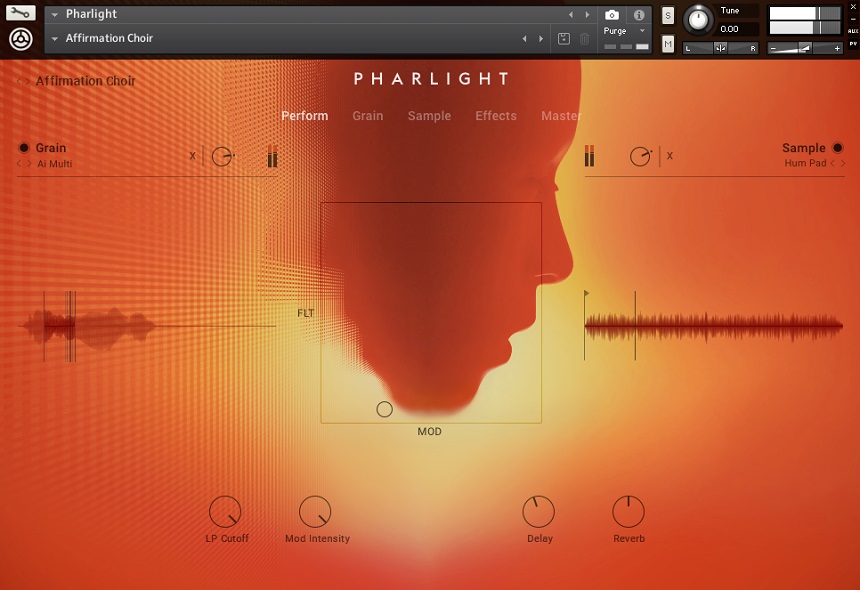
Pharlight is an innovative pad sound generator from the makers of Kontakt and is frequently utilized by cinematic composers.
Pharlight has a granular engine built from the ground up and a variety of audio sources. The granulated sounds are routed via several effect processors and modulators to produce dynamic and immersive soundscapes.
It also has a sample layer that you can use to add background noises, envelope attacks, tonal centering (for atonal soundscapes), and pads to the mix.
Most of the sound sources in this Kontakt library are vocal sounds choreographed to perform well with granular synths. These include invented phrases, noise samples, beatboxing, and choirs.
The main focus is on ensuring that the sources have spectral variations. It provides a variety of sounds for the granular synth to utilize.
Key Features:
- More Than A Library: Besides its built-in sample library, you can import wav, aif, and ncw audio files into Pharlight to use them as sound sources. Of course, you can use the custom sample as either a sample waveform or in the granular synth.
- Grain Page: The core granular engine, letting you shred any loaded sound source into evolving, textural soundscapes rather than static pads.
- Sample Page: A more traditional sample-playback layer that runs alongside the granular engine, useful for grounding a patch with a recognizable tonal or vocal element.
- Effects Page: Dedicated processing separate from the sound-generation pages, letting you shape the final mix character without disturbing the underlying granular or sample settings.
Compatibility:
- VST2, VST3, AU, and AAX for Windows and macOS. Runs in the free Kontakt Player or full Kontakt.
Summary:
- Pharlight is a strong pick specifically for atmospheric, vocal-based granular textures — the ability to import your own audio sources makes it more flexible long-term than a preset-only granular synth.
Output Substance

With Substance, gone are the days of layering multiple samples and synths to achieve your perfect low-end rumble.
Substance is a complete bass sound designing instrument featuring built-in samples of real-life acoustic instruments and dirty analog synth sounds. On the main page of the user interface, you will find a peculiar layout of three instrument layers, their controls, and macro faders that let you customize the sound quickly.
And you can also assign the macros to a MIDI CC to control them with your MIDI controller. You’ll find the power buttons to mute/enable the layers at the center of the layout. Moving out a step will lead you to the volume of each of the layers. Next, you can select various sound sources by clicking on the source name.
Outside of this section, you’ll see the category of the sound source you’ve chosen, and the logo represents the same. On the outer edge of the circular layout, you’ll find four macro faders, which differ based on the preset or your assignments.
Key Features:
- Edit Page: Deep per-layer sound editing for each of the three instrument slots, letting you shape the acoustic and synth bass sources independently before blending them.
- Mixing: Dedicated volume, pan, and effect send controls per layer, so you can balance the acoustic and synthetic elements of your bass sound without leaving the instrument.
- Rhythm Page: Built-in rhythmic and pattern tools for adding movement to a sustained bass sound, rather than relying on manual automation.
- Arpeggiator: Turns any loaded bass layer into a rhythmic, sequenced pattern, useful for basslines that need motion rather than a static low end.
Compatibility:
- Requires the full version of Kontakt 5.6.8 or higher — does not run in the free Kontakt Player.
Summary:
- Substance solves a specific, common problem well — layering acoustic and synthetic bass sources without stacking multiple plugins — and the macro-fader workflow makes it fast to dial in a finished low end rather than fighting a complex signal chain.
Native Instruments Symphony Series Percussion
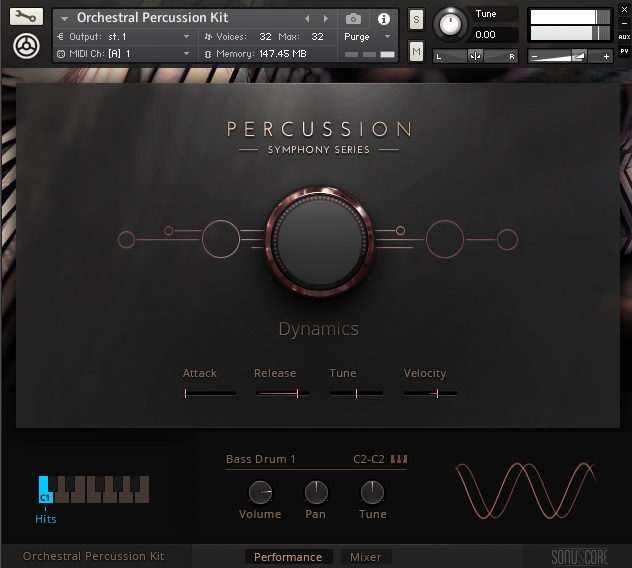
Symphonic Series Percussion provides depth and versatility with its vast collection of orchestral percussions.
This Kontakt library boasts a vast amount of 55 instruments featured. Recorded at Studio 22, Budapest, with the collaboration of Sonuscore, this collection offers flexibility with all the instruments it includes as well as the tools for shaping the timbre and performance.
Its GUI is simple and intuitive and, combined with the articulations, a large number of samples and the drum head resonance simulation, provide the users with a detailed and authentic sound with ease.
Key Features:
- DHRS: Library uses Drum Head Resonance Simulation (DHRS), a unique sampling and playback system that switches intelligently between samples of beating on a still drum head and a resonating drum head to simulate a real-life performance.
- 5 Microphones: Multiple recorded mic positions let you dial in anything from a tight, close-mic’d hit to a full, ambient hall sound without needing external reverb.
- 55 Instruments: A genuinely large orchestral percussion collection, covering the range most cinematic scores need without requiring a second percussion library.
Compatibility:
- VST2, VST3, AU, and AAX for Windows and macOS. Runs in the free Kontakt Player or full Kontakt.
Summary:
- The Drum Head Resonance Simulation technology is what sets this apart from a standard sampled percussion library — the intelligent switching between struck and resonating samples genuinely adds realism to sustained rolls and rhythmic passages.
Native Instruments Electric Vintage

Native Instrument’s Electric Vintage is a capable guitar library that lets you play rhythm and lead.
Electric Vintage faithfully reproduces the sound of the Fender Telecaster, one of the most popular electric guitars of the late 1950s. It has a flexible engine that can play lead melodies and dynamic strums with an extensive library of patterns. You’ll find hand-played strums, arpeggios, and riffs in the pattern library.
The single-coil pickups produce a nasally, twangy tone that made the Telecaster stand out throughout history. And the recordings in the Electric Vintage library accurately capture the tone. Furthermore, while the library is a natural fit for funk and pop, it also shines in hip-hop, rock, and EDM music.
Tweaking the built-in virtual amp and effects results in a large variety of tones.
Key Features:
- Rhythm Patterns: There are 231 patterns in the library, which span various genres. Strumming, open and muted chords, riffs, arpeggios, etc., let you choose the style you need for your Similarly, changing the chord voicing (fret position) opens up a whole new world of possibilities. You can also assign key switches to each pattern and play them in various orders to create custom rhythms.
- Playing Melodies: Electric Vintage comes with two instruments. The first is for playing rhythms, whereas the second is for playing melodies. Furthermore, you can also combine the melodies with the rhythm patterns. It results in a dynamic and convincing performance.
- Mixing: Electric Vintage lets you select between the bridge pickup and the neck pickup. And you can also enable doubling to add stereo width. Other settings include muted note length, fret noise, and detuning. Similarly, you can add effects to mix your guitar sound further. The Amps & FX Browser allows you to select effects like distortion pedal, EQ, compressor, reverb, delay, modulation, and tape effect.
Compatibility:
- VST2, VST3, AU, and AAX for Windows and macOS. Runs in the free Kontakt Player or full Kontakt.
Summary:
- Electric Vintage is a strong choice specifically for funk, pop, and hip-hop rhythm guitar parts — the 231 patterns and built-in amp/effects chain make it fast to get a convincing, playable part without recording a real guitarist.
Vir2 Instruments MOJO 2: Horn Section

Mojo 2 is a collection of deeply-sampled brass and reed instruments with excellent features for realistic performances.
Vir2 is one of the most known sampled instrument developers producing a variety of instruments, from mallets to guitars, and they have undoubtedly nailed the recording and programming in Mojo 2. It’s a brass library ideal for jazz, march-style music, beguine, funk, big band, pop, etc.
It features various legato modes that make playing solo parts effortless while keeping everything sounding natural.
The library features seventeen sampled instruments, including trumpet, muted trumpet, piccolo trumpet, muted piccolo trumpet, flugelhorn, muted flugelhorn, French horn, muted French horn, clarinet, baritone sax, tenor sax, alto sax, soprano sax, bass trombone, muted bass trombone, trombone, and muted trombone.
Each horn features three round robins and four velocity layers for the ultimate realism.
Key Features:
- Era: Mojo 2 comes with four era-presets: modern, retro (60s – 70s), vintage 1 (40s – 50s), and vintage 2 (20s – 30s).
- Legato: Mojo 2 features both true legato and running legato.
- Mixing: First, the library’s Mixer page provides you with three mic positions: close, near, and room. These help you adjust the raw tone of the horns. Furthermore, it also allows you to adjust the number of players from one to ten per instrument with auto-divisi.
- Mapping Page: The last page in the library’s user interface is the Mapping Page. On this page, you’ll find the thirteen articulations of the instrument.
Compatibility:
- Runs in the free Kontakt Player or full Kontakt 5.8.1 or higher, VST2, VST3, AU, and AAX for Windows and macOS.
Summary:
- With 17 sampled instruments and genuinely natural legato, MOJO 2 is one of the stronger brass libraries for jazz, big band, and funk specifically — the era presets are a fast way to nail a specific decade’s horn sound without EQ-ing it yourself.
Native Instruments Straylight
More Info & Price (Trial Available)
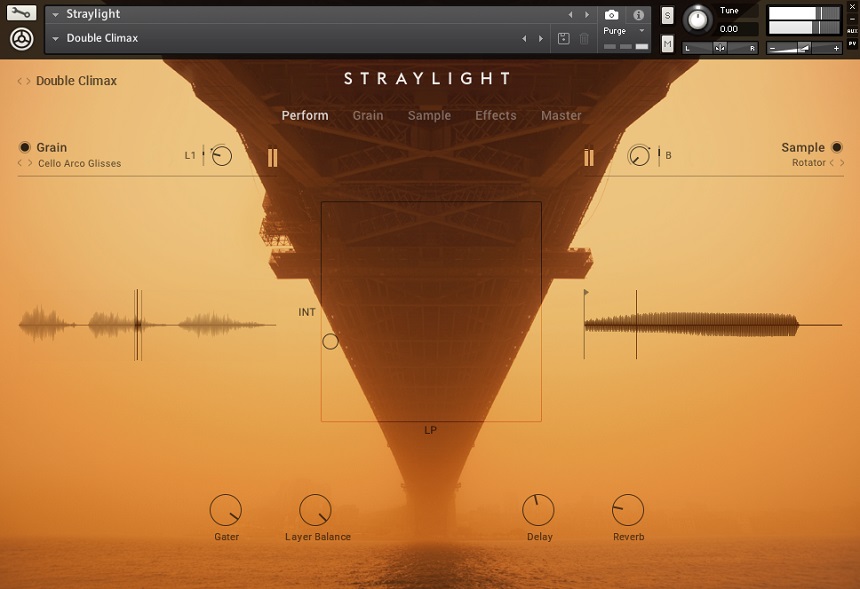
Straylight is yet another granular synth-based cinematic sound designing tool on my list and one of the best Kontakt library synths.
Ambient soundscapes, strange textures, and enveloping pad sounds are essential in film, TV, and game scores or trailers. Straylight aims to use a granular synth engine mixed with a sample player to generate organic yet superficial sounds fit for everything from post-apocalyptic sci-fi and action to moody thrillers.
The most powerful part of the library is its sample library. The sound sources include everything, from simple string ensembles to off-the-wall ideas like rubbing a rubber ball on a glass surface. The resulting library features over 360 distinct sound sources for granular and sampler layers.
Furthermore, if you are short on time, you can find your perfect sound from over 300 presets.
Key Features:
- Customize: Like Pharlight, this library also allows you to load custom samples in both the grain and sample layers.
- Granular Engine: Clicking on Grain reveals the page where you’ll find Straylight’s granular synth. As mentioned in the previous libraries, a granular synth divides a sound source into small segments called grains.
- Sample Player: The Sample page features the sample layer, which provides parameters to shape and manipulate the playback of the sample. These parameters include tuning, start offset, a filter, filter envelope, and an amp envelope.
- Effects Page: You can apply effects to each of the two layers I’ve described above on this page. There are four effect slots for each layer, and you can choose from nine effects. These effects include delay, drive, dynamics, EQ, filter, gater, modulation, reverb, and utility (stereo imager).
Compatibility:
- VST2, VST3, AU, and AAX for Windows and macOS. Runs in the free Kontakt Player or full Kontakt.
Summary:
- Electric Vintage is a strong choice specifically for funk, pop, and hip-hop rhythm guitar parts — the 231 patterns and built-in amp/effects chain make it fast to get a convincing, playable part without recording a real guitarist.
Bonus Library:
Native Instruments Schema: Dark

Schema Dark is a Native Instruments Kontakt library that offers dark cinematic loop content for music creation.
Its four-layered Kontakt interface allows for layer mixing and pan, loop playback speed, direction, and sample reverse modes. The plugin has a dark tonality ranging from field-recorded sounds to orchestral recordings. Each layer can be edited using intuitive macro knobs, mix controls, and studio-grade effects.
Key Features:
- Multi-layer loop player: Each of the four layers runs its own independent loop, so you can mix and match field recordings, drones, and orchestral textures into a single evolving sound rather than relying on one static loop.
- Easy GUI: The interface keeps everything on one screen — mix controls, macro knobs, and the four loop slots are all visible at once, so building a layered patch doesn’t mean digging through multiple pages.
- Presets: NI SCHEMA: DARK has 343 professionally designed presets that can be easily tweaked and swapped to suit individual preferences.
- Random knob: The plugin also includes a built-in way to generate sounds with a knob and the option to roll a virtual dice in each of the four loops, giving you even more creative possibilities.
Compatibility:
- VST2, VST3, AU, and AAX for Windows and macOS. Runs in the free Kontakt Player or full Kontakt.
Summary:
- Schema: Dark’s four-layer loop system makes it fast to build evolving, dark cinematic textures — a strong grab-and-go option when you need atmosphere quickly rather than sound-designing a patch from scratch.
Conclusion
That’s 20 Kontakt libraries covering just about every corner of production — vocal and choir tools like Vocal Colors and Choir Omnia, cinematic percussion from Heavyocity’s Symphonic Destruction and Damage 2, orchestral sections via the Symphony Series, and sound-design workhorses like Pharlight and Straylight for anything ambient or granular.
If you’re after authentic world and ethnic instrumentation specifically, Ethno World 7 Complete remains the deepest single library on this list, covering nearly every corner of the globe in one collection.
If you’re scoring for film or trailers, start with the Heavyocity and Sonuscore libraries — they’re built specifically for that kind of impact. If you’re producing pop, hip-hop, or electronic genres, Ignition Keys, Electric Vintage, and Utopia will get more day-to-day use.
Remember to check the Compatibility notes on each library before buying — not every one runs in the free Kontakt Player, and some require the full paid version to load properly.

The Integraudio Editorial Team consists of experienced music producers, audio engineers, and plugin enthusiasts dedicated to providing in-depth reviews and guides for music production software.