
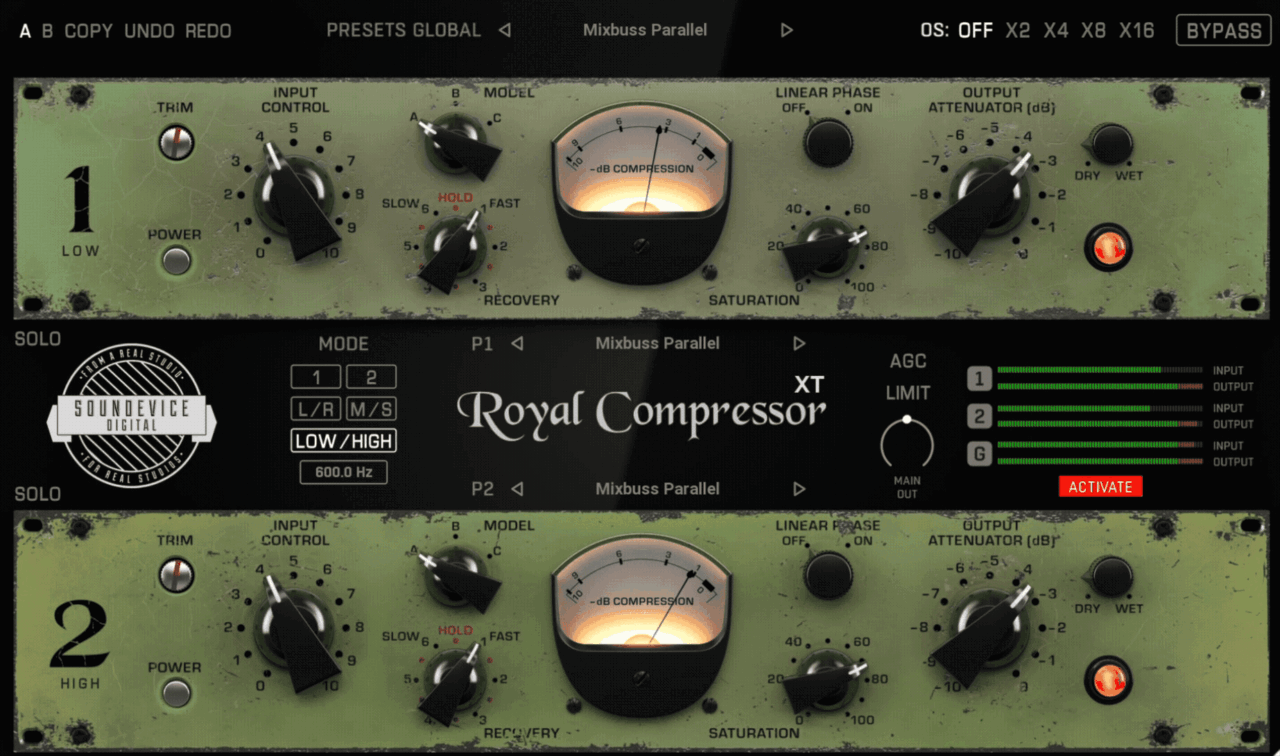
I have always liked compressors that add character and movement instead of simply controlling peaks, and United Plugins Royal Compressor XT takes that idea in an interesting direction. After trying it across different material, what impressed me most was not simply the familiar vari-mu warmth, but how much more useful that sound becomes when you can decide exactly which part of the signal receives it.
Royal Compressor XT essentially puts two complete Royal Compressor units inside one plugin. The signal can be processed normally or split into L/R, Mid/Side, or Low/High, with independent Model, Recovery, Saturation, Output, and Dry/Wet controls for each side.
In practice, that changes the way I use it quite a bit. I can keep the center of a mix controlled while leaving the sides more open, tighten the low frequencies without flattening the top, or give the two sides of a stereo recording slightly different compression. It still feels like a vintage character compressor at heart, but XT adds the kind of control I normally associate with much more modern dynamics processors.
Key Features
| Key Feature | What It Does |
| Dual Vari-Mu Compression | Places two complete Royal Compressor units inside one plugin, each with independent controls. |
| L/R Mode | Processes the left and right channels independently, useful for stereo recordings and double-tracked material. |
| Mid/Side Mode | Separates the center and sides for different compression, saturation, and blending. |
| Low/High Mode | Creates a two-band vari-mu compressor with an adjustable crossover, set to 600 Hz by default. |
| Modes 1 & 2 | Preserve the more traditional Royal Compressor-style workflow when dual split processing is not needed. |
| Three Circuit Models | Models A, B, and C provide different fixed attack characteristics, from 70 ms on Model A to 17 ms on Model C. |
| Recovery & HOLD | Six stepped recovery times plus HOLD settings for much longer gain-reduction behavior. |
| Independent Saturation | Lets you adjust the valve-style coloration separately from the amount of compression. |
| POWER & SOLO Per Unit | Bypass or audition either compressor independently. |
| Independent Dry/Wet | Provides separate parallel compression control for each unit. |
| Linear Phase | Each section can switch to Linear Phase processing, with additional latency. |
| AGC & Limiter | Automatic gain control helps maintain level, while the global limiter catches output peaks. |
| Up to 16× Oversampling | Offers Off, 2×, 4×, 8× and 16× modes for cleaner saturation processing. |
| Unit & Global Presets | Separate P1/P2 preset systems plus full global presets and transferable settings. |
| A/B Comparison | Stores two complete setups for fast comparison, with a Copy function between them. |
Features
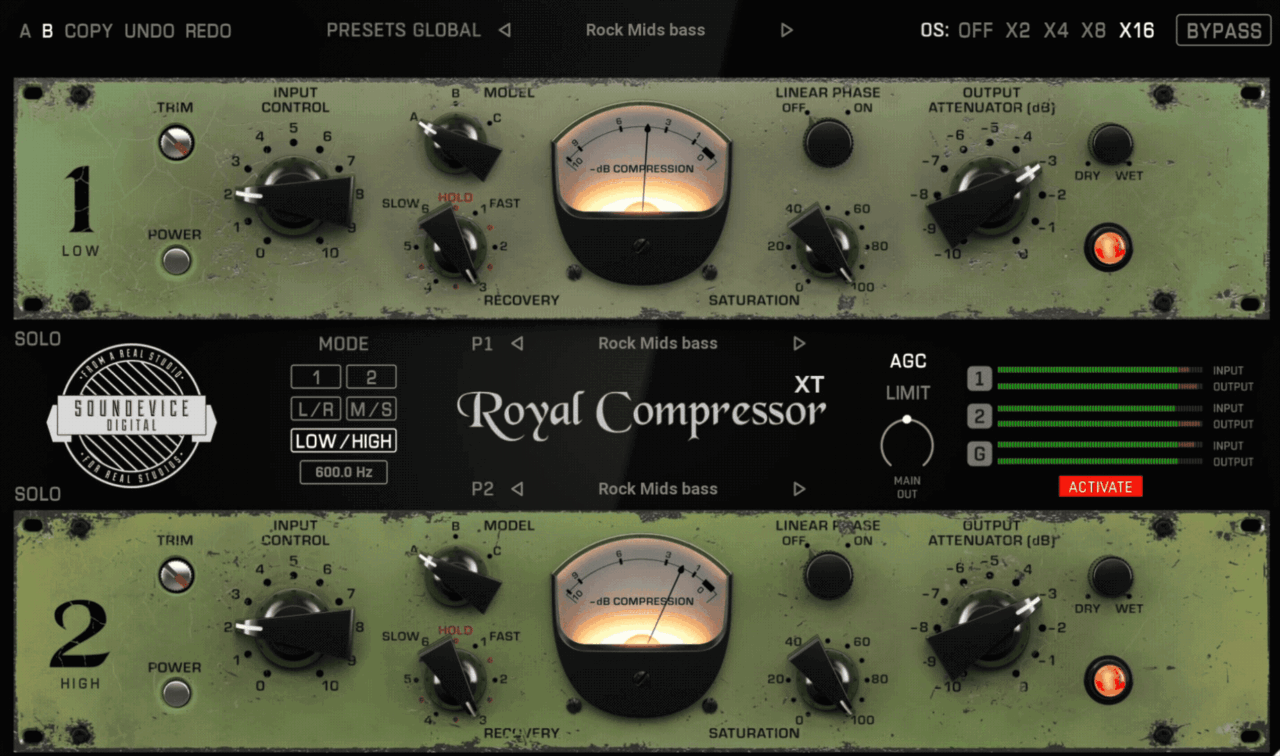
Royal Compressor XT keeps the original compressor at its core, but the dual-engine architecture changes how flexible that sound can be. Each unit has its own Trim, Input, Model, Recovery, Saturation, Output Attenuator, Dry/Wet, Power, and Solo controls.
L/R and Mid/Side Processing
L/R mode lets the two channels react independently, which I found useful on stereo recordings where one side was consistently pushing the compressor harder. Stereo overheads and double-tracked guitars are obvious examples, but it can also help correct slightly uneven stereo material without changing the overall balance manually.
For me, Mid/Side mode is even more interesting. I can keep kick, bass, and lead vocal more stable in the center while allowing the Side channel to breathe, or do the opposite and drive the sides harder for extra density and ambience.
Low/High Split
Low/High mode turns XT into a two-band vari-mu compressor. The crossover defaults to 600 Hz but can be adjusted, with Unit 1 processing everything below the split and Unit 2 handling everything above it.
I liked this most on bass-heavy buses and full mixes. Being able to control an overactive low end while letting the upper frequencies keep more movement made Royal Compressor XT feel far more flexible than a conventional vintage compressor.
3 Circuit Models
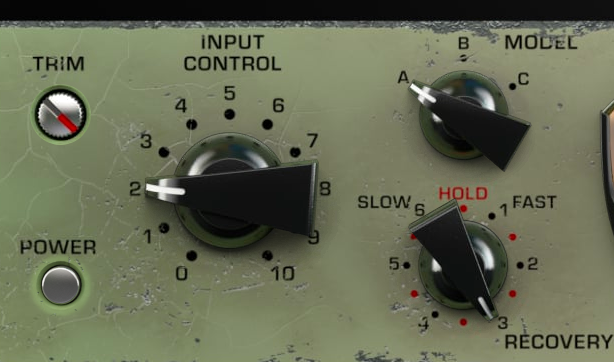
The three A/B/C Models come from different units of the modeled hardware, each with its own fixed attack behavior. Model A is the cleanest and slowest at 70 ms, while Model C is the fastest and most colorful at 17 ms.
I found myself choosing the model more by feel than by attack time. Model A worked nicely when I wanted the transients to remain open, while the more colorful options made more sense when I deliberately wanted the compressor to become part of the sound.
Recovery, HOLD and Saturation
Recovery provides six stepped release settings plus five HOLD positions. The HOLD settings keep the signal close to its most recent compressed level for an extremely long release, which can create very different envelope behavior compared with a normal compressor release.
I also appreciate having Saturation independent from compression. Sometimes I liked the dynamic behavior but wanted less color, while other times I pushed Saturation specifically for the added valve character without needing excessive gain reduction.
Power, Solo and Linear Phase
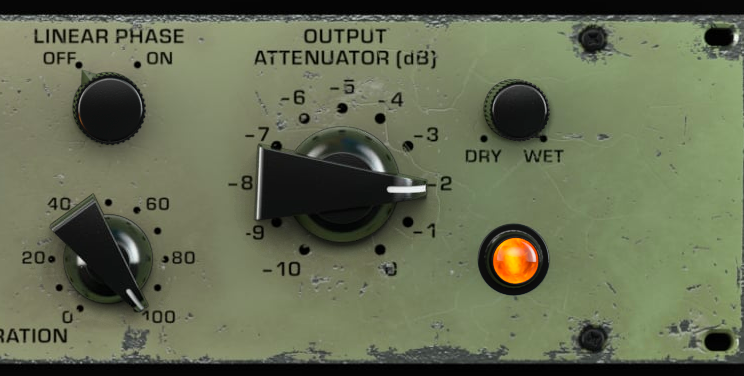
Each section has independent POWER and SOLO, and these became much more useful than I initially expected. When working in M/S or Low/High mode, soloing one unit makes it immediately obvious what part of the signal I am actually changing.
There is also a Linear Phase option for each unit. It increases latency, so I would not leave it on automatically, but it is a useful addition when frequency-split processing needs more phase-conscious behavior.
AGC, Limiting and Oversampling
The global section includes AGC, output limiting, Main Out, and separate meters for Unit 1, Unit 2, and the global signal. AGC follows changes in input gain while leaving the individual Output Attenuators alone, which makes it easier to experiment with stronger saturation without immediately being fooled by extra loudness.
Oversampling runs from Off through 2×, 4×, 8×, and 16×. I generally would not jump straight to 16× while building a mix, but it is useful when driving Saturation harder or when rendering the final result.
Interface and Workflow
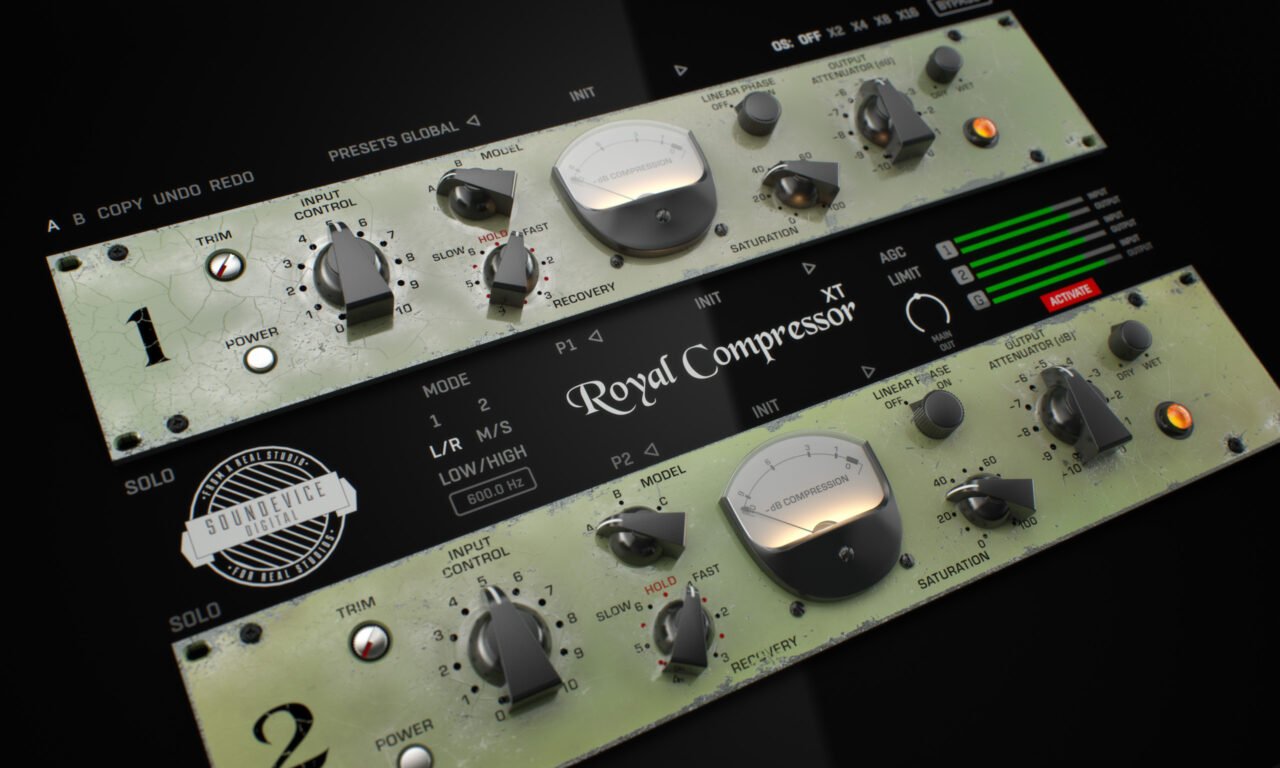
Royal Compressor XT still looks and behaves like a vintage compressor, but the layout does a good job of making the two processing paths understandable. Both units stay visible, while the central mode section makes it clear whether I am working in L/R, M/S, or Low/High.
After using it for a while, I found the best workflow was to start simple. I would first get the basic Royal Compressor sound working, then move into one of the split modes only when I could clearly hear a reason for treating two parts of the signal differently.
The individual SOLO and POWER switches help enormously here. On a Low/High setup, for example, I can solo the low band, adjust its compression and Saturation, then check the high band separately before returning to the full mix.
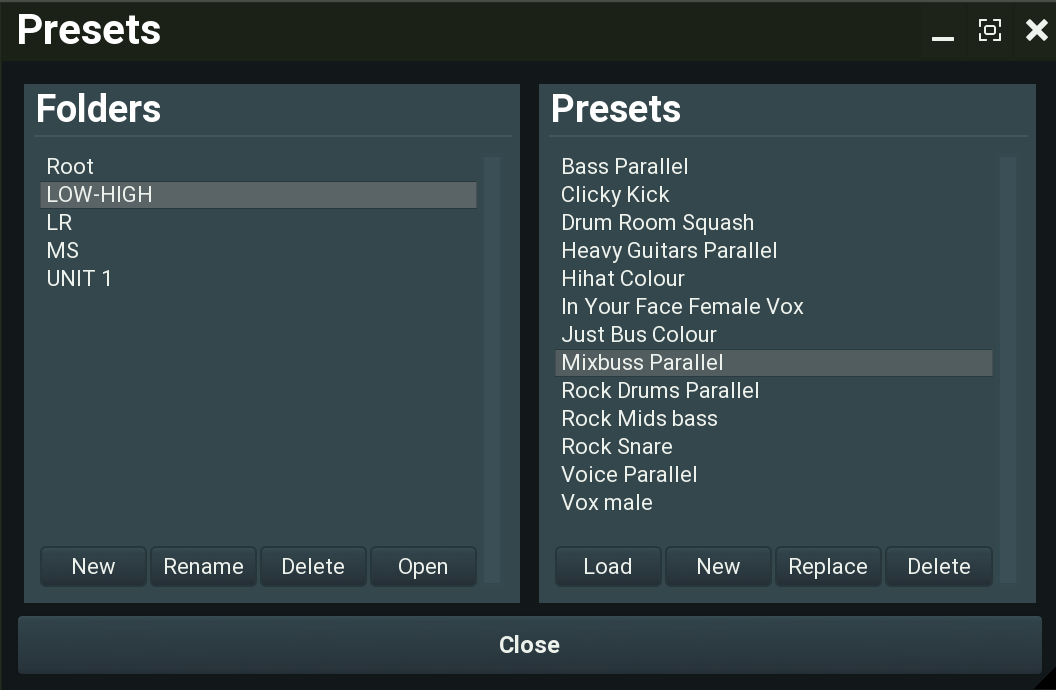
Preset handling is also more complete than I originally realized. There are P1 and P2 preset browsers for the individual units, global presets for the entire plugin, plus A/B states with a Copy button. Settings created for one compressor can also be loaded into the other.
The interface itself is freely resizable, and right-clicking provides access to additional settings such as GUI scaling, GPU acceleration, licensing and Intelligent Sleep. Despite the extra capabilities, I never felt that XT lost the relatively direct character of the original compressor.
First Impressions and Sound
After actually spending time with Royal Compressor XT, the biggest surprise for me was how often I used the split modes for fairly subtle corrections rather than dramatic effects. The plugin can certainly be pushed into heavy, colorful pumping, but I enjoyed it most when the two compressors were only doing slightly different jobs.
On a mix bus, Mid/Side became my favorite mode. I could apply a little more control to the Mid channel, keeping the kick, bass, and vocal centered, then use gentler compression and slightly different Saturation on the sides. The result felt more stable without making the stereo image feel pinned down.
The Low/High mode was probably the second most useful in my testing. On material where the bass was driving the gain reduction too aggressively, compressing the low band separately helped the top remain much more open. I also liked reversing that idea, keeping the lows relatively untouched and adding more valve color to the upper band.
On vocals and bass, I often preferred the simpler Royal Compressor-style approach. Model A has enough space around the transient to keep things smooth, while the faster and more colorful models can make a source feel more forward when that is what I want.
The Saturation control is a big part of the sound for me. At moderate settings it adds warmth without immediately announcing itself as distortion, but it can become much more obvious when driven. The official page also notes that the saturation system includes a random element, which helps explain why the color is not presented as a completely static process.
My main tip is not to assume that two compressors automatically mean more compression. Some of my favorite results came from compressing only one side of the split, or using noticeably less gain reduction on one unit than the other.
Overall, Royal Compressor XT still sounds like a characterful vintage vari-mu compressor, but it no longer forces that color onto the entire signal in the same way. That ability to choose exactly where the warmth, pumping, and saturation happen is what made XT feel genuinely different in use.
Compatibility
| Specification | Details |
| Plugin Formats | VST/VST3, AU, AAX compatible hosts |
| Operating Systems | Windows and macOS |
| Audio Processing | 64-bit internal processing |
| Sample Rates | Supports any sample rate, including 192 kHz and above |
| Oversampling | Off, 2×, 4×, 8×, 16× |
| GUI | Fully resizable |
| Activation | License-file system via UnitedPluginsManager |
| Trial | 15-day fully functional trial, without noise or save restrictions |
| CPU Management | Intelligent Sleep reduces processing when no signal is present |
The official page confirms 64-bit internal audio processing, support for high sample rates, Smart Bypass and Intelligent Sleep. It also uses United Plugins’ license-file system, with no iLok or hardware dongle required.
I did not find the plugin particularly complicated to manage in a normal session. Higher oversampling and Linear Phase naturally add more processing or latency, so I would mainly reserve those options for situations where they provide an audible benefit rather than leaving everything at maximum.
Pros and Cons
Pros
- Great vari-mu character
- Flexible L/R, M/S and Low/High processing
- 3 useful circuit models
- Independent Saturation and Dry/Wet
- Practical Power and Solo workflow
- Linear Phase option
Cons
- Split processing takes some time to explore
- More features than needed for basic leveling
- Linear Phase and high oversampling increase processing demands
Last Words
After trying it properly, Royal Compressor XT feels much more substantial than simply putting two copies of Royal Compressor in the same window. The original vari-mu tone is still the reason I would reach for it, but Mid/Side and Low/High processing give that color a level of precision I did not have before.
For me, Mid/Side is the standout addition for buses and mastering, while Low/High proved surprisingly useful whenever the low end was controlling too much of the compressor’s behavior. I also like that I can simply switch one unit off and process only the sides, lows, or highs when that is all the track needs.
United Plugins has also handled the upgrade nicely. Anyone who purchased the original Royal Compressor before XT receives Royal Compressor XT for free, an XT license also unlocks the original plugin, and Royal Compressor itself has joined the United Free Bundle.
Royal Compressor XT launches at €15 instead of the regular €69 until the end of November, with a fully functional 15-day trial available. At that introductory price, I think it is particularly easy to recommend if you enjoy vintage compression but want much more control over where that character actually hits the mix.
If you’re weighing up alternatives, our guide to the best vari-mu compressor plugins covers the main contenders.

Berk is a multi-instrumentalist musician from Istanbul, Turkey. He has been playing guitar, handpan, and percussion for over ten years, developing a sound that blends melodic sensitivity with rhythmic depth.
He began his musical journey as a teenager, learning guitar and performing in several bands. In 2016, he discovered the handpan, an instrument that immediately resonated with him on a deeper level and gradually became central to his artistic identity.
Since then, he has performed in streets, festivals, bars, and concert venues across different countries, connecting with diverse audiences through both intimate and large-scale performances.
Alongside his live work, Berk is deeply involved in studio production. He works from his home studio, where he composes, records, and produces his own music. His studio serves as a creative space for layering handpan, guitar, and percussion with modern production techniques, allowing him to shape fully realized, atmospheric compositions from start to finish.
His music explores a wide range of genres and textures, combining organic acoustic instruments with detailed studio production to create immersive and expressive soundscapes.