

This article will review some of the best hardware metronomes, focusing on their main features, facilities, and price-quality ratio.
The metronome was created in Europe more than 200 years ago, and although it has changed and evolved over time, its purpose remains the same: to mark the beat of a piece of music and help the musician be in harmony with it the tempo.
Although there are still analog metronomes, digital ones are the most used since they are more versatile, easy to obtain, and better adapted to the requirements of modern music. As a result, it is an essential piece within the set of any drummer, music student, or recording studio.
In a nutshell, here is our list:
2. Korg KDM-3 Digital Metronome
7. Tama RW30 Rhythm Watch Mini
Depending on the purpose we have, there are different options available in the market that will allow us to meet these requirements. Things like the volume of the metronome, the duration of its battery, or the setting options are some things we will have to consider when making the best possible choice for our hardware.
The 11 Best Metronomes For Musicians
1. Boss DB-90
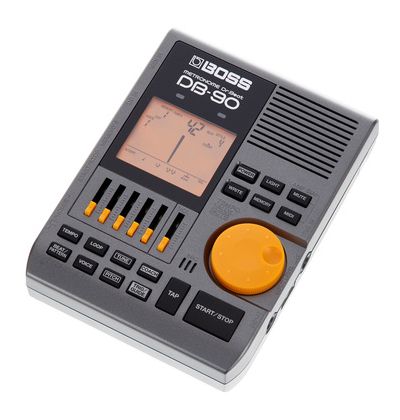
Boss is one of the leading manufacturers of musical effects and accessories thanks to the quality of its products, and the DB-90 is a clear example of this. This model includes different drum patterns, ideal for practicing with different instruments, and many settings available. Therefore, when we purchase this product, we must consider that it is not just a metronome but has many functions, making it very versatile.
It offers the possibility of connecting a guitar, a bass, or a microphone to play directly from the metronome, and it has a MIDI input to connect a sequencer if we wish. Comfortable, compact, and with a generous screen, the Boss DB-90 is one of the best and most complete options in metronomes.
Key Features:
- Note Mixing Function
Allows you to adjust parameters and edit patterns to create different drum bases and beats. It has a rotary dial to easily change the BPM, comfortable rubber buttons, a memory bank with a capacity for 50 patterns, and headphone output.
- MIDI Connection
This allows us to connect a sequencer or a computer to edit the beats manually if needed. They also include a function to tune instruments.
- Instrument Connection
It includes a connection for guitar or bass, an amp simulator to practice using the drum bases that the DB-90 has, and a connection for V-Pad. It also includes a Tap button and an input to connect a pedal that allows us to pause or play without using our hands. Two 6.3 jack and 3.5 mini-jack audio outputs.
- External 9V Power
Very useful when there is the possibility of connecting to the electrical network and thus saving battery. It also includes a dust cover to transport it and keep it protected.
2. Korg KDM-3 Digital Metronome
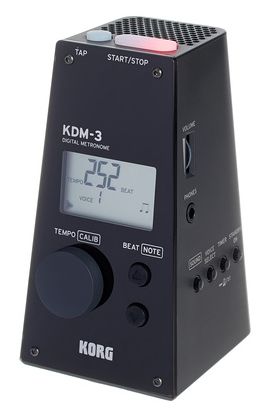
This model made by Korg tries to aesthetically imitate a mechanical metronome, standing up instead of lying on the surface. It is designed so that the user can operate it using only one hand because it has buttons for each function and not a diving menu.
It has different sounds and settings, is lightweight, and works with four AAA batteries, giving it a range of between 15 and 20 hours of optimal performance. Its screen is in high contrast, and its speaker has enough volume to practice without problems. Its tempo range is from 30 to 252 BPM. This metronome is around 65 dollars.
Key Features:
- 19 Beat Pattern
It combines different patterns and rhythms and the possibility of modifying them to emulate various musical styles. It includes eight metronome sounds we can choose from and a reference note mode for tuning instruments. Its calibration range is from 410hz to 480hz, and it has a 3.5mm stereo headphone output.
- Led Markers
This allows us to practice at low volumes or muted, guided only by the lights if necessary. In addition, it has a Tap button, memory backup, and an automatic shutdown mode that activates when it is not used for a certain time.
- Timer Mode
Thanks to this, we can configure the duration of each session and thus have greater control over the practice time. A good option for when we want to divide the practice into different intervals.
3. Thomann CTM-700
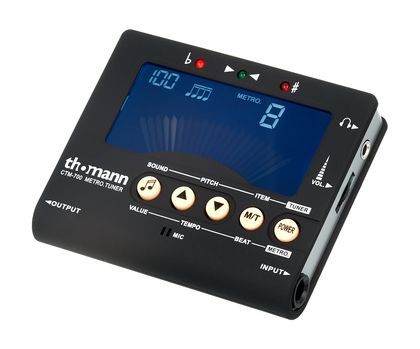
This pocket metronome/tuner designed by Thomann is a compact, simple and economical option that covers all the requirements that a product of this type needs. Despite its size, its screen is large enough to be appreciated without difficulty, and its construction is robust.
It has a precise performance as a tuner, and its microphone has a high sound perception. It works with two AAA batteries, which gives it a range of around ten months, which is outstanding. This product is around 15 dollars.
Key Features:
- Input/Output Jacks
Allows you to connect a microphone or instrument at the input and players or amplifiers at the output to better appreciate the sound. It also includes a mini jack output for headphones and volume control.
- Adjustable Range 30 – 260 BPM
It has a simple metronome function that covers the entire range of beats per minute. In addition, it includes a subdivision of time, dividing the rhythm with eighth notes, sixteenth notes, or triplets if we wish.
- Tuner Clip
In addition to the integrated microphone, this product also includes a clip-on pickup with plug output to tune instruments directly from the vibration it perceives, which is very useful for acoustic instruments.
4. Tama RW200 Rhythm Watch
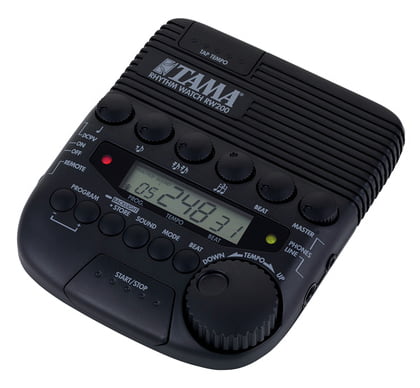
The Tama RW200 Rhythm Watch is a professional-quality metronome, packed with all the features you need for studying, practicing, or playing live, and just the right size for easy portability.
It has a wide range of BPM (35-250), an LCD screen with a backlight, memory to store drum patterns, and a footswitch to control some of its functions without using your hands. With a black plastic finish and good construction, this metronome is around 100 dollars.
Key Features:
- Customize Beat Divisions
It has many patterns, sounds, led lights, and nine different rhythm configurations. It also allows you to customize the beats by adding quarter and eighth notes to each measure.
- Memory Bank
We can store up to 30 tempos or beats to resume our practice directly from where we left off. It includes a Tap button for an intuitive tempo setting and a convenient rotary dial for quick adjustments.
- Footswitch Function
We can add a footswitch to control the on/off and some programming functions. This metronome has a stereo output for headphones, an integrated speaker, and a master output to connect to another device. It works with a 9V battery and also offers the option of connecting an external adapter.
- Clamping Support
It includes a universal M8 mount at the top to hold a drum set clamp and thus integrate it comfortably into your rehearsal or live sessions. The Tama RW200 also comes with a dust cover.
5. Boss DB-30
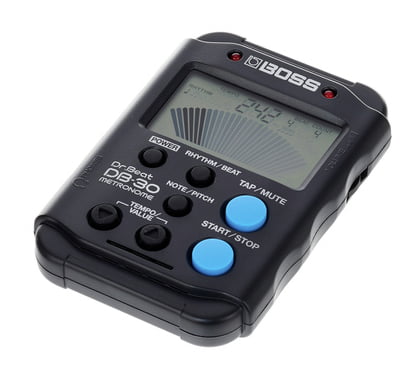
This pocket metronome designed by Boss is another good and comfortable option available anywhere we take it. Includes tuner function and stereo headphone output.
It works with a 3V lithium battery that must be replaced on average every six months if we regularly use the metronome. It includes all the classic and most used configurations in digital models. This product is around 50 dollars.
Key Features:
- Nine Rhythms 24 Variations
We can configure different drum patterns and modify the beats easily and intuitively. Includes Tap tempo button, mini plug output for headphones, and volume control. Its tempo range is 30 – 250 bpm.
- LCD And Led Indicators
This model has a flat construction, with a screen large enough to be able to appreciate the digital indications on it. The LEDs flash at the end of each bar and are also a good reference.
- Tuner Function
You can play up to twelve tones that serve as a reference for tuning instruments. It also includes a clip for holding sheet music and a coin slot that makes the metronome tilt for better viewing.
- Auto Power Off
This function allows the metronome to turn itself off when it is not used for a certain period to save battery life.
6. Wittner QM2 Metronome
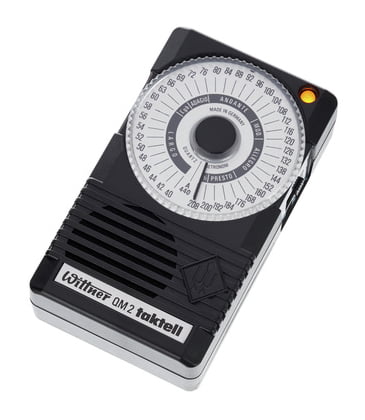
The Wittner QM2 is a digital pocket metronome without too many added functions or complex settings, but it perfectly meets the user’s needs.
This model has a rugged construction, comes with a speaker and an integrated LED, and the sound of its click tries to imitate an analog metronome, making its sound not as bright and sharp as other digital metronomes. The Wittner QM2 is around 60 dollars.
Key Features:
- Rotary Dial
Allows you to select the tempo manually in a comfortable and fast way and keep it even if the metronome is turned off. Its tempo selection range is 40 – 208 BPM.
- Light/Beat Modes
It has a switch that can be used in two different positions. The Beat Mode plays sound and light, while the Light Mode only activates the led but does not play sound. Includes a mono output for headphones.
- Maximum Durability
This metronome works with a 9V battery that, thanks to its few functions, can last many hours until it needs to be replaced. However, some users have claimed to use the same battery for years.
7. Tama RW30 Rhythm Watch Mini
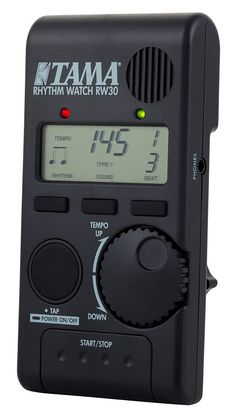
The Tama RW30 is a portable version of RW200, very similar in terms of its functions, but smaller and with some differences. Its backlit display, wide variety of settings, and stereo headphone output make it another great option for metronomes in the $45 range.
This model, designed by Tama, is geared toward drummers and stands out for its versatility in a device no more than 4.7 inches long. It runs on two AAA batteries and includes a useful belt clip.
KeY Features:
- Start/Stop & Tap Buttons
Ideal for pausing and making the necessary configurations. The start/stop button is quite wide, which makes it easy to use. The tap tempo allows you to select the BPM intuitively and is very useful when you want to follow a rhythm in your head.
- Six Rhythm Patterns
This model allows you to choose between six different rhythms, giving the possibility of imitating different musical styles. We can also choose between two click sounds. Integrated speaker, markers, led volume control, and stereo output for headphones.
- Rotary Dial
This type of selector allows you to scroll through the different values using just one finger, thanks to its ergonomic shape. We can choose between a range of 30 bpm – 250 bpm. Its backlit display is very useful for situations with little light.
8. Korg TM-60 Black

The Korg TM-60 is a combo that offers many options in the palm of your hand, both as a metronome and tuner. It has enough settings to rehearse or practice emulating different rhythms. In addition, it has a chromatic tuner and an input to connect microphones or instruments.
This model includes a built-in speaker and microphone and is among the best metronome/tuner options due to the number of facilities it offers and its low cost of around 30 dollars. In addition, both modes can be used simultaneously.
Key Features:
- Wide Backlit Display
This display is large enough to appreciate the settings and has a backlight that can be adjusted to two intensity levels, which is ideal for adding clarity.
- 15 Onboard Rhythm
It includes many rhythm variations that we can edit. It has up to 9 and 5 additional triplets and quadruplet options. Two metronome sounds to choose from, an led marker, headphone output, volume control, and tap tempo button. Its tempo range is 30~252 BPM.
- Auto Power-Off Function
This function allows the metronome to turn off itself after not being used for 20 minutes to save energy. It works with two AAA batteries and has a backup memory to resume the same BPM used last time you turned on the metronome.
- Contact Microphone
In addition, it includes a contact tuner that can be plugged into the metronome through its input to tune acoustic instruments. Its integrated microphone’s ability to perceive tones from C1 to C8.
Conclusion
Each metronome has accentuated certain functions that, depending on our needs, we will analyze to find out the best option. Some have their strong point, their sound quality, others their functionality, and others their comfort. The best option will be the one that best suits us, and at the same time, means a good investment of our money.
Digital metronomes are the most versatile and, simultaneously, the most required by musicians today. The more we get used to using these devices, the easier it will be for us to choose the next one.

The Integraudio Editorial Team consists of experienced music producers, audio engineers, and plugin enthusiasts dedicated to providing in-depth reviews and guides for music production software.