
This article will discuss if studio monitors are suitable for DJing.
DJing is an art that requires specific equipment like DJ controllers, DJ mixers, DJ turntables, DJ CD players, DJ headphones, DJ software, and DJ lighting. As a DJ, you must constantly monitor your mixes, for which many professionals use headphones. However, headphones could get tiring on the ears, especially during practice.
Hence, to avoid ear fatigue and protect your hearing, you can use monitor speakers instead of headphones for practicing and also monitoring during your live set. Now let’s address the primary topic of concern.
Are Studio Monitors good for DJing?
Yes, studio monitors can be suitable for DJing, as they are designed to provide accurate and balanced sound, which is essential for DJs who need to accurately hear the music they are playing and mix it with other tracks. However, they may not be optimized for high-volume club environments.
DJ monitors designed for live performances may be a better choice. They are speakers explicitly intended for use in DJ setups, such as those found in nightclubs, concert venues, and other live performance environments. They are designed to provide high-volume output, accurate and detailed sound, and reliable performance.

Some DJ monitors also feature built-in equalization and other features to help fine-tune the sound for the specific needs of the DJ. DJ monitors are an essential tool for DJs, allowing them to accurately hear their music and mix it with other tracks in real time.
On the other hand, studio monitors are speakers designed for recording studios, production rooms, and other professional audio environments. They are designed to provide accurate and balanced sound reproduction, allowing audio engineers and producers to hear every detail of the sound they are recording and mixing.
Studio monitors usually have powered speakers, meaning they have a built-in amplifier that drives the speaker. They are designed to be neutral and flat, meaning they don’t add any coloration or EQ to the sound, allowing the listener to hear the source material exactly as it was recorded. Further, here are some reasons why studio monitors are suitable for DJs as well:
- Neutral Sound
Studio monitors are designed to be neutral and flat, meaning they don’t add coloration or EQ to the sound. That allows DJs to hear the source material exactly as recorded, which is important when mixing different tracks. - Accuracy
Studio monitors provide a detailed and accurate representation of the sound, allowing DJs to hear every nuance and detail of the music they are playing. That helps them to make precise adjustments to their mix and ensure that it sounds great. - Reliability
Studio monitors are built to a high standard, with high-quality components and rugged construction that make them durable and reliable. That is important for DJs who need their equipment to perform consistently, even in demanding live performance environments. - Convenient Connectivity
Studio monitors usually have multiple inputs, allowing DJs to connect various sources, such as DJ controllers, laptops, and CD players. That gives them greater flexibility when setting up their DJ rig.
Lastly, monitors are great for you, especially if you’re also a music producer, along with being a DJ.
What kind of speakers do I need as a DJ?
As a DJ, you need speakers with high-volume output, clear and accurate sound, and reliable performance. Look for DJ monitors or speakers with the highest RMS power, widest frequency response, and most significant drivers in your budget, along with multiple inputs, portability, and balanced XLR or TRS inputs.
Now I will expand on the key factors to consider when choosing speakers for DJing:
- Power handling
DJ speakers need to be able to handle high volume levels without distorting the sound. Look for speakers with a high RMS power rating and peak power handling capacity. - Frequency response
A broad and flat frequency response is essential for precise and accurate sound. DJ speakers should have a frequency response that covers the entire range of audible frequencies, typically 20Hz to 20kHz. - Driver size
More significant drivers can handle more power and deliver better low-frequency responses, essential for bass-heavy music genres like dance, hip-hop, and EDM. - Connectivity
DJ speakers should have multiple inputs and outputs, allowing you to connect various sources, such as DJ controllers, laptops, and CD players. Look for speakers with balanced XLR or TRS inputs for the best sound quality. - Portability
DJing often involves moving speakers from one venue to another, so portability is important. Look for lightweight, compact speakers with carrying cases or handles for easy transport. - DJ monitors
DJ monitors are a speaker specifically designed for live performance and DJing. They offer high-volume output, clear and accurate sound, and reliable performance, making them a great choice for many DJs.
What are the best monitors for DJs?
As a DJ, you need a monitor that provides accurate sound reproduction, clear visualization of sound waves, and a compact and durable design. In addition, you also need to assess how your mixes will sound in a club. Keeping that in mind, the following monitor list may suit your needs.
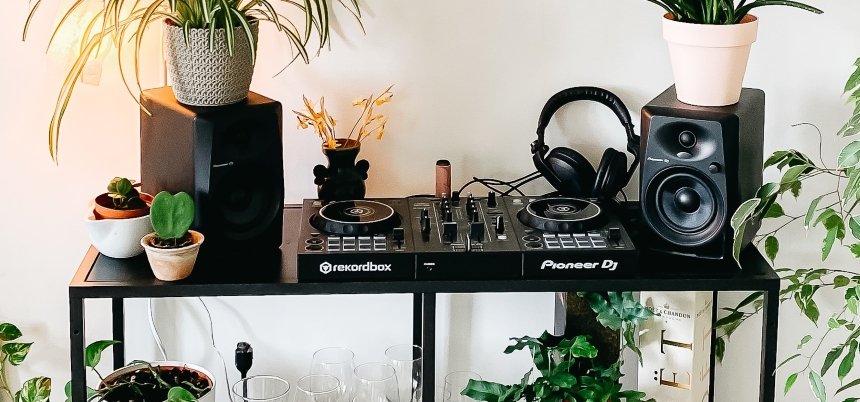
- Pioneer DJ DM-40
This compact, four-inch monitor offers clear, powerful sound with deep bass and bright treble. It also features a built-in amplifier to connect directly to your DJ mixer. - KRK RP5 Rokit G4
This five-inch monitor is a popular choice among DJs and producers. It offers accurate sound reproduction and a balanced frequency response, making it ideal for fine-tuning your tracks. - JBL 305P MkII
This compact five-inch monitor is designed for both studio and live use. It offers clear, accurate sound reproduction and comprehensive frequency response, making it an excellent choice for DJs. - Yamaha HS5
This five-inch monitor is designed for professional use in the studio, but it’s also well-suited for DJ use. It offers a balanced and accurate frequency response, making it an excellent choice for monitoring your tracks.
Conclusion
In conclusion, whether studio or DJ monitors are the best choices for DJing largely depends on the specific needs and preferences of the DJ. However, they offer balanced sound reproduction, making them an excellent choice for DJs who need to hear every detail of the music they are playing.
On the other hand, DJ monitors are designed for live performance environments and offer high-volume output, accurate and detailed sound, and reliable performance. When choosing speakers for DJing, it’s essential to consider power handling, frequency response, driver size, connectivity, and portability. I hope the article was of help. Thank you for reading.

The Integraudio Editorial Team consists of experienced music producers, audio engineers, and plugin enthusiasts dedicated to providing in-depth reviews and guides for music production software.