
Razorgate, a great dynamics processor, not only eliminates unwanted audio but also adds a distinctive character to your sound.
I really like it when I find an interesting analog-sounding plugin. Inspired by analog VCAs, Razorgate has that analog flavor that adds more character to your sound when you want. But the good thing is that it can also act as a transparent filter.
To start with, I have to say there are two versions of the plugin. The first is Razorgate+, which is the paid version. And there is the Razorgate, the free version. The main difference between the two is that the free version lacks the external sidechain, sidechain filter, VCA color, and Dual Mono mode.
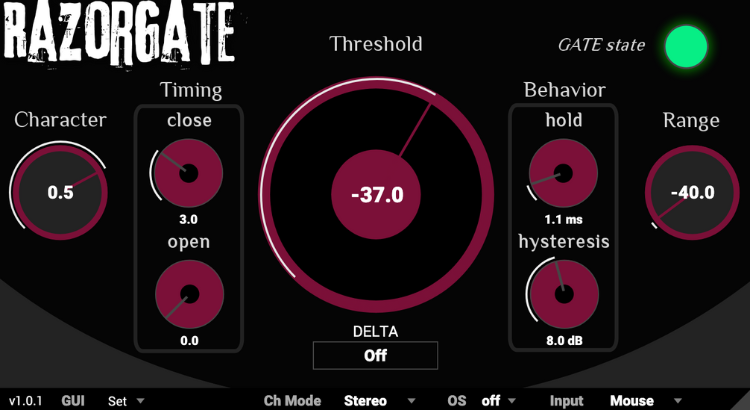
So, let’s look at the interface. I like the straightforward design with the large Threshold knob in the center. Next to it, there are the Open and Close Timing controls with a Slew of Rate Limiter design and a Character knob to emphasize or deemphasize right or left sides. On the other side, there are the Behaviour controls with Hold and Hysteresis knobs along with the Range knob.
Also, I appreciated that they added a Delta button that enables you to hear what you are removing from your sound.

For me, the interesting part of this gate plugin is the Slew Rate Limiter. I want to explain it a bit for those who have never heard about Slew Rate. Slew Rate is the maximum amount of change in voltage that a component can withstand within a period of time. So, for example, if you have a square waveform, you have a change between two voltages almost immediately. But that extreme abrupt change does not happen in an actual circuit. Instead, the theoretical square wave actually has more triangle-like angled sides as the signals need time to go from one voltage to another, as shown in the video.
So, the slew rate limiter limits the time of this change and manipulates the waveform to an exponential curve, which gives us different sound flavors. Typically, gates have timing circuits that create a more linear curve, but with the slew rate limiter, I like those exponential curves that add different characters to the sound.
Okay, I think we’ve had enough of the theory. I tested the Razorgate with drums and distorted guitars and enjoyed the outcome. It adds a bit of analog taste to the sound but does act transparent when I want it to.
I used the Hold around 10 for drums and Hysteresis around 12 o’clock. In the timings section, the Open was entirely at 0, and the Close was around 3.5. The result was a good contrast in the drum dynamics.
For the guitar, Hold around 10 and Hysteresis around 3 o’clock with the Open set to 2.5 and the Close set to 4.5 is a nice sweet spot. As always, you can play around with the Threshold depending on your needs.
To summarize, this is an interesting and unique filter with which you can experiment with easily. It gives you plenty of control and different flavors to try and create different dynamics. Although I did not try it myself, the paid version includes the VCA color option, which could be a great addition, as I heard in the demos. Besides that, I believe the free version is more than enough in terms of sound and controls.
Razorgate comes in VST3 and AU formats for Mac and Windows users.
Check out the manual of Razorgate here.

Berk is a multi-instrumentalist musician from Istanbul, Turkey. He has been playing guitar, handpan, and percussion for over ten years, developing a sound that blends melodic sensitivity with rhythmic depth.
He began his musical journey as a teenager, learning guitar and performing in several bands. In 2016, he discovered the handpan, an instrument that immediately resonated with him on a deeper level and gradually became central to his artistic identity.
Since then, he has performed in streets, festivals, bars, and concert venues across different countries, connecting with diverse audiences through both intimate and large-scale performances.
Alongside his live work, Berk is deeply involved in studio production. He works from his home studio, where he composes, records, and produces his own music. His studio serves as a creative space for layering handpan, guitar, and percussion with modern production techniques, allowing him to shape fully realized, atmospheric compositions from start to finish.
His music explores a wide range of genres and textures, combining organic acoustic instruments with detailed studio production to create immersive and expressive soundscapes.