

When we talk about guitar amplifiers, we can find many models with different uses and particular characteristics. Although many of them share certain similarities, the instrument for which they have been created is the one that defines their main characteristics.
As for acoustic guitars, although it is very common to find musicians who use them with electric guitar amplifiers, manufacturers like Fender or Marshall, to name a few, have dedicated exclusive models for this type of guitar.
Beyond this, the difference is sometimes small and even imperceptible to ears that are not used to hearing instruments in detail. So experimentation is always an important part of this area.
In this article, we will talk about whether it is possible to use your acoustic guitar in a bass amp and how this can affect the performance of your instruments.
Can a Bass Amp be Used For Acoustic Guitar?
It is possible to use a bass amp with an acoustic guitar. A bass amp can bring out the low frequencies in a way that could benefit an acoustic guitar. However, in the same way, it may not have the definition and tone necessary for the mid and high frequencies that an acoustic guitar emits.
The sound of acoustic guitars has a very wide frequency range. Its resonance box allows the low sounds to have the body and sustain necessary to achieve their particular sound. At the same time, due to the type of strings it uses, it has an extremely bright sound that stands out and makes it recognizable when listening to it. Because of this, the high frequencies have as much presence as the low ones in an acoustic guitar.
A bass amplifier, being specially designed for that instrument, shares the characteristics of a guitar amplifier. The main difference is that its speaker is built to handle low frequencies without taking damage from vibration, which makes it possible to play electric guitar on a bass amp. Conversely, if you were to try to play a bass into a guitar amp, the amp would run the risk of generating too much distortion and eventually failing.
So if you connect an acoustic guitar to a bass amp, you would have the low frequencies covered. Still, you would need to equalize it in a way where there is as much balance as possible between all the frequencies, or look for a bass amp model in which medium and high response be enough.
On the other hand, acoustic guitars do not always include microphones or integrated amplification. This means there are different ways to transmit your sound to the amplifier. Whether you use a dynamic microphone, a condenser microphone, or internal pickups, the results will be different, which is something to consider as well.
Ultimately, and beyond any technical specification, the sound of your instrument must meet your expectations. As unusual as it may seem, if you are satisfied with how your acoustic guitar sounds plugged into a bass amp, that is reason enough to continue using that setup.

What Are The Best Acoustic Guitar Amps?
Some of the best acoustic guitar amps are those created by well-known brands such as Fender, Marshall, Vox, Stagg, and Laney, to name a few. Unlike other guitar amps, these amps have specific features designed to get the most out of acoustic guitars.
When we talk about guitar amplifiers, we can find a wide range of options; however, the offer is smaller when we refer to acoustic guitar amplifiers. This is because this type of amplifier has certain characteristics that take away some versatility compared to electric guitar amplifiers. At the same time, not all amp manufacturers have acoustic guitar models available.
To begin with, an acoustic guitar amp has a different arrangement than an electric guitar one. While electric guitar amps offer the option of increasing the gain to generate distortion to achieve the desired tone, on acoustic guitar amps, this is different. It is designed so that even if you increase the volume, the signal transmits a clean and natural sound with more significant headroom. This is possible thanks to the type of circuits and electrical components with which this type of amp is made.
Another clear difference is their inputs, since acoustic guitar amps, in addition to the classic TRS inputs for instruments, have balanced XLR inputs to connect microphones. This makes it possible for you to amplify your guitar and your voice if you want to. On the downside, due to its way of emitting sound, this type of amp is less suitable for electric guitars, which takes away some of its versatility compared to other amps.
Other than that, if you’re more into acoustic than electric guitars, models like Laney’s LA30D Series, Fender’s Acoustasonic 40, Marshall AS50D, Vox VX 50 AG, Fishman LoudBox Mini, or Stagg 40 AA R are some of the models specially designed to get the best performance from your acoustic instrument in the range of 30 to 50 watts of power. All these amps usually include effects such as reverb or chorus, which are ideal for experimenting with an acoustic guitar.
How Big Should my Acoustic Guitar Amp be?
The size of the amp of your acoustic guitar must be according to the needs that you need to cover. A tube amplifier of 10 to 20 watts is more than enough to rehearse a small environment or a room. If you need to cover larger spaces, an amplifier with greater power will be necessary.
Thanks to the acoustic guitar’s wide range of sound, a medium-sized amp may be enough to cover the needs of a small room session. The acoustic guitar is usually a rhythm instrument, since it is often used to support the harmonic bases of a musical structure rather than to be a leading instrument.
If you require more power to cover a larger space or to match the sound of a drum set or other amplifiers, a larger amplifier will be necessary. It is necessary to clarify that transistor amplifiers have less power and capacity than tube amplifiers. We will classify the amplifiers into small, medium, and large to define in which scenario it is convenient to use each one.
- Small Amps
In this range are those portable amplifiers with a power of 2 to 10 watts. This type of amplifier is designed for small spaces and is oriented to practice or study the electric guitar since acoustic guitars can cover this range with their own sound. While they’re a good way to get louder, these amps can show some limitations if you’re looking to accompany another instrument. They usually use speakers between 4″ and 6″. The vast majority of these amplifiers are of the transistor type. - Medium Amps
You can find amps designed for rehearsals, small venue gigs, and even home use here. Here you will find transistor amplifiers and some valves. This range of amplifiers can have 8″, 10″, or 12″ speakers and a power of between 20 and 40 watts. Although they are amps that allow some portability, their weight is well above that of small amps, and they are less comfortable moving from one place to another. - Big Amps
In this range, you will find fully tube amplifiers, made to play in large concerts, in open and closed places, with a lot of people. We are talking about amplifiers with power ranging from 50 to 100 watts or even more, with 12″ and up to 16″ speakers in some cases. Another peculiarity of this type of amplifier is that their boxes can contain two and up to four 12″ speakers, so moving them from one place to another is uncomfortable.
Which Microphone Captures The Sound of The Acoustic Guitar Best?
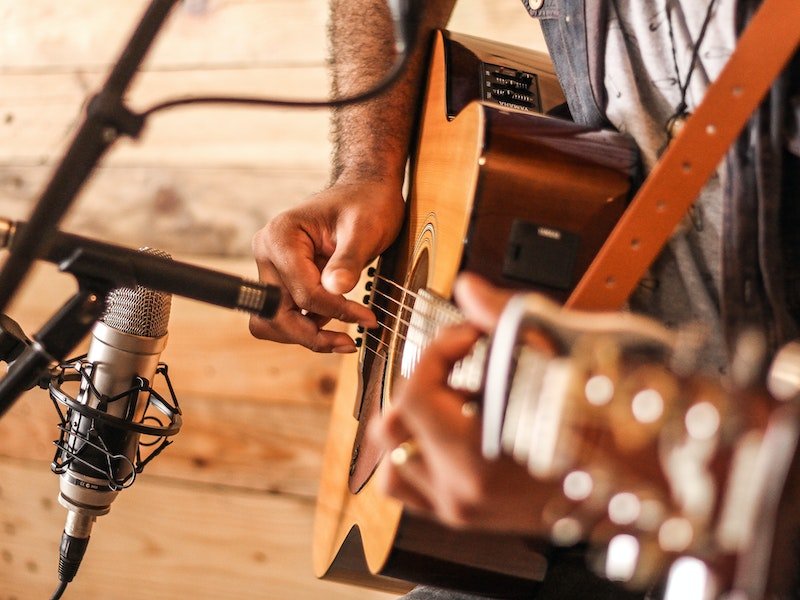
When it comes to playing live, the best option is to use external acoustic guitar pickups or internal if the guitar already includes them inside. While for a recording session, the most recommended is to point one or more condenser microphones directly toward the guitar.
Acoustic guitar mics are designed to pick up sound and vibration as it passes through the instrument. Although the so-called electroacoustic guitars already include this type of built-in microphone, there is also the possibility of taking an acoustic guitar and adding pickups to it to make it possible to connect it to an amplifier.
However, when facing a recording session, most choose to capture the acoustic sound with microphones pointed directly at the guitar, which makes it sound more natural. Condenser microphones are especially effective for this task because they capture a wide range of frequencies with a high level of detail.
Some even recommend capturing the acoustic guitar signal from two microphones simultaneously, with one located in the bridge position and the other at the height of the fingerboard. While the first one is in charge of picking up the acoustic reflections that come from inside the guitar, the second microphone picks up the metallic sound of the strings when they touch the frets, giving the shot greater realism and the sensation of being close to the instrument. Those two takes are then mixed to achieve a well-balanced sound.
However, this type of procedure using condenser microphones is only possible in a recording studio or a place prepared to isolate any external sound source. To play live, it is also possible to use an external microphone pointed directly at the guitar, but in this case, the microphone must be dynamic, which only picks up the sound from its front and not from the rest of the environment.
Should I First Invest in a Good Acoustic Guitar or a Good Amp?
If what you need is to increase your power to play with more range, what you should do is invest in a better amplifier, but if you intend to improve your sound, in that case, you should invest first in a higher-quality instrument. Both of these will enhance your sound in different ways.
One of the most frequently asked questions when it comes to improving your sound is where to put your money to make the best possible investment. Analyzing what you want to achieve is of great help in making the best possible decision. It is important to be clear that the instrument is the most relevant component of your gear, especially when it comes to acoustic guitars. Because of this, purchasing a better acoustic guitar will be a quality leap. You can start building everything else from that, knowing that your instrument sounds good.
If you are in a situation where you are satisfied with the sound of your acoustic guitar, but the volume that your guitars and equipment can put out is not enough, in that case investing in a higher-capacity amplifier will be the right thing to do that best suits your need.
The good thing about this is that most amps include many EQ options, effects, and variants you can add to your sound. Therefore, if you choose the right amplifier, you will not only increase the power and volume, but it can also mean an improvement in the sound of your guitar.
Each instrument behaves differently with each amplifier, so it is often a trial-and-error situation. If there is something evident, it is that even if you have the best amplifier on the market, but a guitar with a poor sound, there will be little that your equipment can improve. It will always be better if you invest in both a good guitar and a good amplifier, but if this is not possible, consciously analyze your possibilities and choose what you think can give you a better performance.
What Are The Best Effects For Acoustic Guitar?
The main effect used on acoustic guitars is the reverb. However, using effects such as delay, tremolo, or phaser is also very common. Although it is valid to use any pedal that you think is necessary, the premise is to enhance the guitar’s acoustic qualities without radically modifying the sound.
The reverb is the pedal par excellence associated with acoustic guitars since it generates the sensation of a wide and deep sound without altering the original signal too much. Thanks to these qualities, it can generate favorable environments for the acoustic guitar to support the entire musical structure. This effect can be applied both from the amplifier and an external pedal, depending on each user’s preferences.
In the second order, pedals are usually used to optimize the signal, such as a slight compression, allowing greater control over the dynamics and a tuner pedal. Although the tuner pedal does not influence the signal, it is a key piece for any guitarist’s set, especially in live performances, due to its comfort and ease.
In the third order, effects called modulations are used, such as tremolo, phaser, or chorus. These effects are usually applied partially, allowing the guitar sound to take on a different character without losing the naturalness of the instrument. Like the reverb, this effect can be applied from an amplifier and an external pedal.
Finally, any type of effect that you want to add to your acoustic guitar is valid as long as you apply it judiciously. One of the possibilities that music offers is to experiment, so although sometimes a certain effect is not the most conventional or recommended for an acoustic guitar, there are no clear limits when looking for new sounds.

Conclusion
Combining elements with similar purposes is always possible, even with the possibility of discovering new sounds and options. Beyond this, each manufacturer designs their products to meet requirements tailored to a particular need. So it is necessary to do things responsibly to not put the integrity of your equipment and instruments at risk, much less your own.
Acoustic guitars play a fundamental role in the genres used, so the most important thing before adding any effect or amplification is to have an instrument in good condition and sounding properly.
Considering this, choosing the best option when combining your acoustic guitar with other equipment will be much easier. I hope this article is of great help to you. Thanks for your time!

The Integraudio Editorial Team consists of experienced music producers, audio engineers, and plugin enthusiasts dedicated to providing in-depth reviews and guides for music production software.