

Finding quality piano plugins can be difficult. So, we’ve rounded up the 8 best piano plugins of 2025 suitable for all kinds of music creators.
If it weren’t for the limited sustain performance, I would say that the piano is the most versatile acoustic instrument. However, pianos are also close to being the most expensive. Hence, it’s no surprise that digital hardware and software piano plugins have grown popular.
Most software pianos provide recorded samples of an actual piano featuring multiple mics, round-robin samples, ambiance, and so on. However, recording samples is only half the battle; providing a usable user interface along with enough flexibility to make it perform in any situation is just as tricky.
Hence, we experimented with many piano plugins in varying price ranges and capabilities to present this list. Let’s jump right in! You’ll find the best choices for all sorts of musicians, regardless of background and budget.
Top 8 Piano Plugins For Musicians
1. VSL 5 Synchron Pianos Bundle
This sample-based piano plugin bundle featuring multiple pianos from Synchron Stage Vienna comes from the makers of some of the best orchestral libraries.
If you are looking for a piano plugin with an in-depth sampling of some of the best pianos ever built, VSL 5 Synchron Pianos has it. It’s not technically a plugin, though.
It’s a bundle featuring six piano libraries: Bösendorfer 290 Imperial, Steinway D-274, Yamaha CFX, Blüthner 1895, Bösendorfer 280VC, and Bösendorfer Upright. If you are a pianist, you are no doubt familiar with each of these brands.
The models in the bundle cover everything from orchestral grand pianos and ambiance to pop and intimate sounds.
However, what matters more is how meticulous the sampling is. For example, the Yamaha CFX features up to 4,500 samples per key! That does end up making the library’s size ginormous, though.

Key Features:
- Phenomenal Sampling
As I’ve mentioned, the samplings in the VSL Synchron Pianos bundle are meticulously detailed. A vast number of samples isn’t everything, though; the method to capture the sounds is just as important. VSL had engineers develop a highly accurate motion-control “robot finger” that played the strokes in precise velocity levels while remaining noise-free.
- The Sound of Vienna
Each VSL Synchron Pianos offers at least 7 to 11 microphone placements to ensure that you are getting the most customizability. These include standard close, ribbon, mid, sphere, and Decca Tree stereo and room mics.
Having all of these options allows you to get the authentic sound of the Synchron Hall Vienna from the comfort of your studio.
- Customizations
In addition to mixing mics, you can also utilize onboard effects such as EQ, compressor, saturator, reverb, delay, chorus, flanger, etc. Furthermore, the software allows you to control body resonance, pedal noises, sympathetic strings noise, and even tuning and dynamic range per key.
- Release
A real piano has various quirks that provide it its natural sound, and one of them includes the release sound. VSL Synchron Pianos feature an advanced release sample technology, which produces a convincing hammer-off sound depending on the velocity of your stroke.
The following video shows three excerpts played in each of the VSL 5 Synchron pianos and ends with a demonstration of the various mic positions:
Compatibility:
The plugin is available for Windows 10 or higher and macOS 10.12.6 or higher, both 64-bit only. It comes in VST 2/3, AU, and AAX formats.
2. Arturia Piano V3
More Info & Price (Trial Available)
The piano is one of the most popular, used, and familiar sounds in music history.
However, finding a good one in the digital era is often challenging, especially if you’re after a realistic and authentic sound. Arturia has created Piano V3 to capture the most authentic piano sounds possible through physical modeling, from mechanical to sonic behavior.

Key Features:
- Wide range of sounds
Piano V3 doesn’t focus on a single piano sound. Instead, Arturia was interested in creating an instrument that accurately portrays various pianos styles.
Therefore, with Piano V3, you can access American, Japanese, or German Grand Pianos, Jazz, Classical, or Pop Upright Pianos, plucked Grand Piano, or experimental options like the Glass and Metal Grand Pianos.
You can achieve all sorts of sounds and feelings with these models, from shimmery Pop piano sounds to punchy and dark hip hop sounds.
- No samples
When you invest in a high-quality piano instrument, you’ll need many gigabytes of space on your hard drive to cover the large sample libraries that come with it. Fortunately, Arturia’s Piano V3 is not sampled-based.
Instead, it uses physical modeling to simulate a real piano’s physics and acoustics in real-time. This complex algorithm guarantees consistency and authenticity in your piano sounds.
- Tweak the sound
Even though the piano sounds are excellent and authentic, you can still adjust and tweak certain parameters to make them fit your productions.
For example, you can adjust the brightness knob for brighter or gloomier sounds, the timbre knob for different sonic and harmonic characteristics, the dynamics knob for a punchier or more sustained feel, and the stereo width knob for customizing your stereo field.
Each of these knobs can transform the sound drastically, giving you much room to play with.
- Dig deeper
You can dig deeper with the studio page if the above knobs are insufficient to get the piano sound just right. Here, you can adjust the mic positions and create realistic spaces for your pianos to exist in with amazing reverb algorithms.
Effects like EQ, compressor, and preamp are further tools you can use to customize your sound. Finally, you can adjust the noises that come through the hammer and pedals, the age of the strings, as well as their exact tuning and acoustic settings like the lid position, soundboard resonance, and sympathetic resonance.
Compatibility:
Piano V3 is available on Windows 8.1 or higher and macOS 10.13 or higher in VST, AAX, and AU formats, 64-bit only.
3. XLN Audio Addictive Keys
More Info & Price (Trial Available)
Despite being a little dated, Addictive Keys has remained relevant thanks to its flexible sound and enthusiastic fans.
If you are familiar with Addictive Drums, you’ll find the visual similarities between the two. When you first open Addictive Keys, you’ll notice a flashy but slightly aged interface, which is still very functional. Furthermore, the philosophy behind the piano plugin is also similar to the drums: providing a flexible library with multiple effect processing options but in a small size.
Purchasing Addictive Keys is a little different compared to others on our list. There are four libraries: Modern Upright, Studio Grand, Electric Grand, and Mark One. You can buy each individually, in pairs, in a triplet, or all four of them, with each step reducing the price further.

Key Features:
- Mic Positions
The plugin features multiple mic positions that can drastically alter the sound to your liking. For example, in the Studio Grand library, you have five mic positions: Close Ribbon, Ambiance, Close Tube (XY), Middle Tube, Body Tube (mono), and Side Ribbon. You can mix up to three microphone positions to create your personalized sound.
- Mixing
Other than mics, you can use the onboard effect plugins to modify your sound further. There is an EQ, a noise generator, tremolo, and chorus on the main Edit page of each mic position you have selected. And there are two FX sends that feature a delay, reverb, and an EQ.
And finally, you will find a phaser, EQ, compressor, distortion, noise generator, and a filter in the Master channel.
- Explore
Under the Explore tab on the interface, you can change your sample library (if you have more than one) or select presets. I’m very impressed by the variety of presets you can find. Even if there aren’t many sample libraries, you can get a surprisingly wide variety of sounds thanks to the mic placements and effect plugins.
So, you’ll find patches such as “Prepared Horror” and “Woody Pizzicato” that are heavily manipulated to sound otherworldly.
- Further Edits
You can also make adjustments to the pitch to create detuned effects or vibrato. Furthermore, there is an envelope each for the pitch, filter, and volume. And other than that, there are three pedals: sustain, sostenuto, and soft.
You can adjust each pedal’s characteristics as well. Unfortunately, though, there is no way to edit resonance or the lid position.
Here you can find Stu Harrison from Merriam Pianos reviewing the Addictive Keys with some detailed look at the Edit tab and sound demonstrations.
Compatibility:
The plugin is available for Windows 10 or higher and macOS 10.9 or higher, both 64-bit only. It comes in VST 2/3, AU, and AAX formats.
4. ujam Virtual Pianist Score
More Info & Price (Trial Available)
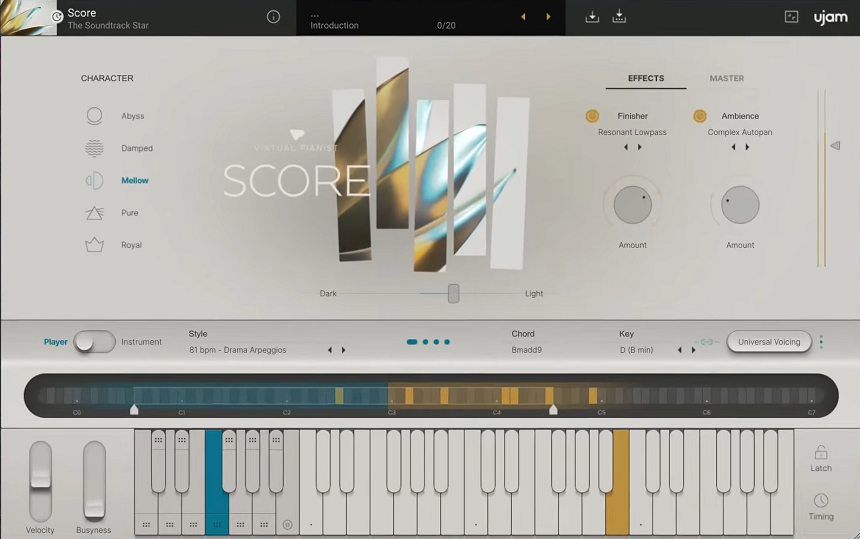
ujam Virtual Pianist SCORE is a virtual session pianist assistant and piano instrument designed for musicians and composers, to facilitate music composition and scoring for films, games, and shows.
It features a virtual grand piano instrument meticulously sampled and modeled after a Steinway Model D Grand piano, known for its rich and expressive sound. SCORE is designed to be user-friendly and offers quick and easy access to high-quality piano sounds, making it one of the best scoring plugins and piano instruments.
The software also includes a wide selection of MIDI patterns and multisample instrument presets, allowing you to create music with various styles and expressions.
The plugin offers various characters, including Abyss, Damped, Mellow, Pure, and Royal. These presets allow you to shape your piano sound with different tonal qualities and textures, adding depth and personality to your compositions.
Key Features:
- Finisher Multi-Effect Modes and Ambience FX
With 45 Finisher Multi-Effect Modes and 45 Ambience FX Presets, including Finisher Metamorphosis and Reverb effects, this plugin provides an extensive palette of creative effects to sculpt your piano sound. These effects enhance your music with unique textures and spatial depth.
- Pianist Performance Styles
The plugin allows you to explore 40 pianist performance styles, encompassing 360 integrated phrases. The plugin’s MIDI Drag & Drop functionality makes incorporating these musical expressions into your compositions effortless. Over 175 presets further simplify the music creation process, offering various starting points for your projects.
- Highly Expressive Controls
The plugin provides powerful tools for expressiveness, including Velocity and Busyness sliders. These controls enable fine-tuning of dynamics and complexity in your piano performances. The Player/Instrument switch allows you to seamlessly switch between different playing styles and instrument articulations, enhancing your musical expression.
- Various Effects
Virtual Pianist Score offers 45 Finisher Multi-Effect Modes and 45 Ambience FX presets, enhancing the creative possibilities and enabling you to add unique textures and effects to your music. These also include the great Ujam Finisher effects and other effects like Reverb, Delay, Compression, etc.
5. Modartt Pianoteq 7
More Info & Price (Trial Available)
Pianoteq 7 is nothing short of a marvel that advancement in music technology has managed to conjure.
Pianoteq surpasses the quality of piano sounds found on most digital pianos. Instead of using thousands of recorded samples as other piano plugins do, Pianoteq 7 uses an advanced form of physical modeling to generate piano sounds.
It simulates an actual piano’s physical shape, strings behavior, room acoustics, and mics. The result is that nothing beats its level of flexibility in terms of tweaking the piano’s resonance, action, hammers, and mic placements.
Once in a while, you will want to use “prepared” pianos to create otherworldly sounds, and Pianoteq’s flexibility is ideal for it. You can even age the piano from a mint condition to utterly worn out using a single fader. And all of that, plus 2-4 instruments, come in a plugin that uses less than 100 megabytes of your disk space.
Modartt offers many instrument packs and three flavors of Pianoteq: Stage, Standard, and Pro. The first version provides as much flexibility as a sampled instrument, whereas the latter two add more flexibility and instrument packs.
You can choose the instrument packs you want when you purchase your Pianoteq. Note that we will be describing the features of the Pro version.

Key Features:
- Piano Model Tweaking
Each piano in Pianoteq provides you with numerous options to tweak the physical model. That includes basics like tuning, hammer noise, soft pedal, lid adjustment, and sympathetic resonance to damper position, mallet bounce, string length, unison, and many more. Furthermore, you can even remove the piano lid if you don’t like the resonance.
- Per-note Adjustments
As if the plethora of tweaks weren’t enough already, Pianoteq lets you adjust 30 parameters per note. That includes hammer hardness, detune, string length, damper position/duration, cutoff, strike point, spectrum profile, harmonics, unison, and so on.
I also love the per-note editor that lets you create shapes across the keyboard to, for example, have unison high only on the lower octaves.
- Mic Simulation
Pianoteq 7 features a microphone modifier section, where you can add up to 5 microphones from 17 mic varieties, including the esteemed Neumann U87 and AKG C414 with multiple polar patterns.
Furthermore, it has a top and front view window, where you can set the position of each of the five mics anywhere you like. You can even angle the mic 360°.
- Multiple Outputs
The plugin employs 5 audio outputs, where you can route each mic. This feature allows you to use your DAW’s mixer over the internal mixer to adjust the level of each mic. However, it’s only available in the mic mode – the plugin also features binaural mode, which lets you listen to the piano as a pianist would.
- Onboard Mixing
We’ve talked about several aspects of mixing already, but let’s talk about effects next. The plugin features three FX slots to add tremolo, wah, chorus, flanger phaser, fuzz, delay, amp simulation, compressor, and EQ. And there’s also a convolution reverb section, which features many impulses and allows you to load 3rd party WAV impulses.
- Morphing & Layering
The plugin lets you morph between two instruments using the new morphing technology, providing stunning acoustic authenticity. Similarly, you can mix multiple instruments together or separate by range simultaneously, thanks to the Layering feature.
- Performance
In addition to being a sound designer’s delight, you can use the standalone Pianoteq with a metronome and a recorder for practicing or stage performance.
The plugin features four pedals that make the performance even smoother, and you can assign each to various parameters: sustain, soft, harmonic, sostenuto, super sostenuto, rattle, buff stop, celeste, pinch harmonics, glissando, and Mozart rail.
The following video is a detailed demonstration of the presets and features in Pianoteq 7. It also shows you a comparison between the previous version of Pianoteq and the current one. You can follow along as the demonstrator discovers Pianoteq fully, helping you learn the instrument as well.
Compatibility:
Pianoteq 7 is compatible with Windows 10 or higher, macOS 10 or higher, and Linux (Ubuntu). It comes in VST 2/3, AU, and AAX formats.
6. UJAM Virtual Pianist VOGUE
More Info & Price (Trial Available)
A consistently good-sounding piano library that doesn’t have a robotic aspect to it.
For some years, ujam has offered awesome sample libraries for multiple instruments, and they all tend to sound very good and realistic. Expanding their product line, Virtual Pianist VOGUE was introduced to deliver a good-sounding piano performance suitable for most pop productions but not necessarily requiring a skilled musician to do so.


Key Features:
- Piano characters
There are some pre-made piano profiles to be explored right before you start playing. Each can make your instrument sound differently but retain the same general aspects. You can choose from “Emotion,” “Ballad,” “Concert,” “Power,” and “Plastic” modes, and they are ordered from softer to more aggressive overall dynamics.
| Character | Room type | Best use |
| Emotion | Wooden room | Cinematic, ambient, and intimate productions |
| Ballad | Bright stage | Romantic, pop, or background tracks |
| Concert | Large studio | Vocal accompaniment, prominent piano |
| Power | Hard ambiance | Pop and rock band situations |
| Plastic | Bouncy artificial room | Motifs and themes in modern electronic music |
- Finisher
One of the two effects modes included is entitled “Finisher.” It contains 30 different multi-effects modes tailored for a particular piano profile, with awesome sound design options that can expand their sonority significantly.
- Ambiance
Similarly to the previous item, the “Ambiance” is also part of the effects session and deals specifically with ambient-related effects, like reverb and delay, to get the perfect ambiance nailed instantly.
You can not only select different effects individually but also merge them to create even bolder sonorities.
- Dynamics knob
This special control adjusts the overall dynamics in the instrument, setting the perfect sensitivity of the key velocity values (the softer you play each key, the lower MIDI values will be presented).
Turning it all the way down makes the piano sound louder but without much dynamics, and the more you turn it up, the more dynamics will be presented in general.
- Tune knob
Using the “Tune” knob will allow you to set the appropriate piano tuning for your track. You can tune it up or down by 50 cents (half a semitone). If you need to use a specific Hz tuning, check the table below.
| Frequency | Tune |
| 435Hz | -20 cents |
| 436Hz | -16 cents |
| 437Hz | -12 cents |
| 438Hz | -8 cents |
| 439Hz | -4 cents |
| 440Hz | 0 cents |
| 441Hz | +4 cents |
| 442Hz | +8 cents |
| 443Hz | +12 cents |
| 444Hz | +16 cents |
| 445Hz | +20 cents |
Compatibility:
This plugin is available for macOS 10.14 or higher (64-bit only) and Windows 10 or higher (64-bit only). It runs in VST2, AAX, and AU2 plugin formats.
7. Universal Audio Ravel
More Info & Price (Trial Available)
UAD’s Ravel is its first acoustic modeled virtual instrument based on the Steinway Model B’s grand piano.
The plugin is based on the company’s physical modeling techniques. It was recorded using vintage mics by the renowned engineer Allen Sides, giving it a natural playing experience and a full & superior yet responsive and expressive sound. In addition, the close and room mics can be mixed and used in different settings.
You can add animated effects to your sounds like reversed piano and other experimental and modern sonic characteristics and textures for more dramatic effects.
Key Features:
- Tone slider
The tone slider gives you access to a single-control EQ, which gives a dark to bright texture to the sound from left to right. It’s a combination of a low shelf and a high shelf curve, which brings about tonal changes to the sound.
- Dynamic slider
That lets you control the instrument’s responsiveness to the input MIDI velocity and release data. From left to right, the emphasis changes from low velocity to high-velocity sounds.
- Simple interface
The GUI is intuitive and uncomplicated, making it easy to navigate through the plugin with straightforward and easily understandable controls, which is perfect, especially for beginner producers, and also composers who just want to use ready-made sounds without having to tweak a lot.
Compatibility:
Ravel requires at least 10 GB of free storage in an APFS (Apple File System) formatted SSD drive and is available as AAX, AU, LUNA, and VST 3 format plugins. It’s available on Mac and Windows 10 or more.
8. Spectrasonics Keyscape
From the makers of the famed Omnisphere synth comes this extensive collection of keyboards and pianos.
Keyscape provides multiple instruments totaling over 500 patches and a plethora of tools to create unique sounds. It also integrates into Omnisphere 2 if you happen to own the plugin. Furthermore, its minimalistic user interface makes this a good plugin for technically challenged users who still want creative possibilities.
The acoustic pianos in the plugin sound warm and resonant, whereas the electronic keyboards have distinct sounds. Similarly, the included set of historical instruments revel in authenticity. And of course, as with Omnisphere, you can use multiple instruments simultaneously to create unique patches.

Key Features:
- Numerous Keyboards
Keyscape provides 36 keyboard options beyond a basic acoustic piano to accommodate all genres. The plugin includes varieties from grand and upright to toy pianos and historical instruments like the Dolceola. You’ll also find iconic electronic keyboards like Fender MK-80 Rhodes, Clavinet, and more.
- Authentic Expression
Each instrument’s sheer amount of detail makes for higher quality audio and more realistic, expressive performances, especially in the plugin’s acoustic models. These details include mechanical noise, pedal noise, and release noise behavior modeling to create a digital instrument that sounds as natural as possible.
- Controls For Customization
You can edit each patch with highly intuitive, user-friendly controls, giving you endless customization options to work with. The visually clean nature of the UI makes it ideal for users who struggle with complex software.
- Duo Mode
This intriguing feature of Keyscape allows you to mix two instruments and save the unique combinations as presets for future use. For the more inventive creators, this feature gives them access to a whole treasure trove of new instruments.
- Onboard Effects
The plugin features a collection of built-in effect processors to mix your sounds. The effects include reverb, EQ, character shift, compressor, etc. However, the available effects change depending on the sound patch you have opened.
And if you integrate your Keyscape with Omnisphere, the possibilities of sound design increase even more with its many effects processors.
Have a listen to the presets of Keyscape and you can also see how the effects available on the Editor page are changing depending on the category of the instrument the reviewer Mike Pensini is selecting:
Compatibility:
The plugin is available for Windows 7 or higher and macOS 10.13 or higher, both 64-bit only. It comes in VST 2, AU, and AAX formats.
Bonus Plugins:
Garritan Abbey Road Studio CFX Concert Grand
Get the sound of the world-class Yamaha CFX in this meticulous venture by Garritan.
The CFX grand piano resulted from over 20 years of experimentation and development by over 40 of the world’s best engineers and artisans at Yamaha. Garritan and Abbey Road collaborated to record this handcrafted beauty in the Studio One orchestral hall with some of the best microphones.
The result is a detailed sample library with thousands of samples, and many presets covering a wide range of usage.

Key Features:
- Mic Perspectives
This piano plugin features three microphone setups or perspectives: Classic, Contemporary, and Player. Classic features close mics, mid-field mics, and main room mics. This setup captures the natural tone and nuances of the instrument most faithfully.
On the flip side, the Contemporary setup features close mics and ambiance mics designed to bring up clarity and create a bright and hard tone. Similarly, the Player perspective captures the experience of playing the CFX grand via close mics and a binaural mic.
- Presets
Each mic perspective features numerous presets that sound ideal for various use cases like pop music, rock music, or cinematic scoring. You will find presets created in collaboration with Abbey Road Studios to closely capture the contemporary artists, genres, recordings, live performances, and cinematic settings.
- Voicing
Clicking on the Piano tab on the interface reveals controls for adjusting the sound of the grand piano. You will find sympathetic resonance, sustain resonance, release characters, and pedal noise in this section. Furthermore, you can also change the position of the lid from closed, half-open, and open.
- Mixing
On the Studio page, you will find a convolution reverb section with 12 impulses. Similarly, you can also select between the audience or performer’s perspective of the stereo image. And finally, there is a simple three-band EQ for close output and ambient mic output each, not to mention a mixer to control the two mics’ volume and stereo width.
Have a look as Merriam Pianos describes the Garritan CFX with some preset demonstrations. You’ll get to hear the opinion of someone who has played and used a Yamaha CFX as well.
Compatibility:
The plugin is available for Windows 8.1 or higher and macOS 10.12 or higher, both 64-bit only. It comes in VST 2/3, AU, and AAX formats.
2. EastWest Quantum Leap Pianos Gold
This piano plugin features four of the best grand pianos recorded at EastWest Studios.
The Pianos Gold library took over two years of recording, editing, and programming to develop. It features numerous samples per note in various playing styles at different velocities.
The four included grand pianos are: Bechstein D-280, Steinway D, Bösendorfer 290, and Yamaha C7. The Gold Edition of this library features player’s perspective mics and 16-bit samples.

Key Features:
- The Sound
EastWest Recording Studios used vintage Neumann microphones through the iconic 8079 Neve console to record the samples from the player’s perspective, which gives you the experience of playing these pianos. Furthermore, the Play plugin features convolutions of the EastWest hall to emulate the space.
- Articulations
Eight articulations were recorded per piano: sustain, sustain with pedal, repetitions, repetitions with pedal, soft pedal, soft pedal with a sustain pedal, staccato, and release trails. Also, the plugin features a true repetition detection technology, which switches staccato to actual repetitions based on how you are performing the notes.
It recreates the acoustics of playing said pieces accurately.
- Lid Position
Pianos Gold uses filters to simulate the position of the lid. So, you can control the position smoothly from fully closed to open. The smoothness is quite enjoyable, although, for solo performance, you may not find it entirely convincing enough.
Here’s a demonstration of each of the pianos in EastWest Pianos Gold below along with a look at some of the features available:
Compatibility:
The plugin is available for Windows 10 or higher and macOS 10.13 or higher, both 64-bit only. It comes in VST 2/3, AU, and AAX formats.

The Integraudio Editorial Team consists of experienced music producers, audio engineers, and plugin enthusiasts dedicated to providing in-depth reviews and guides for music production software.