
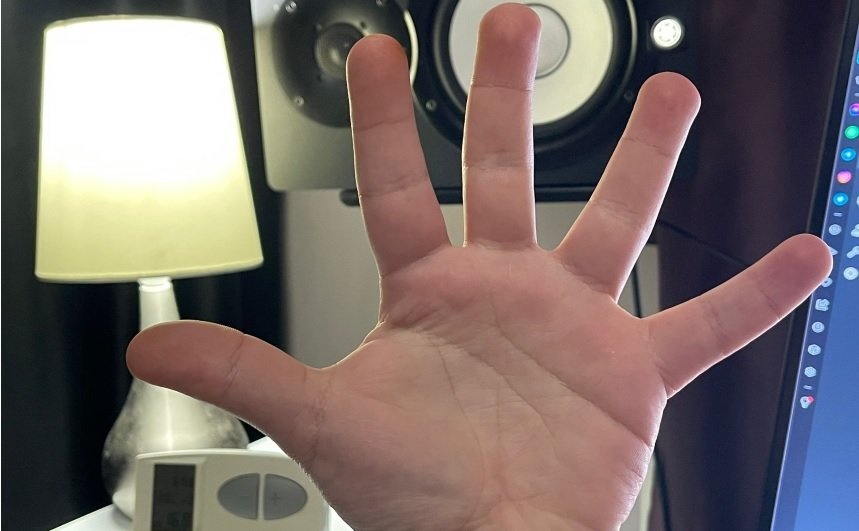
Worried you can’t play bass because you have a small hand? Today we will clarify the mystery and discuss whether you can play bass if you have small hands.
Since the beginning of the bass’s widespread popularity, those who play it with long fingers and comparatively large hands have been held in high esteem. The question, however, is whether or not small hands are a deal breaker for bass and whether or not you need to have large hands if you want to be effective at all.
No matter what styles of music you’re into, having tiny hands shouldn’t prevent you from enjoying a satisfying guitar-playing experience. Many bassists of yesteryear were forced to make do with unsatisfactory instruments, slowing their development. Frustrated by their lack of advancement, many bassists eventually gave up the instrument.
Let’s see how we can play the bass even if we have a small hand.
Can You Play Bass with Small Hands?
Yes, It’s possible and many accomplished bassists have small hands, but this is not an obstacle to learning to perform the instrument. No matter the size of their hands, bassists can learn to play the instrument by practicing finger flexibility and skill and selecting a bass that works well with their body.
For new players, the bulky nature of the bass guitar can be off-putting. Therefore, assuming that those with larger hands will have a simpler time playing the instrument is natural. Technique, hand posture, and finger flexibility are more important than physical ability.
These skills can be honed with practice, making palm size less of a factor. You’ll need to know a few tricks to show off your bass-playing skills despite having tiny mitts. Knowing how to handle the instrument properly is the first step.
The standard bass guitar technique calls for players to position their fingertips and thumbs on the neck out in front of them. Ensure your index finger is on the sixth string and your middle digit is on the fifth string when you play.
How Can You Improve Your Playing Technique to Compensate for Having Small Hands?
The most important thing is to understand that the bass is an instrument you can play in many ways. If you optimize the musical phrase so that you don’t put so much effort into reach and strength or incorporate special techniques to alleviate this ‘‘problem,” you will see that you won’t have any difficulty.
Less Reach
Many bass guitarists have short, stubby digits because they have small hands. You’ll need to tweak your setup if you’re one of these players to get the best possible results. If you fret too low on the neck, your hand will purse too much, and if you play too high, you may have trouble keeping time.
You need to locate the sweet spot between these two extremes to play easily and precisely. Learning to perform with a shorter stride is also crucial. To maximize the mobility of your fingertip joints, assume a loose grip and straighten your wrist.
You should also avoid using only comping patterns and instead use harmonic sounds. You can master bass guitar despite your small hands by experimenting with various methods and adapting them to your playing style.
Strength and Endurance
To master the bass guitar with small hands, developing a natural and effective method is crucial. Some players may need to modify their setup to suit smaller hands, but there are still steps you can take to improve your accuracy and consistency on the field.
First, check that your fingertips are resting properly on the frets. The digits ring and little should rest between the index and middle fingers, with the index finger raised slightly higher. Switching from one instrument to another can be challenging when forming chords or playing solo if your fingers need to be properly placed.
Building muscle and stamina is crucial to settling into a relaxed bass guitar performance. Increase your finger power through exercises like warm-ups and stretching if you have trouble holding notes for long periods.
Try exercising in a smaller area to improve your technique further and focus. Last but not least, remember the importance of eating right! Finger dexterity and general muscle fitness can benefit from a diet rich in fruits and vegetables.
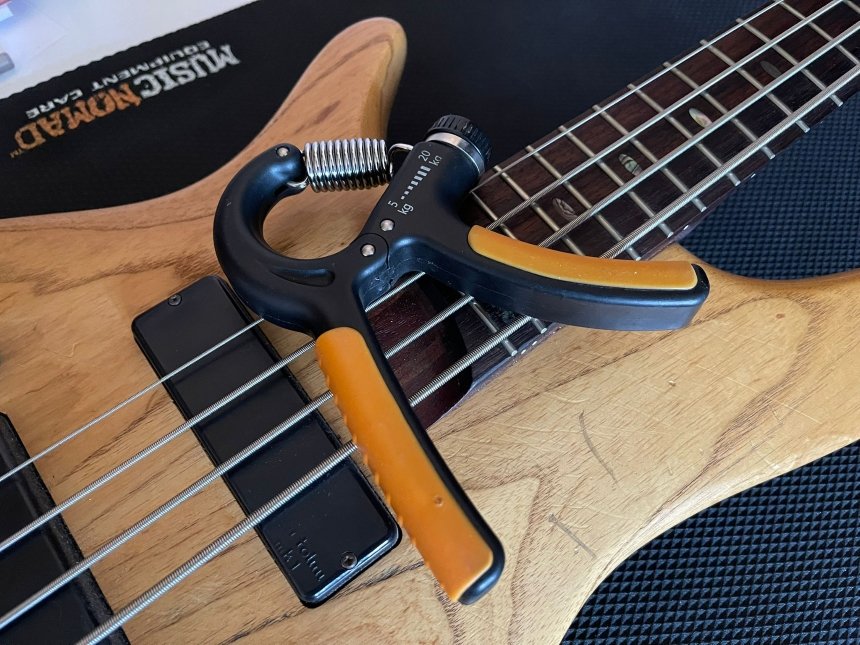
I use this device daily before I play to warm up my muscles and improve my strength.
Pressing the Strings
Okay, so we’ve covered how increasing your reach can help if you have small hands, but we still need to get into ways to simplify pressing the notes. Even though having a longer reach can help, being able to depress the notes fully is essential when you still have to stretch quite a distance.
There will be an unpleasant vibration if you do not. Two primary methods exist for perfecting the art of fully depressing the notes. The first is to know how much pressure you apply to each sound. Although this may appear obvious, a surprising number of people need to consider this aspect of their work before considering it.
Next, apply more force than is strictly necessary to resolve the issue. The one caveat is that you should avoid getting into the practice of pressing down too hard because you’ll want to press down as lightly as possible in the future for speed and tone. However, when you’re just beginning out, it may be best to focus on mastering pressing down each note.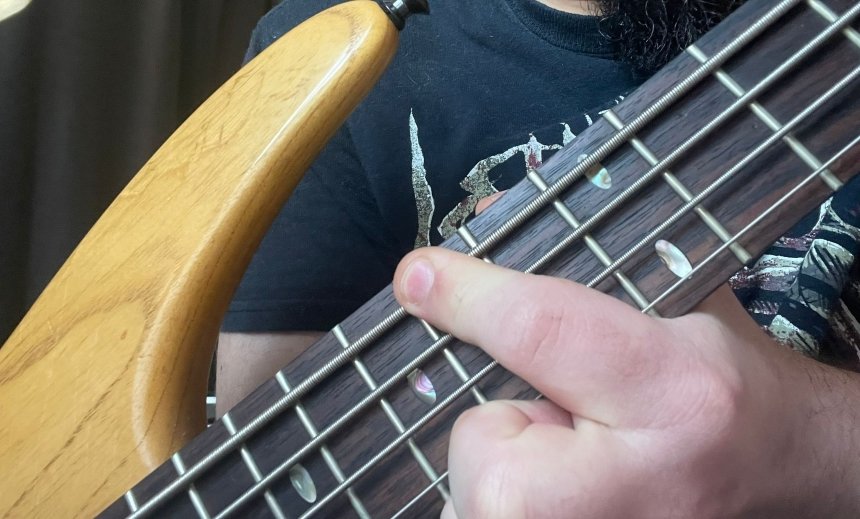
Octaves
If you’re a smack enthusiast, you’ll love this solution. Why not make the most of the fact that octaves are one of the most frequently used techniques in slapping? Considering that there are only three frets in an octave on bass, this makes intuitive logic.
Playing octaves with your pinkie instead of your ring finger is one way to strengthen it considerably. Again, if you use your pinkie sparingly, this will feel very strange. However, you will acquire a lot of strength by doing so.
Ensure that only your pinky finger, not your ring finger, is touching the string. This will allow you to gain muscle quickly. It’s become so normal that some people now play octaves with their pinkie instead of their thumb.
Incorporating Special Techniques
Even though having small hands can make it more difficult to play the bass guitar, anyone can learn to master this instrument by using techniques such as slapping, tapping, and hammering on the instrument’s strings.
- Slap
If you want a quick attack that can be helpful for quickly picking up chords or driving patterns, try slapping the strings on the lower bout of the bass guitar with the tips of your fingertips. Keeping your hand open while you do this will help ensure you get hold of all the threads. - Tap
There is no easier way to produce a gentle sound than pressing the strings near their fretboard end with your fingertips. You can use this to add melody or accents to chords, and it is one of the most common techniques for fingerstyle guitarists. Applying only a light amount of pressure with your fingertips is important to avoid breaking the strings or damaging the fingerboard. - Hammering
When you strum the strings forcefully with your fingertips, you can produce a robust sound that can be used for solos or to amplify chords. You can also use this sound in other musical contexts. If you strum the string with excessive force, you’ll be greeted with some unpleasant shrieks in response.
How To Adjust The Setup Of Your Bass Guitar For Comfort?
If you have small hands and want to learn to play the bass guitar but find it too difficult, you can change the setup of your instrument to make it more manageable. Smaller frets on the bass instrument are one solution. Also, experiment with a different grip style or strap extension for your bass.
Most bassists agree that you should keep the thumb behind the other strings, and the index and middle fingers should play the strings nearest to the neck. While practicing your skill and flexibility will help you play the bass more easily over time, you can also make immediate changes. These measures related to your bass’s setup are crucial for playing ease.
Lower the Action
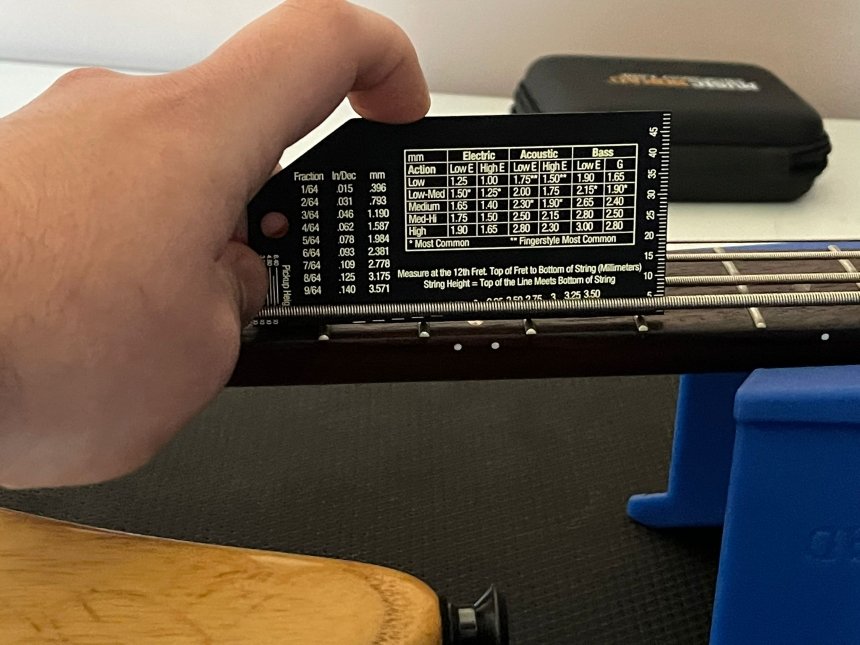
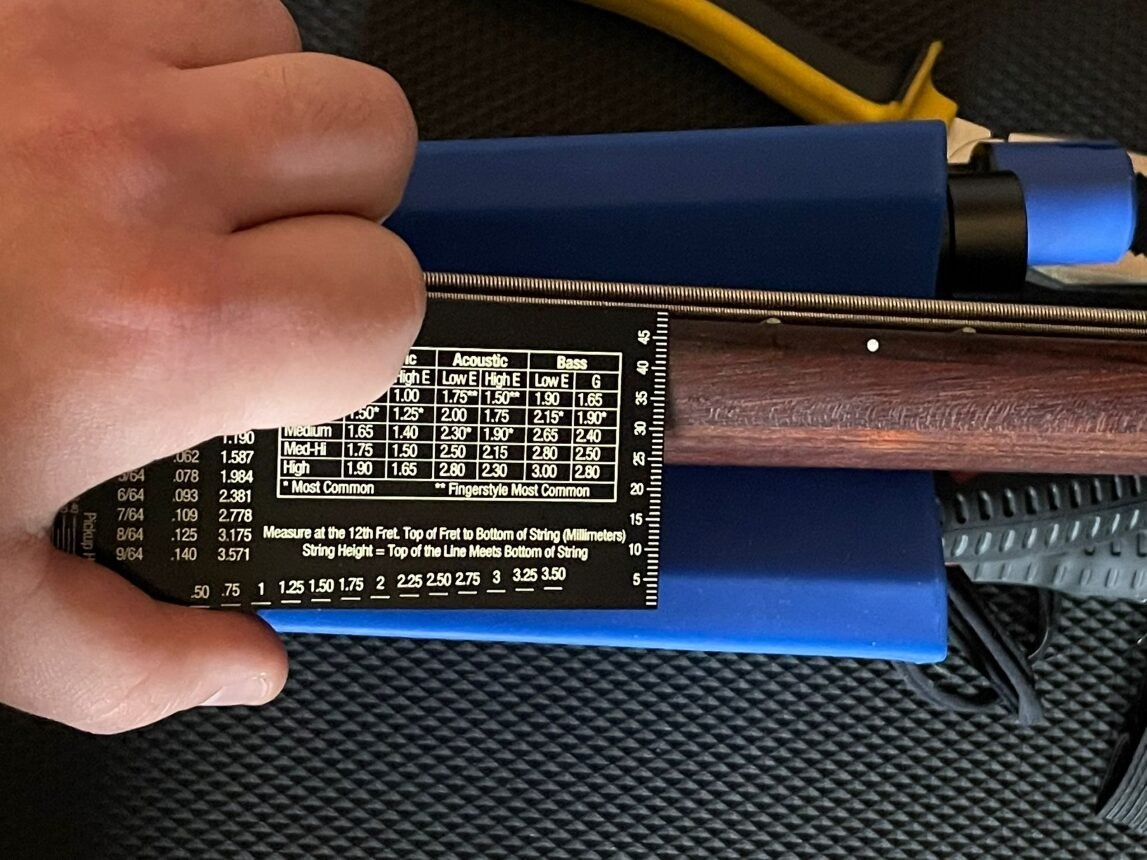
“Motion” describes the distance between a bass’s strings and frets. When the action on the bass is low, fretting the strings requires less effort, making the instrument feel more comfortable. Because of this, you can perform for longer without experiencing finger fatigue.
Since fretting the strings takes less time and the transition between notes is smoother with low action, you can play quicker. Too low of a motion will result in static because the strings won’t be able to vibrate freely.
You can significantly enhance a bass’s playability by lowering the action if the strings are too far away from the frets. The player can lower the motion of the bass. Another option is to have a luthier adjust the motion of the bass for you, making it play more smoothly.
Use Lighter Gauge Strings
Setting the action low or changing to a thinner set of strings can make the bass’s neck easier and quicker to play. It’s because fretting the strings will be easier on your fingertips and less of a chore. Standard sizes for bass strings are around 105-85-70-50.
Therefore, switching to a set like 100-80-65-45 is more comfortable if you have tiny hands. If you perform in standard tuning (E), we would recommend something other than string gauges that are much thinner than those given above.
Keep in mind that this will alter the sound of your instrument. As a result, the low frequencies will be muted while the mid and high ones become more visible. For this reason, some bassists prefer playing with thinner strings, while others avoid them.
Switch to a Thinner Neck
Changing to a thinner bass neck can make your instrument better suit your body, but it is more expensive and time-consuming. It’s simpler to get a firm hold on and play with a bass that has a thinner, narrower neck. As a result, the instrument’s neck will feel lighter and more manageable to perform. The cost of necks for basses can vary considerably, an average replacement neck will cost you between $50 and $200.
The expense of having a luthier replace the neck is an additional consideration. DIY bass neck swaps take woodworking skills, drilling equipment, and careful measurement. Accordingly, changing collars is often a time-consuming and expensive endeavor. We bring it up because it’s an alternative for bassists who already have a bass but want to make it more ergonomic without buying a new instrument.
What Are The Most Frequently Mistakes Made By Bassists With Smaller Hands?
Overcoming typical playing errors is a major obstacle for bassists with smaller wrists. These blunders, when coupled with weak fingers, can make it hard to keep track of what you’re writing and slow your progress. Here are three common mistakes small-handed bassists can make and how to fix them.
- Avoid Choking Your Strings
Choking the strings to play harder is a frequent mistake among bassists. As a result, your instrument will produce buzzes and other low-quality sounds that will only discourage you from continuing to perform. Instead, play harmonies gently with a light touch to avoid producing short pitches and tones. - Keep Your Fingers Parallel
Small-handed bass guitarists often make the error of fretting notes with fingers that are parallel to each other. Because it’s tiring to push down all 27 frets at once, making it difficult to hold down each note. Position your fingers slightly off-center to lay comfortably on the strings, and you can still fret the note correctly. - Practice More Regularly
The third piece of advice for small-hand bassists is to practice more frequently. Playing an instrument is an excellent way to hone the techniques you’ve learned in classes or practice.
How To Choose the Right Bass Guitar for Small Hands?
The average bass guitar player’s hand is about half a size smaller than the instrument’s recommended size. For this reason, most bass guitars are twelve inches or longer, making them unplayable for players with tiny hands (such as those with a Nine-Inch hand).
You might not need a lesser instrument if you’ve been playing bass for a while. Basses are large and heavy, making it hard for inexperienced musicians to hear and perform the notes. In some cases, a smaller tool can facilitate learning and increase precision.
To perform the bass well, however, you must practice a lot each day, so beginners should start with a larger instrument. Trying to learn music on a lesser instrument may seem too challenging initially, causing you to give up.
If you’re starting or are looking for something simple to perform that still produces great results, look no further than the Fender Precision Bass. It can be plugged straight into an amplifier and features two pickups for many tonal options.
Everyone can easily play this model because it is available in left and right-handed configurations. Depending on the condition and desired characteristics, prices can range from $100-$200.
Conclusion
Despite the difficulties, playing the bass guitar is feasible even with small hands. Playing becomes a lot more fun when you have a bass instrument and a setup that works for you. You can improve as a bass player by learning the proper technique for tiny hands, practicing frequently, and strengthening your fingers and wrist.
Last but not least, if you want to appreciate playing the bass guitar despite having small hands, expanding your musical horizons and getting over any stage fright you may have are essential steps. One can learn to play the bass guitar even if their hands are too tiny, as long as they are committed to the task and puts in the time and effort.

The Integraudio Editorial Team consists of experienced music producers, audio engineers, and plugin enthusiasts dedicated to providing in-depth reviews and guides for music production software.