

Looking for a compressor for your signal chain but don’t want it to take up a lot of space in your pedalboard? Today we will talk about the 12 Best Mini/Small Compressor Pedals 2025 (All Budgets).
Compressor selection for a pedal board is not an easy task. Despite the abundance of high-quality compressor pedals available today, making a final decision might take time and effort. Compressor pedals are popular among guitarists and bassists because they allow for a fuller sound, a thicker tone, and longer sustain.
You may want only a touch of compression to color your tone or something more restrictive. Now more than ever, it is a fantastic period to pursue a career in music. There is an unbelievable quantity of high-quality equipment, and that translates directly into the field of compression.
Now, let’s dive into the list:
12 Best Mini/Small Compressor Pedals 2025
1. Donner Ultimate Comp 2
If you’re a guitarist on a tight budget, you should check out the Donner Ultimate Comp.
Even though there are more powerful and expensive compressor pedals, this one does a great job considering the price. The company is new to the market; thus, its musical instruments and accessories are cutting-edge in price and design. The company is well-known for its compact pedals and effects processors. They also sell a variety of high-quality, affordable musical instruments and accessories.
Key Features:
- Normal Mode
The Normal Mode, as one might guess from the name, offers a more conventional form of compression. It’s an optical compressor that maintains a warm neutral tone. If you’re a musician who finds that using compressor pedals drastically alters your instrument’s tone, this setting is for you. It has a fairly natural sound and modifies only the dynamics, not the tonality.
- Treble Mode
In the Treble setting, the optical compressor’s sound is brighter and has more bite, emphasizing the signal’s treble frequencies. The high frequencies are emphasized further. Those who want their compressor pedals to color their guitar tone can benefit greatly from this mode.
The sound quality will naturally vary depending on the instrument and the amplifier. The pedal does a decent job, though, regardless of the configuration.
When the tone knob is turned up, and the treble switch is engaged, the resulting sound is extremely bright and funky, whereas when the knob is turned down, and the normal switch is involved, the resulting sound is darker and heavier.
- Level
You can use the Level control to adjust the loudness. You may hear a significant volume rise as the dial turns clockwise on this construction. If you put the Comp dial at midday or lower, you’ll have to turn up the Level dial to compensate.
You will need to turn the Level dial down when the Comp dial is at midday or above. Also, you can use the Donner as a boost pedal because a sufficient amount of gain is available.
- EQ
You can use the Tone knob to add or remove frequencies, similar to a tilt EQ. The EQ function is most neutral at noon, while some people have reported hearing a little boost in brightness if they didn’t start with EQ slightly behind noon.
But if you turn the dial counterclockwise, you’ll get more bass and fewer highs. If you turn the knob counterclockwise, it will have a reverse effect. There is much power in minimalism. Increasing the bass by turning the dial counterclockwise creates too much complexity in the mids and a muddy sound.
Damage occurs when rotating clockwise. However, there are occasions when an instrument needs a little extra bite, such as with a bass guitar already too bright.
2. Amazon Basics Compressor – Fully Analog Circuit
This compressor can improve the guitar’s tone in a recording studio or on stage.
This pedal functions similarly to an audio signal processor, giving a compressed range for a more even and powerful sound by decreasing the intensity of loud sounds and increasing the volume of soft ones. This guitar pedal has an all-analog circuit and more controllable parameters than similar offerings.
Key Features:
- Housing
The pedal’s true bypass feature allows for greater flexibility and control by routing the signal directly to the output, bypassing the effect circuitry. An external AC adaptor powers the pedal, and its status may be quickly and easily checked via an LED indication.
- Rubber Pads
The guitar pedal’s compressor is made of sturdy aluminum alloy and finished in silver for a modern look and feel. Backside rubber anti-skid pads improve pedal stability and cut down on friction.
- Circuit
This programmable low and high pass filter is built on a twin op-amp IC. In addition, at the output of one of the amplifiers, there is a series of symmetric hard-clipping diodes. This clip is when the gain is turned up quite high. A transistor also buffers the output; the whole thing is quite well-designed.
3. Wampler Mini Ego Compressor
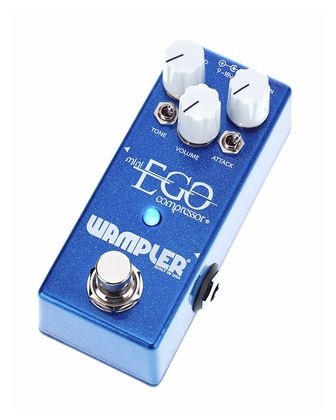
The Wampler Mini Ego Compressor delivers the same high-quality sound as its full-size counterpart.
It’s a nice addition to the range and fits neatly on a pedalboard. It has a well-known blend knob for adjusting the dry signal level relative to the compressed one, and its straightforward control structure makes it easy to dial in. You’ll notice an immediate improvement in the quality of your playing thanks to the pedal’s superior construction and components.
Key Features:
- Compression
All across the world, pedalboards have the original pedal. This space-saving pedal is like the original but smaller, so it can go wherever you have it on your board.
This circuit is a common choice for a constantly-on pedal because it allows for a wide range of compression, from the broody squished of pickin’ bluegrass to the barely-there sounds often associated with fingerstyle playing.
- Controls
The pedal’s 5-knob design makes dialing in just the right amount of dynamic range quick and easy. The blend knob lets you add your dry signal back in while the sustain and volume controls determine how much compression and output the pedal provides. You can make easy voicing adjustments with the pedal’s mini-toggle attack and tone switches.
- Housing
The compressor’s small size is the first thing you’ll notice about it. Compression is necessary for all pedalboards; therefore, this is helpful. The pedal’s true-bypass switching preserves the unaltered dry signal. In this way, you may calculate how much headroom is necessary.
The pedal is a fantastic illustration of Brian Wampler’s commitment to quality, as evidenced by his reputation for employing only the highest-grade materials in all his electric guitar effects pedals.
- Blend Control
The Blend control lets you adjust the ratio of the compressed signal to the uncompressed one. If you want something completely uncompressed, you should go clockwise; the opposite is true if you want it completely clean.
The amount of compression you hear depends heavily on the blend knob and the quantity of clean signal you include.
In some compressors, adjusting the blend has a hardly noticeable impact on the outcome.
Turning the blend all the way clockwise will provide some impressive results. More dry signals blended in help restore dynamics, transients, and overall “punch.”
4. Xotic SP Compressor
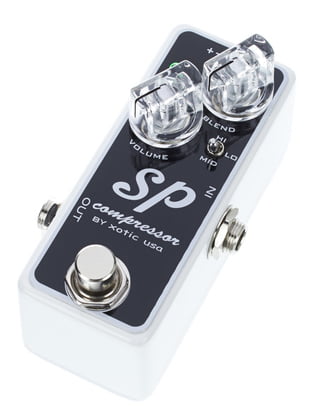
Many guitarists’ standard equipment includes a Xotic SP Compressor pedal.
The pedal, based on the legendary Ross compressed circuit and highly regarded for its transparency, does an excellent job of smoothing out your dynamics and adding harmonic sparkle. The internal dip switches, the variable blend control, and the three compression settings all work together to tailor the sound to your liking.
Key Features:
- Knobs
The volume and the mix are adjusted using the two primary knobs. You can achieve a +15dB boost by turning up the volume. With the blend control, you can adjust the level of compression applied to the signal. The blend knob is crucial since it allows you to adjust the overall compression level and choose whether it is utilized heavily or discreetly.
- Switch
This is typically adjusted through a knob on other pedals, but a simple three-position toggle switch will do the trick here. Most people will try out a few different options until they discover one they like, at which point they never adjust the knob again.
For this purpose, a switch, rather than a knob, makes setting up the pedal simpler and faster. Increased management of compression is possible via four built-in dipswitches. The switches toggle the pad, attack, high-cut filter, and release.
- Circuit
The pedal’s Ross circuit design guarantees a fantastic experience. The pedal can help even out your audio output’s peaks and accentuate its intricacies with ridiculous simplicity. The analog compressor’s straightforward design makes it a breeze to operate.
You can adjust the volume and blend with the two knobs on the front of the analog compressor.
- Power
You can use a standard 9V battery and an additional power source to activate the pedal. Note that a 9V battery is not included; nevertheless, finding one is simple enough that it is not worth mentioning. We haven’t talked about the fact that it’s a true-bypass pedal yet.
Your guitar’s tone will remain unaltered when the signal passes through the pedal. These days, true-bypass functionality is standard on most pedals, so it’s great that this one does too. This also implies that the guitar pedal won’t mess with your signal when it’s not in use. You can leave it in your pedal chain without worrying about a negative effect on your sound.
5. TC Electronic SpectraComp Bass Compressor
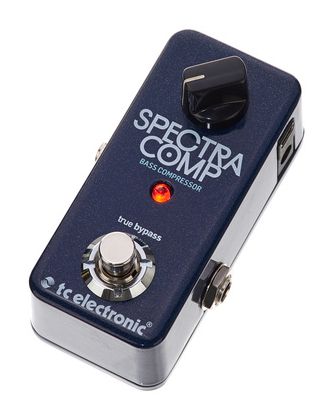
The SpectraComp from TC Electronic is a portable multi-band compressor with a tone tailored to the bass guitar.
The pedal is based on the well-known MD3 engine, and it provides translucent and melodic compression to control midrange roughness and low-end woofer without destroying dynamics. Focus on the music at hand with one-knob compression and unleash your creativity with a bevy of distinctive TonePrint algorithms.
The pedal’s construction makes it suitable for live settings, and its studio-quality tones and True Bypass output mean that your input signal will remain unaltered.
Key Features:
- Controls
This one needs to be improved in raw power compared to other bass compressors. This brand has cut everything down to a small size and left off every other part of the product save for the knob. An encoder in the pedal’s upper section controls the amount of compression applied to your sound.
The effect is stronger the further you turn it in a clockwise direction. The absence of Volume adjustment is the major drawback of this design. Compressors, as is common knowledge, alter the volume of your recording. The most typical occurrence is a drop, which is usually compensated for by an encoder in neighboring pedals.
But that isn’t a problem here, and although the output could be more consistent, it’s still better than anything else. However, once inside the editor’s interface, you’ll notice how many customizable features it offers.
Being a multi-band compressor allows you to fine-tune the compression settings for each band separately, allowing you to achieve a consistent and accurate sound. Getting the hang of TonePrint takes some practice, but it’s possible to master the program with enough experimentation.
- Circuitry
Additionally, it can compress across multiple frequency bands. This technological advancement suggests that the influence is imparted uniformly over the high, low, and medium spectra, resulting in a well-rounded sound.
This pedal can play like a pro in the recording studio. With its true hardwire bypass, you can rest assured that it will preserve the full weight of your bass as it travels through the device. Ensuring that the bass remains intact throughout the process is of paramount importance, as no one wants their bottom end to vanish.
- Housing
The pedal has a tiny yet sturdy chassis made from die-cast aluminum that will shield its sensitive internal components. Power options are limited to the power source in this case, most likely because of the compact footprint.
Finally, when weighed against other available choices, this infant is surprisingly inexpensive.
- Toneprint
You keep thinking the pedal gives you too little control as you use it. A solitary knob whose functions you cannot even guess at is all you can see. However, the company chose to reduce the number of knobs on the pedal and maintain them in the accompanying mobile app to conserve space.
Once more, there may be better cases for some, but we are confident that most of you will find this arrangement quite attractive. The functions of the app and program extend beyond those of the surface-level controls.
You can play around with pre-recorded pieces or make your compression effects, and they open up a world of possibilities. In any case, this guy gives you a lot of leeways.
6. JHS Whitey Tighty Compressor
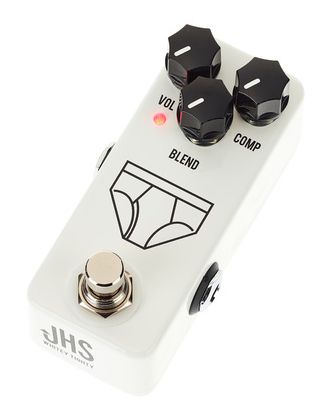
This studio standard is now available in compact, user-friendly guitar effects pedal thanks to the JHS Whitey Tighty.
The pedal’s three knobs make it easy to find the perfect squash. The pedal’s Blend control stands out the most. You can use it to zero in on the optimal compromise between your original signal and the compressed version.
The pedal provides studio-quality compression to enhance your sound to the next level, whether you want a subtle smoothing or an all-out slam fest.
Key Features:
- Controls
The pedal’s three-knob interface makes fine-tuning a breeze. You can adjust the volume up or down using the Volume knob. The Compression knob determines how much compression is applied, allowing you to get subtle velveting or a severe squash that works well in many musical contexts.
Furthermore, a Blend knob helps you strike the right balance between your uncompressed signal and your compressed signal, allowing you to keep the unaltered sense of your tone even when using heavy compression.
- Housing
Unsurprisingly, the pedal is dressed in white; it is housed in a little metal enclosure; it tips the scales at a feathery 156 grams. An image of the iconic underwear was also etched onto the pedal’s top. Three knobs with blackheads and white line markings fit snugly into the top.
The power cord plugs into the front of the device, while the audio jacks sit somewhat off-center on the right and left sides.
- Power
In addition to the footswitch, there is a red status LED. The pedal contains a true bypass circuit and needs just the mains voltage for operation; to do so, it draws 21 mA (18 mA bypass) from a 9 V (center negative) power supply.
7. Mooer Yellow Comp
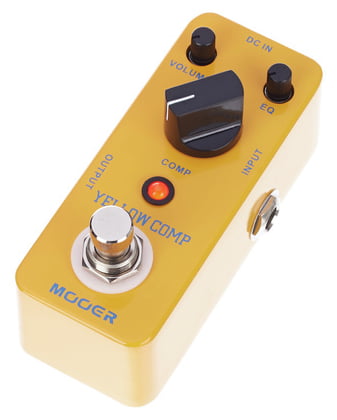
Mooer Audio is known for making high-quality effects pedals that carry a punch despite their diminutive size and low price.
The pedal, the company’s second compressor in its Micro Pedal series, compresses sound optically using a straightforward analog circuit. The brands are aware of this mentality on the part of their customers and work hard to satisfy it by including all the features consumers want without adding unnecessary complexity.
Customers always notice when brands care about the little things and always come back for more. In a similar vein, they developed a fantastic and straightforward compressor.
Key Features:
- Housing
The circuitry of the pedal fits inside a small housing. The size of your fist is too big to hide it. The only problems with the compact size are the need for a built-in battery and the top-heavy, narrow shape that makes Velcro almost essential. Only 9-volt Boss-style batteries will work to power it.
The pedal has a tiny LED that gets brighter the harder you press it and tiny photosensitive resistors that react to that light. Compared to similar IC and FET-based circuits, some believe that optical compressors offer more dynamic and transparent compression.
There are only three knobs to manipulate the volume, compression, and illumination. These basic settings are sufficient for most circumstances but may not provide adequate fine-tuning for more experienced musicians.
- Controls
You may find all the options and adjustments we could ever want in only three knobs. That is to say; we do have what we need to survive. However, upon hearing the sound of this one, some might be disappointed that there is no Attack and Release.
The volume knob adjusts the output volume, but in case you were wondering, you can adjust the volume to match the rest of the chain. Equalization, which modifies timbre, is also available.
You can emphasize the highs and lows with a simple dial tone. Comp, which adjusts the effect’s strength, is the show-stopper. All the variations in compression sound can be made with these three knobs. We naturally employ a True Bypass footswitch to engage the circuitry and pedal.
- EQ
To a Strat and Reverb setup with the pedal’s Comp and Level knobs at noon, the result is a very mild compression that is more accurately described as a tonal enhancer than an “effect.” Thanks to its clarity and lack of coloring, it works well with already good-tone recipes, like those found in the Strat and Twin.
It’s not just that the notes sound fuller; we can sense the decay of each one, making the whole thing sound more organic. The pedal’s excellent EQ knob is a close second to the quality of its tone.
It acts similarly to other single-band tone controls by allowing you to alter the balance between the bass and treble frequencies gradually. There is no compromise in the midrange’s integrity or naturalness, regardless of where the knob is placed.
8. MXR Dyna Comp Mini M291
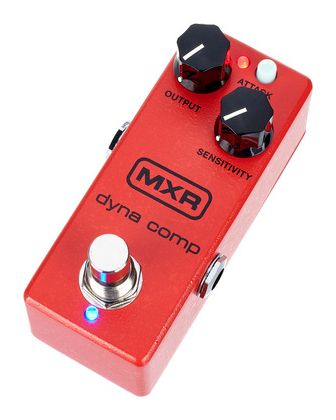
The MXR Dyna Comp Mini is the most portable version of the original Dyna Comp, a legendary comp pedal.
You can now receive the same renowned tone with a pedal that takes up roughly half as much room on your pedalboard as the original squash. The Dyna Comp Mini uses the same type of chip found in classic compressors, resulting in a clean, low-noise sound. An attack option also lets you choose between a more tranquil and aggressive experience.
Key Features:
- Switch
One thing Dyna Comp users have asked for over the years is more of an assault on the pedal’s overall sound. That’s exactly what happens when you push the Attack button on a compressor effects pedal.
These red pedals’ signature squish and sustain are activated by leaving the button depressed. If you press it in, you’ll get an attack that reveals your selection’s nuances—using the IC’s more organic approach to attack and its diminutive size.
- Circuitry
In no time at all after their initial release, the original pedals were featured on thousands of songs and even more stages all around the globe. They enabled you to improve your guitar’s tone organically without resorting to overdrive.
The transparent squash of the highly sought-after 1970s script-logo pedals may now be yours with the help of a meticulously crafted compressor effects pedal. The scarcity of such chips is a major factor. The pedal’s quiet operation is another perk.
- Housing
For today’s guitarists, a pedal compressor is an essential piece of equipment. They are essential because of their added sustain and clarity to your tone. The compressor foot pedal, fortunately, is significantly smaller than a regular pedal.
That means you can squeeze this tone-improving device onto a pedalboard of any size. There has yet to be a more practical pedal introduced.
- Power
If the switch is turned on or off, the red LED to the left of the switch will light up. The pedal also features a footswitch, which is front and center. As could be expected, turning the power on requires pressing the footswitch.
Once the pedal is activated or deactivated, a blue LED light will light up. Discovering the compressor’s features will take a little bit of time. Plug in your instrument, and within minutes, you’ll have figured out how to tune in a nice, smooth compression.
The pedal is powered by a 9V adaptor that is included, which is unusual for effects pedals. That’s a perk you won’t find on most pedals.
9. Keeley Electronics Compressor Mini
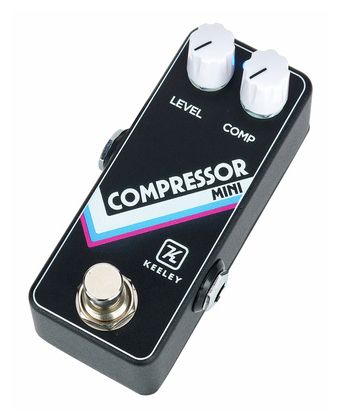
Though it looks like a toy, Keeley’s Mini Compressor Pedal produces a sound that is everything but minuscule.
This compact device has everything you need to give your tone that traditional compression, and it only takes two knobs to set it to your liking.
The Compressor Mini improves your sound’s transparency and articulation by combining your dry and compressed signals. Moreover, it’s guaranteed to bring out the best in both humbucker and single-coil pickups thanks to an expanded sustain range and an enhanced transient release time.
Key Features:
- Circuitry
It is hardly shocking that the pedal accomplishes so much with so little effort. The foundation of Robert Keeley’s mini-empire, the compressor, was solid adjustments to Ross’s iconic circuitry.
- Controls
The Compressor Plus is a four-knob stompbox that improves upon the original comp’s two-knob design by including a tone control, a wet/dry blend knob, and a release time switch to account for differences in output between single coil and humbucking pickups.
However, the pedal only controls volume and compression threshold, so he must manually adjust the ratio, attack, and release. To his credit, he has an uncanny talent for finding the optimal values for those controls. They also made the course quite active for a competition with as few controls as this one.
- Parallel Compression
The pedal employs parallel compression, which lets the dry signal through before summing it at the output, enhancing the clarity and presence of quieter passages while squishing louder transients more harshly.
A tone-recovery component is also included, which restores the high end typically lost in highly compressed signals. Having this pedal in place has helped to bring more life and harmony to the sound.
10. Joyo JF-312 Pipe Bomb Compressor
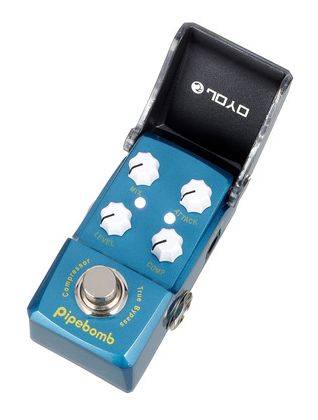
This little pedal won’t break the bank or your pedalboard.
This pedal is a bouncing compressor and a nice little thing. The JF-312 features a fourth knob—the Mix—that allows the user to modify the amount of compression applied to the signal subtly. This compressor is transparent and quiet, doing what a good compressor should and keeping the guitar signal clean. Typically, the price of a compressor of this kind is at least twice as high.
Key Features:
- Controls
This pedal is equipped with a lid to protect the small knobs from being damaged by the weight of your feet, which is just one of its many neat little extras. Whether it’s to stop you from accidentally changing the settings while stomping on it or to keep the knobs from breaking off, it forces you into a “set it and forget it” mentality.
Despite their diminutive size, the knobs are quite serviceable because of their well-designed form and attractive hue. It has four parameters, including sensitivity, volume, attack response time, and dry/wet Mix, which should be more than enough for a pedal of its size.
- LED
Indicated by two bright, visible LEDs, you’ll never miss a moment when it’s turned on. This is also another consideration for keeping the cover on. One great feature is that the company logo is illuminated when the lid is closed. When comparing the amount of thought put into the top and the power input, the latter deserves more praise.
- Housing
This compact compressor pedal is a product of their third generation of pedals, which is the culmination of eight years of research and development. This pedal may be mounted on any board with its small footprint and flexible aluminum enclosure.
Protect your tones by flipping the cover closed; the LEDs will remain visible. The compressor adds greater bite and clarity to your tone without altering the sound.
11. Dunlop Dyna Comp Bass Compressor M282
When compared to the standard version of a compressor, the bass version trims a few inches off the waist but adds extra fine-tuning controls.
All the assistance the industry can give us in fine-tuning this effect’s sound is much appreciated. The Dyna Comp Bass Compressor from MXR is ideal for this purpose. It’s modeled by the original device made in the 1970s, which is still widely used today. The pedal is a bass-oriented take on the well-known pedal, housed in the convenient “small” format.
Key Features:
- Circuit
Many guitarists have considered the pedal an essential tool since its introduction. We could fit the same circuit into a tiny pedal chassis and add extra tone controls. It’s a compact compression pedal with a few extra bells and whistles, designed with low-enders in mind.
- Housing
Upon opening the packaging, the power adapter box may appear far bigger than the pedal. This mini-format compressor is as compact as pedals get; it’s perfect for a travel setup or the performer who doesn’t need much more than a tuner.
- Controls
Standard volume and sensitivity knobs from the original pedal are present. This compact unit features a clean knob that allows users to adjust the unprocessed tone to their liking while preserving the bass.
A tone knob is also included for fine-tuning your sound, allowing you to reduce or increase the midrange by 6 dB at 1 kHz. The toggle switch on top controls the assault’s rate of fire.
12. TC Electronic HyperGravity Mini
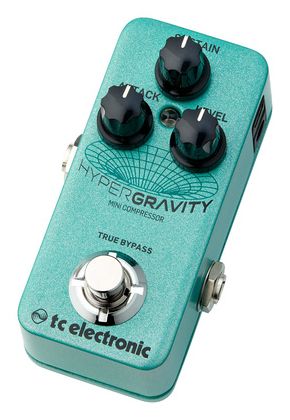
HyperGravity is built on the same algorithms in the company’s flagship product.
In addition to the standard one-band compression, it may provide compression over multiple bands. TonePrint support means you can load one custom setup or make your own with the included TonePrint editing software, a feature shared with other digital TC pedals in the same series.
You can also use the app on your phone to wirelessly broadcast fresh compression presets to the pedal’s slot by simply holding your phone over your guitar’s pickups.
Key Features:
- Multi-band Compression
Before delving into the pedal’s inner workings, it’s essential to learn about the advantages of multi-band compression. Since the highs, mids, and lows are all compressed independently in this setup, the highs are not dragged down whenever the low note triggers the compressor.
The result is less obtrusive compression that maintains a somewhat unaltered tonal balance even in extreme settings. On the other hand, if you’re in the mood for a real gut punch, you can get that, too.
- Housing
The tiny pedal includes a die-cast housing with true bypass, and an LED indicates compressor status like the rest of the series. Due to the low current requirement (about 100mA), you can use a battery or a 9V DC supply to power the device.
TonePrint can be edited on a personal computer by plugging into the small USB port and using the provided cord.
- Controls
There are four knobs for adjusting various settings and a small three-position toggle for choosing between multi-band, TonePrint, and Vintage character sets. The default setting for the TonePrint slot is a multi-band and classic tones hybrid.
Still, with the editor program, you may alter the controls’ behavior, apply auto-gain makeup, tweak the ratios, and limit the mix control’s effect to certain frequency ranges. You can adjust all three bands‘ thresholds, compression curves, and crossover frequencies.
In addition to the standard Sustain, Attack, and output Level, you can use a blend control to set up parallel compression. When using the TonePrint mode, the knobs may behave differently, as previously described. While conventional compression has a noticeable effect on the signal peaks, parallel compression preserves the peak’s dynamic energy while emphasizing the sustain.
Bonus:
13. Pigtronix Philosopher’s Tone Optical Compressor/Sustainer
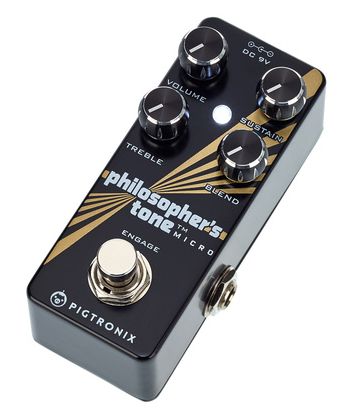
With the help of the Pigtronix Philosopher’s pedal, your guitar will spring to life.
The tone has a treble EQ knob, a mix control, and a control to give your leads more weight, tighten up your rhythm guitar work, and enrich the tone with harmonics. This impressive functionality is now available in a compact, 9-volt pedalboard design.
Using the tone, you can significantly lengthen the sustain of your guitar without adding much-unwanted noise to your setup.
Key Features:
- Housing
Compared to other compression pedals, the original could be more compact; also, the in and out ports are awkwardly placed on the same side of the pedal. This makes it a challenge to place upright on most pedal boards sans taking up too much area.
The Micro model shrinks the pedal’s overall dimensions by about an inch, relocating the jack plugs to the conventional left and right sides and adding a center-negative 9v DC input on the unit’s cap.
The pedal keeps the same knobs as the original, but the Grit section of the circuit has been removed; therefore, the fifth knob has been eliminated to free up space and make the finer settings more manageable. As an improvement over the original’s in-line layout, Pigtronix has opted for gripping dials to make fine-tuning a breeze even on steamy stages.
- Circuitry
The pedal’s low noise floor—even at higher compression ratios—and gorgeous, gritty musical circuitry for applying dirt to the compressed sound has made it a hit with musicians.
Pigtronix’s decision to release compact versions of their best-selling pedals is in line with the industry’s general trend toward miniaturization.
The result is the pedal, which shares many characteristics with its larger relative but operates on a more modest 9-volt battery.
- Controls
Thanks to the user-friendly interface, tweaking the audio is a breeze. With the Volume knob, you can add a respectable amount of clean, noise-free boost or bring highly compressed sounds back to unity gain.
The Sustain knob allows you to adjust the compression level from mild to outrageous without introducing any noise into the sound.
The Blend knob enables parallel compression methods in which the uncompressed signal is blended again with the reduced one.
This paves the way for higher compression ratios that facilitate smoother playing and provide longer sustain while retaining the dry signal’s nuanced and natural assault.
Last, the pedal’s upper-frequency response may be fine-tuned using the Treble control. The 9v DC input has been converted to 18v of internal headroom, bringing the pedal’s tone in line with the original Philosopher’s.
FAQ:
[sp_easyaccordion id=”113686″]
Conclusion
These pedals are supposed to function similarly to their larger counterparts, albeit in a more compact form that does not significantly alter the tone. In particular, the proliferation of innovative pedal designs has surprised us. These are crucial for traveling or even rehearsals, as it can be annoying to lug around a toolbox for two or three hours at a time.
If you’re just getting started with pedals, it’s a good idea to start with smaller ones that will stay in the bank for at-home practice. The Amazon Basics Compressor – Fully Analog Circuit is a pleasant surprise on this list since it serves its function well and is more than sufficient for a beginning.
The gain quantity is handled competently by an analog circuit miming an operational amplifier (op-amp) and a series of symmetric hard-clipping diodes.
But the Wampler Mini Ego Compressor is your best bet if you want a tiny, effective pedal with all the controls you’d need for a compressor. This pedal is a replica of its larger counterpart, down to the last detail. It features the same blend knob as the larger version, and its straightforward layout makes it a breeze.
The reeds will stay plump and won’t drastically alter the low end. The circuit is very low-noise, and while it can run on 18v, 9v is optimal.

The Integraudio Editorial Team consists of experienced music producers, audio engineers, and plugin enthusiasts dedicated to providing in-depth reviews and guides for music production software.