

Today, you’ll find a wide variety of different Lavalier mics suitable for film and video production. Unfortunately, there is no universal best option when it comes to Lavalier Microphones. Instead, you need to determine which option is suitable.
Lavalier mics are referred to as clip mics, lapel mics, personal mics, neck mics, and, most commonly, collar mics. Of course, these mics are much smaller and are, thereby, very discrete.
The small size makes them easy to hide completely, and with their portability, the subject can be recorded clearly even on the go. You’ll find many options in the market, and selecting one could be daunting, especially for beginners, but that’s where we come in.
With that being said, let’s dive in!
Top 9 Lavalier Mics For Film & Video Production 2025
1. Sennheiser EW 100 G4-ME2
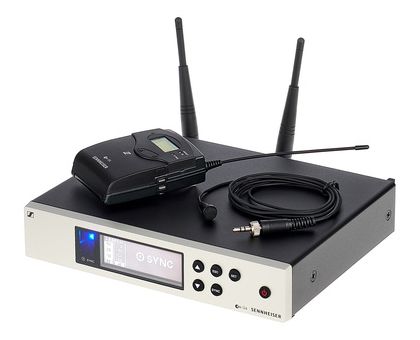
Thanks to its technical prowess, the world-renowned Sennheiser brand truly excels in all things sound.
The G4 series has become the go-to option for many sound engineers, broadcasting enthusiasts, and stage performers over the years. With a wide array of products, the series includes the EM 100 G4 receiver and the SK 100 G4 transmitter.
You’ll also find other products in the range, like the handheld SKM 100 G4 and G4-S microphones and the ASA 214 antenna Splitter device. The EW 100 G4-ME2 comes in a bundle with all the necessary add-ons to get going immediately.
Key Features:
- The Receiver: Interface
The receiver is nice and compact. The user interface has all the necessary controls that you would need for seamless operation. A vivid display shows the status of your mic connectivity with great clarity. The availability of a screen means that you have access to multiple menus to modify different connection-based parameters.
Towards the right, you’ll find two up and down buttons for scrolling, a “Set” button for selecting a parameter, and an “Esc” button to exit menus. The self-explanatory “Sync” button helps pair your wireless mic to the receiver. Towards the far right is the power button.
- The Receiver: Display Explained
The receiver’s screen covers multiple areas with great efficiency. At any given time, you can check the radio frequency and audio frequency levels to check when the mic gain is near clipping so you can make the necessary adjustment accordingly. The EM 100 G4 receiver offers multiple banks and channels. The selected bank/channel can also be seen on the screen. Right in the middle of the display, in a much larger font, is the currently selected frequency. Once the transmitter is synced with the receiver, you’ll also be able to see your wireless receiver’s battery level and mute/unmute status.
- The Receiver: Menus
The menu is broken down into two modes. The “Easy Setup” menu only includes basic things like “Reset List,” “Current List,” “Scan New List,” and “Exit.” There’s also a more “Advanced” menu that gives the user access to features like “Tune,” “Guitar Tuner,” “Pilot Tone,” “LCD Contrast,” “Reset,” “Software Revision,” and “Exit.” Other important adjustments available through the menu include “Squelch,” “Frequency Preset,” “Name,” “AF Out,” “Equalizer,” and “Auto Lock.”
- Rear Panel
The back panel has a variety of inputs/outputs. Starting from the far left, the device has a power input. On the output side, the back features an XLR out for linking to a mixer and a 6.3mm jack for sending an audio signal to a PA system or an amp. There are also a couple of RJ10 connectors here if you need to link several receivers together to set up a data network. On the right are the antenna inputs for the two antennae the receiver comes with.
- The Transmitter: Power & Display
The transmitter runs on two double AA batteries, which can be inserted by opening the compartment below the display screen. The transmitter’s screen is just as comprehensive as the one found on the receiver and shows everything you need to know at a glance. You’ll be able to see the current frequency, the transmission icon, a battery indicator icon, and a “Mute” indication when the mute button on the transmitter is pressed.
- The Transmitter: Buttons
The unit has similar up/down buttons that help with menu navigation. The power and set buttons are hidden inside the battery compartment to avoid accidental pressing. The unit has dual LEDs to indicate when the power is on and when the signal is near clipping. The top panel also has a tiny antenna for transmission and an input for connecting a Lavalier microphone.
Pros:
This all-in-one bundle offers great value to the user. Both the transmitter has a range of more than 300 feet. The EW 100 G4-ME2 offers multiple banks and channels to set various frequencies. In addition, both units offer in-depth customization thanks to the useful display and detailed menus.
Cons:
With everything that’s included in the package, this is a sweet deal. However, some of you may be put off by the hefty price tag. Apart from this rather obvious con, if you’re willing to cough up the dough, the sound quality is great, and the usage is very simple.
2. Shure BLX14/CVL
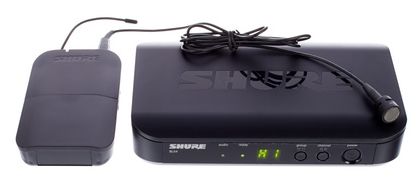
This Shure offering is excellent especially when it comes to general everyday use.
On April 25th, 1925, Sidney N. Shure founded the company. Shure is easily one of the most experienced companies to have its product feature on this list. The company’s headquarters are based in Niles, Illinois, USA.
The company’s primary focus has always been on microphones but its product line includes a variety of different products such as earphones, headphones, wireless and wired microphones, systems for conferencing, mixers, and even phono cartridges.
Key Features:
- Receiver: Front Panel
From left to right, the panel, you’ll find the company’s logo along with 2 LED Indicators for ‘Audio’ and ‘Ready. The Audio indicator denotes the strength of the incoming signal. It’ll light up red for ‘overload’ and green for normal use. The Ready indicator lights green to show denote that the system is ready. Then there’s an LED display panel that shows the ‘Channel’ and ‘Group’ settings, followed by 2 equally sized buttons for ‘Group’ and ‘Channel,’ and a more prominent ‘Power’ button.
- Receiver: Back Panel
The rear side of the receiver hosts a DC 12V to 15V ‘Power socket’ neighboring an ‘Adaptor cord handle’, which can prove quite useful. Next, there’s an XLR Output jack, used to connect the microphone. A quarter-inch Instrument level output jack sums up this side.
- Transmitter
The top left corner hosts a bright LED indicator that denotes the battery status. The top panel hosts a mini ‘Power switch’ in the middle, with a 4-Pin Input jack for the Lavalier microphone at its left and the antenna at its right. Half of the front panel is covered by a flap which opens to allow access to the Transmitter’s ‘Group button,’ ‘Mini LED display,’ a ‘Channel button,’ a ‘Gain control,’ and a ‘Battery compartment.
- Connectivity & Ease of Use
This wireless microphone system comprises of 3 separate units, a receiver, transmitter and a Lavalier microphone. The 3 are black in color and fairly easy to set up and use. All you’ll need to do is place the receiver on a stable flat surface, hook it up to a power source and connect it to an amplifier or a mixer.
After that, just keep the power button pressed and it’ll be ready to go. You’ll find a ‘Group’ button on the receiver, press it to start a group scan. There’s an ‘Audio’ LED indicator on the receiver that will light up once you’ve matched the group on the transmitter as well. Of course, there’s a clip at the back of this unit so you can easily attach it to a belt for example.
Pros:
The device comes with a whole host of options. You’ll even get metal hinges in the box, so you can secure the receiver to where you want it to rest. You’ll also have the option of extending the signal range via additional cables and antennas, which may prove handy.
Cons:
Some users have complained about experiencing unwanted hissing noise. While the general consensus is that the audio captured is of decent quality, some have complained that the audio isn’t reliable as it cuts in and out over short distances of just 20ft to 25ft at times.
3. Comica BoomX-D2

This wireless from Comica Audio is great for fulfilling your audio and video production needs.
The Comica company specializes in a myriad of microphones, including interview mics, studio mics, wired/wireless lavalier mics, and even shotgun microphones. You’ll also find various microphone accessories, audio interfaces, and mixers in their product lineup.
The Comica BoomX-D2 comes with lots of fun accessories that are seen neatly arranged in the stylish box it comes in. Apart from the transmitters and the receiver, you get two lavalier mics, TRS to TRS and TRS to TRRS cables, wind muffs, and a USB charging cable.
Key Features:
- Two Transmitters – One Receiver
The great thing about this kit is that it comes with two transmitters, which can link to the solitary receiver. You can choose between mono or stereo operation if both transmitters are connected simultaneously. The audio from the two transmitting devices will be summed in mono mode into a single track. In stereo operation, the audio from both devices will be sent to separate channels for independent manipulation.
- Transmitter Anatomy
Both transmitters have a built-in omnidirectional microphone, so you can use the clip on the back and attach the transmitter directly to your shirt, and you’re good to go. If you’re outside in a windy environment, you can use the included wind muff, which slides effortlessly onto the microphone grill. There’s also a mic input on top of the unit if you prefer to use the Lavalier mic. The included Lavalier mics do a decent job capturing audio and come with a clip mechanism that uses the slot next to the mic input for secure attachment.
- Transmitter Buttons
The right panel has a multifunctional power/mute button and a “Pair” button for syncing the device to the receiver. However, both transmitters come already paired to the receiver right out of the back. The other panel has a reset button that can be pressed using the included reset pin. Next to this is the USB C port for charging the device. Once fully charged, the transmitters can run for 5 hours without problems.
- Screens
Both the transmitters and the receiver come with display screens. The display clearly shows the user all the important information to consider during a production scenario. You’ll find helpful icons like a mute on/off, signal strength, pairing status, battery life, and a signal level indicator.
- Receiver Anatomy
The screen on the receiver shows which mode the transmitters are operating in (stereo/mono), a battery icon, and finally, the audio level from both transmitters. On the top is a headphone jack for monitoring the audio with zero latency and a line-out jack for hooking the unit to a mobile device, audio recorder, or camera.
- Receiver Buttons
On the side panel is where you’ll find a reset button, much like those found on the transmitters. Another multifunctional button below turns the receiver unit on/off and can help switch between mono and stereo modes. Under this, you’ll find two more buttons marked “A” and “B.” These allow the user to set the mic gain of both transmitters. You’ll find a range from 0dB to 12dB, with increments of 1dB to make the subtle changes you need for any given scenario. Lastly, on the opposite panel is a USB port for charging the unit.
- Camera Connectivity
To make up for the very hot line input that some cameras have, the smart people at Comica have included a couple of different camera cables. You’ll find a separate cable in the kit for Nikon and Cannon cameras. The second cable is ideal for Panasonic, Sony, and Fuji cameras. These cables will sufficiently attenuate the audio signal where needed to prevent distortion or clipping.
Pros:
The availability of two transmitters opens doors to mono and stereo functionality so you can sum your audio, send it to separate tracks, or have both mics capturing the same audio so you have a backup in case one of them malfunctions. Furthermore, the devices have an operating range of 150 feet.
Cons:
With all the components in the kit and the included accessories, it’s a shame that the package doesn’t include a soft case to carry everything in. Furthermore, the headphone jack isn’t accompanied by a volume control which could’ve been a handy feature.
4. Sony UWP-D

One of the most premium products on the list, this offering by Sony brings a lot to the table.
on 7th May 1946, Akio Morita and Masaru Ibuka founded Sony in Nihonbashi, Chuo, Tokyo, Japan. The headquarters are now in Sony City, Minato, Tokyo, Japan. The company has since become a massive success in every sense of the word.
Today, Sony enjoys global distribution, with its more than impressive product line including a wide variety of products such as Cameras and equipment for Telecommunication, Films, and Music. The brand also produces gaming consoles, computer hardware, and even Robots.
Key Features:
- Transmitter: Top Panel
The left side of the unit’s top panel hosts a possible antenna. Next, you’ll find 2 bright LED indicators for ‘Power’ and ‘Audio.’ The Power indicator is green when the battery level is sufficient. As the battery starts running low, the green indicator will start blinking. The Power indicator will light orange when chargeable batteries are inserted and charging.
The indicator will turn red if such batteries have deteriorated and the unit cannot charge them. Similarly, the Audio indicator turns red to show that the input’s audio level is too high and turns green when the level is acceptable. The indicator turns orange and starts blinking when the audio is muted, and it remains off when the audio level isn’t audible. At the right end of the panel, you’ll find an Audio Input connector for the Lavalier microphone.
- Transmitter: Front & Side Panel
Centered at the top near the Power and Audio indicators, you’ll find the unit’s ‘Power/ Mute’ button. Below is an LED display panel with ‘+’ and ‘-‘ buttons to the right, the ‘Set’ button, and an ‘Infrared detector’ to the left. The display shows an ‘RF transmission indicator,’ an ‘RF transmission power indicator,’ an ‘Audio input level meter,’ a ‘Peak indicator,’ an ‘Input level indicator,’ a ‘Battery level indicator,’ and a ‘Menu display section.’ The side panel hosts a ‘USB Type-B Micro port’ and a ‘Battery’ compartment.
- Portable Receiver
The unit looks very similar to the Transmitter but also supports a 3.5mm ‘Headphone jack (Monitor)’ along with an ‘Output connection port (Audio Output).’ Another difference is that there’s another antenna instead of the microphone connectivity port. At the unit’s base, you’ll also find 2 ports for ‘USB connectivity (Micro B type)’ and an ‘Auxiliary connectivity port.’ In all other aspects, the receiver and Transmitter are identical in terms of appearance.
Pros:
This offering from Sony brings Infrared sync with a wide switching bandwidth. You’ll also get several digital clarity features, such as locking connectors. The all-metal construction enhances the device’s durability while also providing a premium feel.
Cons:
Priced at the higher end of the spectrum, many argue that settling for a much more reasonably priced option would be the right way to go. The impressive range and other features simply won’t be everybody’s cup of tea. The aerials are quite challenging to remove or replace.
5. BOYA BY-WM4 PRO K6
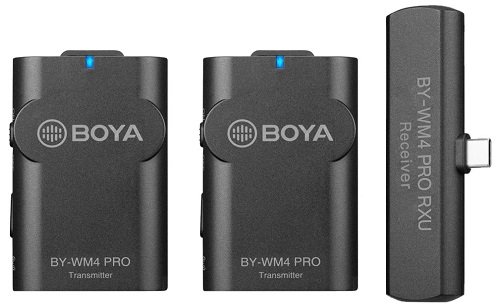
Boya makes some good quality microphones that are highly affordable.
The multipurpose K series from the brand is versatile and covers a wide array of devices. The most notable members of the series include the K2, K4, and K6 kits. The K4 is designed for IOS-enabled devices such as iPads and iPhones.
The K2 is ideal for various cameras, while the K6 kit discussed here has a USB-C type receiver, making it compatible with most Android and USB-enabled devices. All the variants are priced modestly and won’t put much of a dent in your savings.
Key Features:
- What you get
The great thing about the overall packages is the inclusion of a very well-made hard case that stores all the components included in the BY-WM4 Pro K6 kit. When the case is unzipped, you’ll find two transmitters, a receiver, multiple cables (3.5mm to TRRS, 3.5mm to TRS), and two omnidirectional lavalier microphones. Also included for the Lavalier mics are a pair of windscreens and microphone clips.
- Transmitter: Functionality
The WM4 PRO K6 kit has two compact matchbox-like transmitters operating simultaneously in mono and stereo modes. The operation is relatively simple. On the side of the transmitter is where you’ll find the power button and a “Pair” button to link the device to the receiver. The top has two 3.5mm jacks where one can be used to connect a lavalier mic, while the other is a line in port for connecting audio devices. Both transmitters can be powered by two triple A batteries, which can be inserted by opening the battery compartment on the base of the transmitter.
- Transmitter: Status LED
You won’t find a display on either transmitter, but Boya smartly uses a status light to indicate various instances. When the transmitter and receiver are paired, the light blinks after every 2.5 seconds. If the link is severed for any reason, the status light will blink continuously after every second. Finally, in low power conditions, the led will flash in red.
- Receiver: Functionality
The receiver from the K6 kit is sleek. Not only does it connect effortlessly with your Android device, but it hardly adds any weight to it. The think tanks at Boya have equipped the unit with volume buttons and a headphone jack. There’s also a very handy “M/S” switch that toggles between stereo and mono operations.
- Receiver: Status LED
The receiver is also installed with a tiny status light that changes behavior depending on different situations. When the connection is established with the transmitters, the light stays blue. However, when the connection is lost, the light will flash continuously.
Pros:
Two transmitters working simultaneously with a single receiver unit is always a great feature. This not only opens doors for mono operation but stereo applications as well. Furthermore, the kit is affordable and has a sturdy, high-quality padded carry case.
Cons:
The K6 variant can only be used with an Android device, so if you’re switching to an iPhone, for instance, or want to use the mic system with your camera, you’ll need to purchase variations. Perhaps Boya could’ve come up with an all-in-one solution for each scenario.
6. Shure PGXD14/85-X8
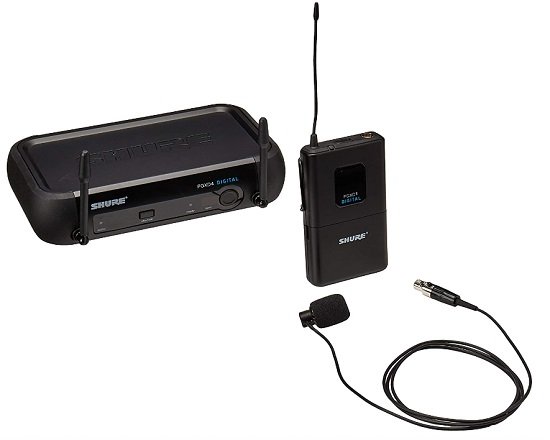
The offering from Shure is easy to set up, highly reliable, and records very accurately.
You’ll be able to use 5 systems at a time, and the receiver can also scan and automatically select a clear frequency. The infrared link also allows for easy synchronization. The system provides a recording range of up to 200ft.
The offering also brings nice power efficiency. You’ll be able to record for up to 10 hours on 2 AA batteries. The device is built like a tank with high-quality materials. You’ll also get a foam-padded hard-shell travel case, perfect for performers on the go.
Key Features:
- Receiver Controls & Connectors: Front Panel
The device hosts 2 antennas, one on the left side of this panel and the other on the right, between which you’ll find an LED ‘Audio’ indicator, an LED display panel, a rectangular ‘Channel’ button, an LED ‘Ready’ indicator, an Infrared port, and a ‘Sync’ button. The Audio indicator remains green when the recording is acceptable, turns amber when the audio is too strong, and red when there’s audio clipping.
The display panel shows channel and group settings, and the channel button allows you to change the channel and group. The ready indicator lights green when the transmitter battery is at a normal level and red when the battery is running low. The infrared port and the sync button allow easy sync with the transmitter.
- Receiver Controls & Connectors: Rear Panel, Sides & Top Panel
The back panel houses a ‘Power’ socket at its lower left corner. The device may be powered via an AC adaptor. To the right, there’s an ‘Adaptor cord tie-off, which may sometimes prove handy. Next, you’ll find an XLR jack for ‘’Microphone Output,’ neighboring a quarter-inch ‘Instrument level Output’ jack. The sides and base of the device are all plain, while the top of the device carries a prominent ‘Shure’ logo.
- Transmitter Controls & Connectors
The handheld microphone (sold separately) has controls identical to the transmitter. On the side of the transmitter, you’ll find a multi-function LED indicator. This indicator denotes the battery level, whether or not the device is muted, and the infrared connectivity status. Just underneath, there’s a ‘Power/ Mute’ switch which can be pressed to unmute or mute and held to power off or on. A 4-pin jack for microphone input sums up the panel. The transmitter also allows ‘Audio gain adjustment,’ and you’ll find an IR port at the front for quick sync with the receiver.
Pros:
The system has an outstanding recording range of up to 200ft. The receiver allows for easy synchronization and setup. The audio quality and the capability of hosting up to 5 devices makes this offering from Shure convenient and versatile.
Cons:
The Lavalier wireless system brings great value but carries a price tag that ranks on the moderate to high side of the spectrum. The handheld mic is sold separately. The Battery indicator isn’t easily detectable, especially during outdoor recording sessions.
7. Sennheiser AVX-MKE2
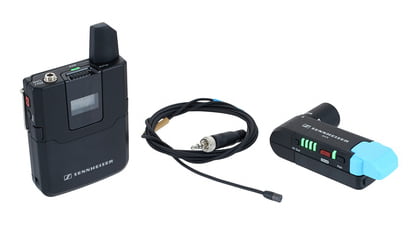
Sennheiser, one of the most sought-after microphone brands, has many great products.
For instance, the G series from Sennheiser has been a popular choice for many broadcasters, podcasters, and vloggers. Although a little expensive, the G3 and G4 kits, in particular, offer great quality, reliability, and ease of use.
The AVX system is another great option for wireless microphone enthusiasts as it is rugged, smartly built, and hardly takes any space on or around your camera. In addition, the kit has an great battery life and will capture audio for hours on a single charge.
Key Features:
- Connectivity
The receiving unit is nicely streamlined and can be connected directly to your camera through the built-in XLR connector. You can still use the AVX system if your camera doesn’t have an XLR port because an XLR to 3.5mm adapter is included in the package. The transmitter and receiver have pair buttons that, when pressed, instantly link the two units together.
- The Transmitter
You won’t find anything too fancy on the transmitter. However, it does its job wonderfully well. At the top is a mute slide switch and an input for the lavalier microphone. The AVX comes with two microphone options. You can either get an MKE2 microphone that is top of the line and captures audio flawlessly, or you can opt for the ME2 variation, which is slightly less capable in audio capturing but costs considerably less. Regardless of which mic you go for, you can connect it to the transmitter via the input port and then tighten a screw to lock it.
- The Receiver
The receiver’s interface is also fairly simple. You’ll find a power button, a “Pair” button to link with the transmitter, and an “AF OUT” button on it. Accompanied by a segmented led strip, the AF OUT button adjusts the output volume at four levels.
- Frequency Management & Longevity
Firstly, the AVX-MKE2 works at a frequency of 1.9 GHz, which is not very commonly seen on most microphone kits which usually operate at 2.4 GHz. This means that there’ll be less interference and more clarity. Secondly, if interference occurs, both components are engineered to intelligently vary the frequency band to overcome this.
In addition, apart from the impressively long battery life, the transmitter and receiver have detachable batteries, so you can carry extras if you’re anticipating a recording session. You can also charge via USB during a live situation, as there’s no hum noise, and the audio quality remains unaffected.
Pros:
Through continuous scanning, the transmitter and receiver capture the best possible sound in any given situation. The compact size and the inclusion of the MKE2 Lavalier microphone provide access to professional-grade audio recording. Also, the transmitter has a 10-hour battery life.
Cons:
As far as microphone kits go, you may have seen how some options are quite modestly priced. That’s not the case with the AVX-MKE2. Even if you’re willing to compromise on the Lavalier mic’s performance and buy the cheaper alternative, you’ll still be paying a considerable amount.
8. Comica CVM-WM100 Plus
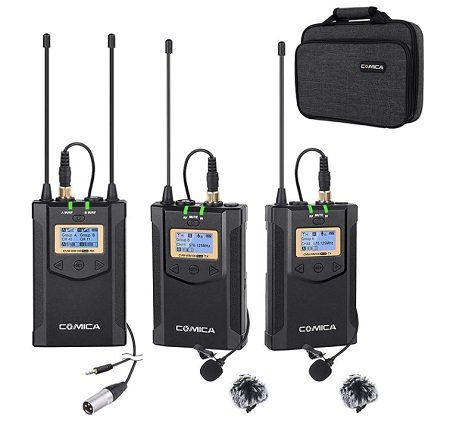
This wireless audio system comprises 2 mic transmitter packs and 1 receiver.
CoMica Technology Co., LTD was founded in 2012. The company has since established itself to become one of the most complete Audio Equipment enterprise, owing to its own manufacturing, sales, and product research and development.
The company’s distribution channels ensure its products reach North and South America, Europe, the Middle East, and Asia markets. Today, CoMica is a well-known brand with a mission of self-R&D, providing quality products and continuous creativity.
Key Features:
- Lavalier Transmitter – Top & Side Panels
The top of the unit features an antenna, followed by 2 Input sockets for ‘Line in (External)’ and ‘Mic (external), with a conveniently placed ‘IR sensor’ in between. You’ll also find 2 LED indicators curving up to the device’s top from the front panel. These indicators denote the ‘Working Status’ and the ‘IR status.’ The left side of the device is completely plain, whereas the right side hosts a ‘Micro USB slot’ for ‘External charging,’ an uncommon feature in most wireless systems.
- Lavalier Transmitter – Front & Rear Panels
The unit’s front panel hosts a tiny ‘Power on/off’ button that doubles as a ‘Mute’ button. This button is located just under the LED indicators and just above the LED display screen. Underneath, you’ll find 3 useful buttons reading ‘+,’ ‘Set,’ and ‘-. ‘The ‘Plus’ and Minus’ buttons allow you to scroll through ‘Functions,’ whereas the Set button, as the name suggests, selects the function of choice. The device’s back panel supports a large, sturdy ‘belt clip’ and a ‘Battery compartment.’
- Receiver
In terms of appearance, the Receiver looks just like the Transmitter, aside from one difference. The Receiver also has a 2nd’ Group B’ antenna. Of course, the Receiver operates in a completely different way. The 2 LED indicators represent ‘Group A working status’ and ‘Group B working status.’ The unit also houses a 3.5mm ‘Monitoring’ jack.
- Travel Case
The nylon travel case is padded from the inside, allowing the transmitter packs and Receiver to fit snuggly. The material used is quite durable, and the travel bag has an outer pocket with 2 mesh pockets for the Lavalier microphones, wind covers, wires, and batteries. The fabric used is tough and could protect from spills and dust as well.
Pros:
The Receiver can mount onto a camera with the help of a shoe mount that comes with the system. The travel case is pretty solid, owing much to the foam used with snug cutouts. The wireless system brings great value, priced at the lower-mid side of the spectrum.
Cons:
Some users have complained about audio drop-related issues. The all-plastic construction makes the system lightweight and easy to carry but gives all the units a cheap look. The flaps feel flimsy. Simply due to the construction, some users have discouraged buying the product.
9. Saramonic Blink500 B4
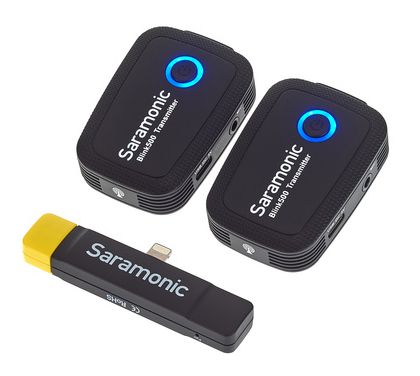
In many ways, the Blink500 B4 resembles the Boya BY-WM4 Pro K6 kit discussed earlier.
The bundle features a similar-looking receiver that connects directly to the charging port of your iPhone or IOS device, and the Blink500 B4 also comes with dual transmitters. This kit also has an Android variant that is virtually identical except for the receiver’s connector.
If you want to get into YouTubing, Vlogging, or broadcasting, the Blink500 B4 will surely give you your money’s worth with its professional-grade audio and solid build. One thing that cannot be overstated is how easy this microphone system is to use.
Key Features:
- Two Transmitters
Having two transmitters at your disposal is a great option to have. You can use them simultaneously or one at a time, depending on the setup and the situation. Both have a minimalist design. There’s a large button with a ring led around it to power the unit on. You’ll find gain buttons on the transmitter to adjust the mic sensitivity directly from the device. The side panel has an input for a lavalier mic and a USB port for charging. There’s also a built-in microphone on the top panel, which you can talk directly into if the lavalier mic is unavailable.
- The Receiver
The receiver is cylindrically shaped and doesn’t take up much space. It’s important to ensure you get the right kit for your phone because the Blink500 bundle has an Android and IOS version of the receiver. The rest of the components in the kit are, however, the same.
- Accessories
You’ll also find two charging cables in the package. Each transmitter takes about 5 hours to fully charge, but the kit offers long battery life, so you’ll get through an extended shoot without many problems. Having two transmitters means that the bundle also includes two lavalier microphones. The quality of these microphones is great as they capture the user’s voice with great clarity while ignoring unwanted noise. Everything in the package can be easily carried around in the string tie pouch that’s also included.
Pros:
The kit comes with two transmitters allowing you mono and stereo functionality. All the components in the kit are immensely compact, and including the carry pouch is a great plus. Although the lavalier mics are great, the transmitters’ built-in microphones also capture good-quality audio.
Cons:
One thing to note about kits that include a receiver that connects to the base of your phone is to ensure a solid connection at the port. If you have a bulky phone cover, your receiver may seem paired to the mobile device, but the audio may be glitchy and unusable when you play it back.
Bonus:
1. Sennheiser EW-112P-G4
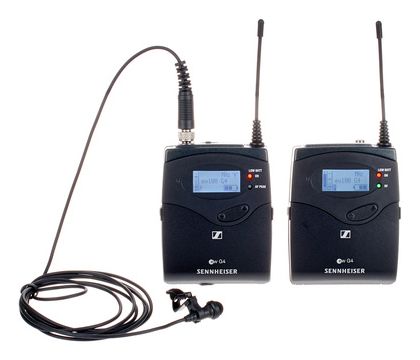
This Sennheiser offering is one of the most straightforward wireless systems in terms of looks and usage.
Fritz Sennheiser founded Sennheiser in 1945. The company finds its humble beginning in a farmhouse located near Hanover. Fritz was very ambitious and soon realized that there was a fast-growing market for equipment he could provide.
With a career in science, Fritz decided to seize the opportunity, and there was no looking back. It was his knowledge and ambition that allowed the business to skyrocket. Over the years, several big names held a preference for Sennheiser equipment.
Key Features:
- Transmitter
At the top, next to the antenna, there’s a 3.5mm ‘lockable’ socket. Most prominently on the device’s front side, you’ll find an LED display screen. The display is small but can hold quite a lot of detail. To the right of the display, a ‘Battery level’ LED indicator lights up to show the device is on and blinks to denote ‘Low Battery.’ Below, there’s a green LED indicator that lights up to signal sufficient wireless reception.
- Menu Controls & Battery
2 buttons grouped in a glossy oval design just under the display screen are the ‘up’ and ‘down’ buttons that toggle the menu. The ‘Set’ button can then select the setting required. On the opposite side of the front panel, there’s an ‘On/ Off’ button that doubles and a ‘Return’ button for the menu. Next, there’s an ‘Infrared detector.’ The device is relatively compact, and it’s impressive how they’ve also managed to cram in the battery compartment.
- Display Screen Contents
The LED display screen holds a surprising amount of information for its size. On the top-left corner, there’s the ‘Radio signal level’ with the initials’ RF’ used for Radio Frequency. Next, you’ll see the initials’ AF’ for Audio Frequency followed by the ‘Current Receiving Frequency.’ Just below, there’s the name of the Receiver and a ‘Mute’ icon that only appears when the unit is muted. The bottom-right corner mentions the Receiver’s ‘Battery Status,’ and the ‘Lock’ icon shows the unit is locked.
- Display Screen Contents – Pilot Tone
There’s a ‘P’ icon to the left of the Mute icon. This signifies ‘Pilot Tone.’ When the ‘P’ is present, the pilot tone evaluation is activated, and the absence of the symbol denotes the deactivation of the function. If the ‘P’ has a black highlight, it signifies that Pilot Tone is being received.
Pros:
The Sennheiser offering is reasonably priced. Although some have criticized the construction material, plastic makes the units lightweight and easy to carry. The audio quality is top-notch, as expected from a Sennheiser product. The unit is simplistic and ideal for beginners as well.
Cons:
Some users have criticized the wireless system for not having many available channels, stating further that it doesn’t justify its value for money. Others have stressed the system catching unnecessary distortion and feedback. The all-plastic build is a massive letdown for many as well.
2. Comica CVM-WM300A
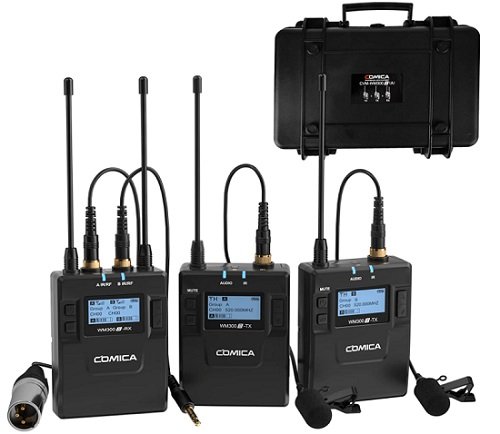
There’s much to look forward to when you get your hands on the CVM-WM300A.
This kit comes in a pelican-style case, which is the most protective and reliable way to carry the kit’s components around during your shoots. The internal lining is padded with cutouts to hold the dual transmitters and receiver in place.
Also included in the kit are a couple of Lavalier microphones, wind muffs for outdoor recording, and all the essential cables needed for seamless operation. In addition, the 3.5mm to XLR adapter comes in handy when you’ve got a camera with an XLR port on hand.
Key Features:
- Display
The transmitters and receivers have a clear screen that gives adequate information to the user during operation. For instance, the display on the receiver shows things like the current battery status of the receiver itself and each of the transmitters, which is very useful. You can also assess other aspects like signal strength, mute/unmute, and locked and unlocked status of the mute feature.
- The Transmitters
Both transmitters have a “Set” button which can be long pressed to access various functions, with the arrow buttons aiding in navigation. You can make channel adjustments directly from the transmitter. You can also toggle between “Group A/B” and choose to mute or unmute the transmitter unit. Another feature the transmitters have is the ability to change the power settings to provide better signal transmission over longer distances. However, even at low power settings, the CVM-WM300A kit can operate over a distance of 90 to 180 feet when no obstacles are in the way.
- Low Cut Feature
Another great feature the kits comes with is the “Low-Cut” mode. If you’re in an outdoor setting, you can eliminate a lot of the unwanted sounds around you by activating this feature. Although this will make your overall audio sound thinner, it’ll effectively remove low-end noise like insects or crowd sounds from the audio. However, when the feature is off, the audio will, conversely, sound thicker.
Pros:
This kit has a lot going for it. Everything from the very useful pelican case to the metallic exteriors of the transmitters and receivers shouts out premium quality. The audio capabilities are impressive, and the system’s power consumption can be altered to increase the signal range.
Cons:
While all three components are perfectly built, the camera mount is made of plastic and is very fragile. When increasing the mic sensitivity, the noise floor also gets raised slightly, which is normal. Besides that, it’s hard to find any chink in the armor of the Comica CVM-WM300A kit.
Conclusion
The Saramonic Blink 500 and the Boya BY-WM4 Pro K6 come in different version to cater to the needs of Android and IOS users. The Comica CVM-WM300A offers a tremendous range and does a great job when it comes to sound quality.
The Sennheiser AVX-MKE2 although on the expensive side not only captures audio really well but smartly adjusts the frequency band for optimal performance which is surely an impressive function. If you’re looking for a dual transmitter kit with built in microphones and a detailed display, you can’t go wrong with the Comica BoomX-D2.
The Sennheiser EW 100 G4-ME2 and Shure’s BLX14/CVL both have bulky looking receivers

The Integraudio Editorial Team consists of experienced music producers, audio engineers, and plugin enthusiasts dedicated to providing in-depth reviews and guides for music production software.